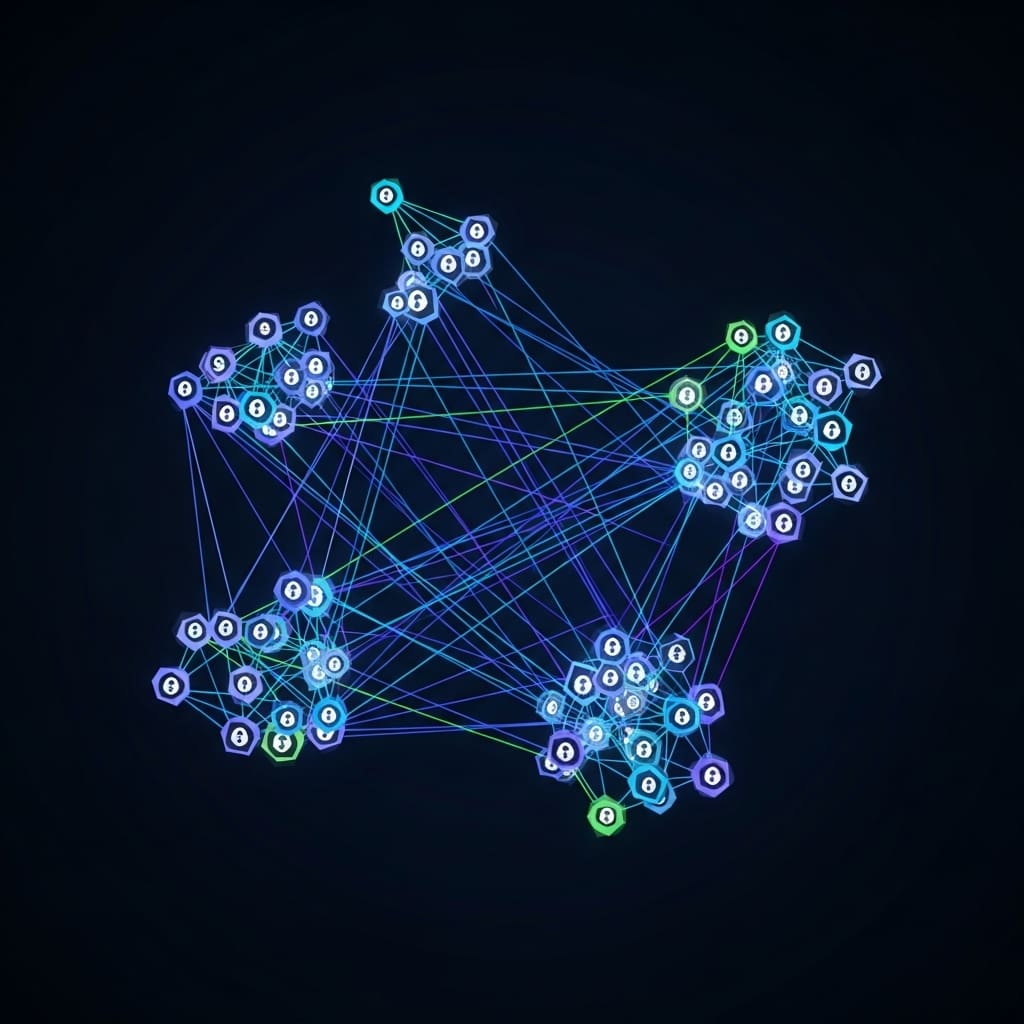
Detecting cross-institutional money laundering presents a significant challenge for Virtual Asset Service Providers (VASPs), forcing a compromise between regulatory requirements and user privacy. Daniel Commey, Matilda Nkoom, and Yousef Alsenani, from Texas A&M University and King Abdulaziz University, alongside Sena G. Hounsinou and Garth V. Crosby, address this issue with FedGraph-VASP, a novel framework for privacy-preserving federated graph learning. This research is significant because it allows collaborative anti-money laundering (AML) analysis without directly sharing sensitive transaction data, utilising a Boundary Embedding Exchange protocol and post-quantum cryptography , specifically the Kyber-512 mechanism , to secure exchanges. Demonstrating a 12.1 percent performance increase over existing methods on the Elliptic Bitcoin dataset, FedGraph-VASP offers a promising solution for enhancing financial crime detection while upholding data privacy standards.
These exchanges are fortified with post-quantum cryptography, specifically the NIST-standardized Kyber-512 key encapsulation mechanism combined with AES-256-GCM authenticated encryption, safeguarding data against both current and future quantum computing threats.
The core innovation lies in the ability to collaboratively analyse transaction patterns across institutions without compromising individual user data. Researchers propose that sharing compressed graph embeddings, rather than raw data or model parameters, strikes a balance between analytical power and privacy protection. In high-connectivity regimes, the framework approaches centralized performance, achieving an F1-score of 0.620. This finding underscores a crucial topology-dependent trade-off: embedding exchange proves beneficial in connected transaction graphs, such as Bitcoin, while generative imputation dominates in highly modular, sparse graphs like Ethereum.
A privacy audit confirmed the limited invertibility of the shared embeddings (R^2 = 0.32), restricting the recovery of exact features and bolstering user privacy. This work opens new avenues for secure and collaborative anti-money laundering efforts, enabling VASPs to comply with regulations like the FATF Travel Rule without sacrificing user confidentiality or competitive advantage. The research establishes a foundation for future development of privacy-preserving machine learning techniques in the financial sector, potentially mitigating the $24.2 billion in illicit cryptocurrency transactions recorded in 2023.
Privacy-preserving federated learning for AML
Scientists are addressing a critical challenge in virtual asset service provider (VASP) compliance: balancing regulatory requirements with user privacy during anti-money laundering (AML) detection. The study achieved an F1-score of 0.508 on binary fraud detection, demonstrating a 12.1 percent improvement over the state-of-the-art generative baseline, FedSage+ which attained an F1-score of 0.453. This highlights a topology-dependent trade-off; embedding exchange proves beneficial in connected transaction graphs like Bitcoin, whereas generative imputation dominates in highly modular, sparse graphs such as Ethereum. A privacy audit revealed the embeddings are only partially invertible, with an R^2 value of 0.32, limiting the potential for exact feature recovery and bolstering user privacy. Data shows that the framework maintains robustness even in low-connectivity settings, where generative imputation methods typically degrade. These results highlight a topology-dependent trade-off, where embedding exchange excels in connected transaction graphs, while generative imputation proves more effective in highly modular, sparse graphs.
Measurements confirm the privacy of the exchanged embeddings, with an R^2 value of 0.32, indicating only partial invertibility and limiting the potential for exact feature recovery. Scientists recorded that this hybrid post-quantum encryption architecture provides robust protection against both embedding inversion attacks and network eavesdropping, even considering potential future quantum computing threats. The system enables collaborative anti-money laundering efforts without requiring the direct sharing of sensitive user transaction data. However, the framework exhibited reduced effectiveness on an Ethereum dataset under sparse connectivity conditions, where FedSage+ performed better. A privacy audit indicated partial non-invertibility of the embeddings, limiting the potential for exact feature recovery. The authors acknowledge limitations related to performance in sparse graph topologies and plan future research focusing on multi-chain datasets and formal differential privacy guarantees. They also intend to investigate partitioning regimes that optimise the balance between privacy and accuracy.
👉 More information
🗞 FedGraph-VASP: Privacy-Preserving Federated Graph Learning with Post-Quantum Security for Cross-Institutional Anti-Money Laundering
🧠 ArXiv: https://arxiv.org/abs/2601.17935