

The development of quantum networks demands efficient methods for distributing entanglement over significant distances, a challenge researchers now address with a novel approach to atom-photon entanglement. Tian-Yu Wang, Ren-Hui Chen, and Yan Li, alongside Ze-Hao Shen et al., have demonstrated a network node based on a simple, cavity-free cold atomic ensemble that achieves long-distance entanglement distribution. This achievement represents a significant step forward because the team successfully generates and distributes entanglement between atomic qubits and photons at telecom wavelengths, exceeding 80% fidelity after transmission through 20 kilometres of optical fibre. Crucially, the system’s high-efficiency frequency conversion module and low-noise operation pave the way for scalable entanglement distribution over distances exceeding 100 kilometres, establishing a new platform for future quantum networks and distributed quantum technologies.
Efficient Entanglement Filtering and Polarization Control
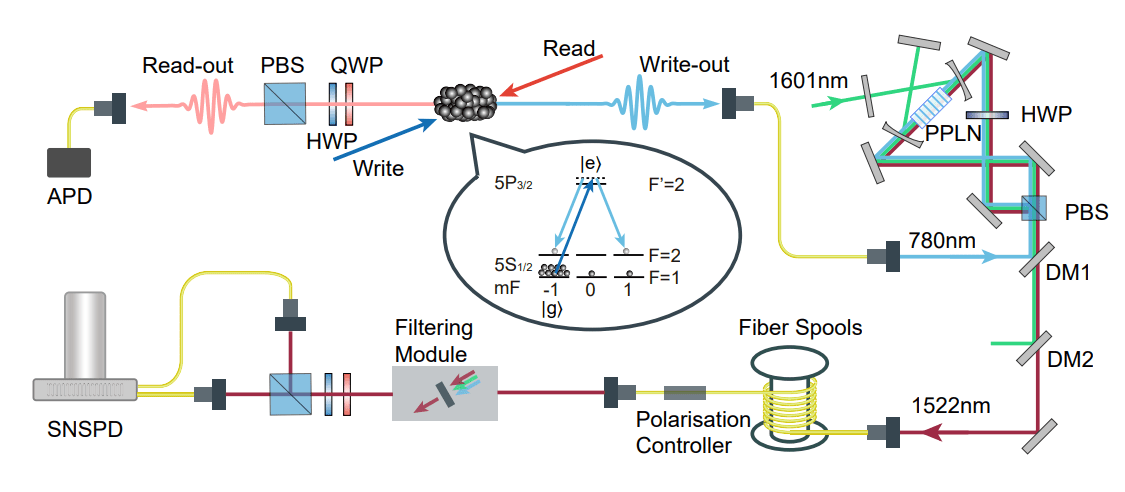
The team developed a system to minimize noise and prepare photons for detection, employing a dichroic mirror, bandpass filters, an etalon, and a volume Bragg grating. This filtering module achieves an overall efficiency of 37. 3%, reducing noise to approximately 280 counts per second. Polarization is carefully analyzed and isolated using a motor-controlled half-wave plate, a polarizing beam splitter, and a Faraday rotator. An acousto-optic modulator blocks unwanted noise photons, enhancing the signal of retrieved photons by a factor of approximately 1500.
This careful optimization of each component delivers a robust and efficient system for long-distance quantum communication, with the quantum frequency conversion converter achieving 72. 6% external quantum efficiency, the filtering module transmitting 66. 9% of photons, and the polarization analysis maintaining 93% transmission.
Cold Atom Ensemble for Long-Distance Entanglement
Scientists have demonstrated a novel approach to building a quantum network node, employing a cold atomic ensemble without complex cavity structures. They engineered a system where atomic qubits exhibit a memory lifetime of 160 microseconds and an initial retrieval efficiency of approximately 50 percent, establishing a robust platform for quantum information storage. The system relies on laser cooling of 87Rb atoms to extremely low temperatures, followed by optical pumping to initialize them into a specific quantum state with around 90 percent efficiency. Entanglement is generated by exciting the atoms with a short laser pulse, correlating the atomic spin wave with the polarization of the emitted photon, creating a maximally entangled state.
To read out the atomic state, scientists project the emitted photons using sensitive detectors, and a Raman state transfer overcomes imbalances in readout efficiencies. They developed a polarization-independent quantum frequency conversion module, efficiently converting 780-nm photons to 1522-nm for transmission through standard optical fibers, achieving an external quantum efficiency of up to 48. 5 percent and signal-to-noise ratios of 6. 9 for photons transmitted over fiber lengths up to 100 kilometers. Through this combination of techniques, the researchers observed entanglement fidelity exceeding 80 percent after transmitting the photon over 20 kilometers of fiber, paving the way for a long-distance quantum network.
Atom-Photon Entanglement and Telecom Conversion Demonstrated
Scientists have achieved a significant breakthrough in quantum networking by demonstrating a functional memory node capable of distributing atom-photon entanglement over considerable distances. This work establishes a crucial building block for future networks supporting distributed computing, cryptography, and remote sensing. The team constructed a node utilizing a simple, cavity-free cold atomic ensemble, achieving an initial retrieval efficiency of approximately 50% and a memory lifetime of 160 microseconds for atomic qubits. This extended memory duration allows for reliable storage and manipulation of quantum information.
Experiments revealed that the generated entangled photon can be efficiently converted to the telecom S band at 1522 nanometers using a high-efficiency, polarization-independent frequency conversion module, achieving an external quantum efficiency of 48. 5% and delivering a signal-to-noise ratio of 6. 9 for transmitted photons even over 100 kilometers of fiber. Measurements confirm an entanglement fidelity exceeding 80% between the atoms and telecom photon after transmission through 20 kilometers of fiber, with the remaining infidelity primarily attributed to atomic decoherence. The system automatically compensates for polarization drift, maintaining entanglement integrity over extended periods, and delivers a new platform for realizing long-distance quantum networks.
Entanglement Distribution and Memory Over 20km Fibre
This research demonstrates a significant advance in the development of quantum networks through the construction of a functional memory node capable of distributing quantum information between atoms and photons over considerable distances. The team successfully created a system utilizing a cold atomic ensemble, achieving initial qubit retrieval efficiency of approximately 50% and a memory lifetime of 160 microseconds. Crucially, they integrated a high-efficiency frequency conversion module to translate entangled photons to a telecom band suitable for long-distance transmission through optical fiber. The results show that this system maintains entanglement fidelity exceeding 80% after transmitting photons over 20 kilometers of fiber, with the primary limitation on performance being atomic decoherence. Furthermore, the system achieved a signal-to-noise ratio sufficient for reliable transmission over 100 kilometers, establishing a foundation for entanglement distribution at this scale.
👉 More information
🗞 Long-distance distribution of atom-photon entanglement based on a cavity-free cold atomic ensemble
🧠 ArXiv: https://arxiv.org/abs/2510.17275