Autonomous drone navigation in challenging, cluttered environments remains a significant hurdle, yet Xin Chen, Rui Huang, and Longbin Tang, along with their colleagues at the National University of Singapore, present a novel solution with AERO-MPPI. This research introduces a fully GPU-accelerated framework that streamlines navigation by unifying perception and planning, allowing drones to operate without pre-built maps. AERO-MPPI rapidly identifies spatial anchors from LiDAR data and uses these to explore multiple potential flight paths simultaneously, avoiding the pitfalls of traditional methods that rely on sequential mapping, planning, and control. The team demonstrates, through extensive simulations and real-world experiments with a LiDAR-equipped quadrotor, that AERO-MPPI achieves sustained reliable flight at speeds exceeding 7m/s, with success rates above 80%, representing a substantial advance in agile and robust drone navigation.
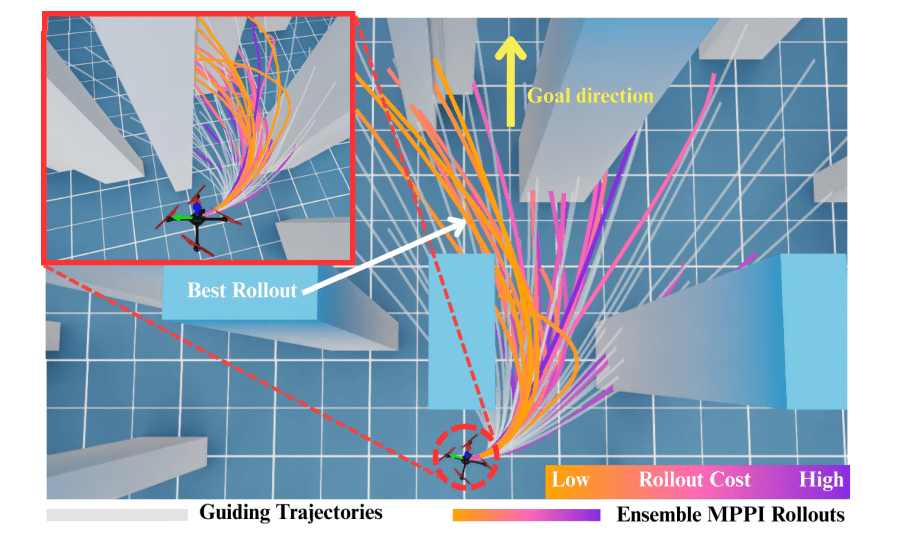
Predictive Path Integral (MPPI) optimizers form the basis of this research. The team designs a multi-resolution LiDAR point-cloud representation that rapidly extracts spatially distributed “anchors” as look-ahead intermediate endpoints. These anchors then construct polynomial trajectory guides, allowing exploration of distinct flight paths. At each planning step, multiple MPPI instances run in parallel and evaluate performance using a two-stage cost function that balances collision avoidance and goal reaching. Implemented entirely with NVIDIA Warp GPU kernels, AERO-MPPI achieves real-time onboard operation and mitigates the local-minima failures often seen in single-MPPI approaches. Extensive simulations in forests and vertical environments demonstrate the system’s capabilities.
Anchor-Guided Planning with Spherical Partitions
This research introduces AERO-MPPI, a novel framework for enabling agile and robust mapless flight for quadrotors. The system addresses limitations in traditional quadrotor planning, which often relies on pre-built maps or complex planning pipelines, hindering performance in dynamic and unknown environments. AERO-MPPI offers a solution by integrating perception and planning into a single, GPU-accelerated system. The core innovation lies in using a spherical partitioning of the environment and anchors to guide trajectory generation, diversifying exploration and helping avoid getting stuck in local minima.
The system employs a multi-resolution spherical partitioning to efficiently represent and explore the three-dimensional environment, and an ensemble of trajectories improves robustness and handles uncertainty. GPU acceleration is critical for real-time performance. AERO-MPPI achieves speeds exceeding 7m/s with success rates over 80%, generating smoother and more efficient trajectories compared to state-of-the-art planners. The entire pipeline runs onboard an NVIDIA Jetson Orin NX 16 GB, demonstrating practical applicability and effective obstacle avoidance in complex and unstructured environments without requiring pre-built maps.
The system works by perceiving the environment using LiDAR data, dividing it into spherical regions, and placing anchors within these regions to represent potential trajectory points. MPPI generates multiple trajectories, guided by the anchors, and the best trajectory is selected based on cost functions, such as collision avoidance, smoothness, and goal reaching. The selected trajectory is then executed by the quadrotor. AERO-MPPI represents a significant step towards enabling truly autonomous and agile flight in complex and unknown environments. Its ability to operate maplessly and achieve real-time performance on embedded hardware makes it a promising solution for a wide range of applications, including search and rescue, inspection, and delivery. The system utilizes Python, FAST-LIO2, running on an NVIDIA Jetson Orin NX 16 GB with a LiDAR sensor.
Drone Navigation via LiDAR-Guided Trajectory Optimization
Scientists developed AERO-MPPI, a new framework for autonomous drone navigation in complex three-dimensional environments, achieving sustained reliable flight above 7 meters per second. This work unifies perception and planning through an ensemble of Model Predictive Path Integral (MPPI) optimizers, guided by spatially distributed anchors extracted from multi-resolution LiDAR point clouds. Experiments demonstrate the system’s ability to generate diverse flight paths, enabling effective obstacle avoidance and robust navigation. The team implemented the entire perception-to-planning pipeline using GPU kernels, enabling real-time onboard computation and high-speed flight.
At each planning step, AERO-MPPI runs multiple MPPI instances in parallel, evaluating them with a cost function that balances collision avoidance and goal reaching. This parallel approach mitigates the local-minima failures often encountered with single-MPPI methods, fostering global exploration and improving navigation robustness. Results from extensive simulations across forest, vertical, and incline scenarios show AERO-MPPI achieves success rates exceeding 80%, with smoother trajectories compared to existing state-of-the-art planners. Real-world experiments conducted with a LiDAR-equipped quadrotor and Jetson Orin NX 16G confirm the system operates in real time onboard, consistently achieving safe, agile, and robust flight in cluttered environments.
The framework utilizes a multi-resolution partitioning of the environment to generate guiding trajectories, allowing for efficient exploration of potential flight paths. The team’s approach to MPPI involves generating thousands of rollouts in real time, sampling random control sequences and evaluating their cost, then updating the nominal controls with a weighted sum of the sampled disturbances. This sampling-based formulation allows direct incorporation of complex dynamics and high-dimensional constraints, while the use of GPU parallelization significantly accelerates the computation. The framework’s ability to generate diverse trajectories and maintain real-time performance represents a significant advancement in autonomous drone navigation.
Agile Drone Navigation Without Pre-built Maps
AERO-MPPI represents a significant advance in autonomous drone navigation, delivering a system capable of agile and reliable flight in complex, cluttered 3D environments without relying on pre-built maps. Researchers developed a fully GPU-accelerated framework that unifies perception and planning, employing an innovative approach using spatially distributed anchors to guide trajectory generation and diversify exploration possibilities. This anchor-guided ensemble of Model Predictive Path Integral optimizers enables the drone to discover flight paths that conventional methods often miss, mitigating the risk of becoming trapped in local minima. Extensive simulations and real-world experiments demonstrate the effectiveness of AERO-MPPI, achieving sustained flight speeds exceeding 7m/s with success rates above 80%.
The system consistently maintains smoother trajectories compared to existing state-of-the-art methods, and importantly, operates in real time onboard a LiDAR-equipped quadrotor with an NVIDIA Jetson Orin NX 16GB. While the current work focuses on single-drone navigation in complex environments, the researchers acknowledge limitations and plan to extend the framework to address multi-robot coordination, outdoor large-scale deployments, and integration with learning-based perception and adaptive dynamics models. These future developments aim to further enhance robustness and autonomy in dynamic real-world scenarios.
👉 More information
🗞 AERO-MPPI: Anchor-Guided Ensemble Trajectory Optimization for Agile Mapless Drone Navigation
🧠 ArXiv: https://arxiv.org/abs/2509.17340