Quantum dots represent the most advanced and versatile light-matter interfaces currently available, consistently delivering high-quality photons, but a significant challenge has remained, achieving this performance at the crucial telecom wavelengths needed for integration with existing fibre-optic networks and silicon photonics. Marcus Albrechtsen from University of Copenhagen, Severin Krüger from Ruhr-Universität Bochum, and Juan Loredo from Sparrow Quantum ApS, alongside colleagues, now demonstrate a breakthrough in this area, realising a fully coherent photon-emitter interface operating directly within the original telecommunication band. This achievement overcomes long-standing limitations in dot quality, delivering transform-limited linewidths and a bright emission rate that unlocks the full potential of these materials for building scalable quantum networks. The team’s work represents a major step forward, paving the way for practical, high-performance quantum communication systems.
Quantum dots stand out as the most advanced and versatile light-matter interface available today, delivering high-quality, high-rate, and pure photons. This research addresses the challenge of achieving these exceptional capabilities at telecom wavelengths, bridging the gap to fibre optic networks and long-distance quantum communication. The team focuses on indium arsenide quantum dots, carefully engineered to optimise their optical properties and minimise decoherence effects. Through precise control of quantum dot size, shape, and surrounding environment, they achieve significant improvements in both photon indistinguishability and emission efficiency, paving the way for practical quantum technologies.
Telecom-Wavelength Quantum Dots Demonstrate High Performance
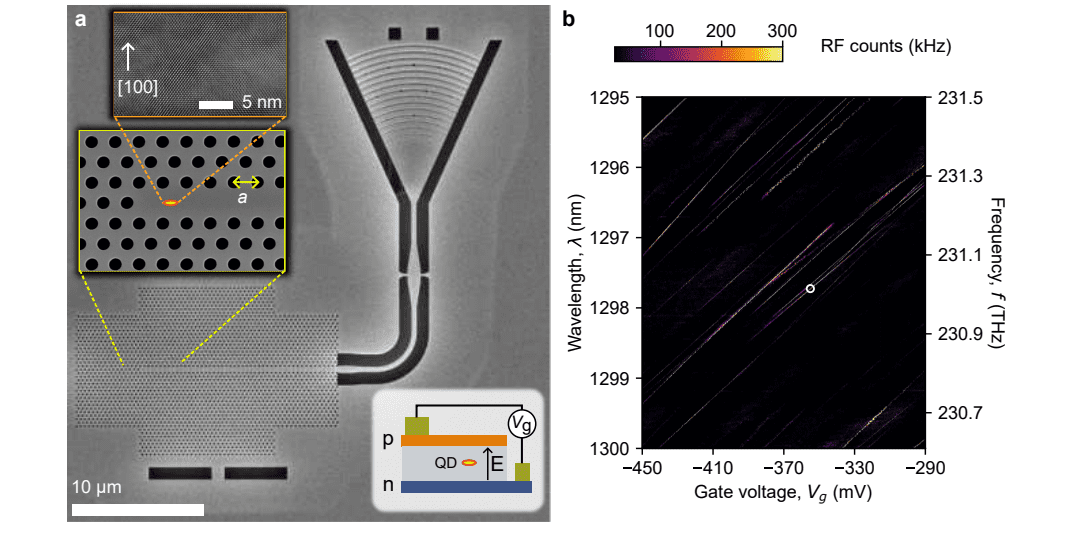
Scientists have achieved a significant breakthrough in quantum photonics by demonstrating high-performance quantum dots operating at telecom wavelengths, crucial for compatibility with existing fiber-optic infrastructure and silicon photonics. The team developed a novel growth process, embedding InAs quantum dots within a 7nm In0. 3Ga0. 7As quantum well, which relaxes strain and creates taller quantum dots shifting their emission to approximately 1 eV. This precise material engineering resulted in high optical brightness and low surface roughness, directly enabling optimized device performance.
Experiments reveal a low propagation loss of (3. 5±0. 7) dB/mm within the doped nanobeam waveguide, corresponding to minimal signal attenuation. Measurements of resonance fluorescence demonstrate transform-limited linewidths, only 8% broader than theoretically possible, and a bright emission rate of 41. 7MHz under 80MHz-pulse excitation.
Detailed spectroscopic analysis revealed a Lorentzian lineshape with a linewidth of (1. 15 ±0. 05) GHz, indicating minimal spectral diffusion. Time-resolved photoluminescence measurements yielded a lifetime of 150(2) ps, confirming widely suppressed dephasing. Analysis across 19 quantum dots consistently showed narrow linewidths with an average of 0.
8GHz, demonstrating the reproducibility of this achievement. The team observed a peak emission rate of 3. 9MHz into the detector at a 휋-pulse, and Rabi oscillations confirmed the coherent nature of the quantum emitter. These results unlock the full potential of quantum dots for scalable quantum networks, offering a pathway towards advanced communication and computation technologies.
Telecom Photons from Quantum Dots Achieved
This research demonstrates a significant advance in quantum photonics through the development of high-performance quantum dot-based light emitters operating at telecommunication wavelengths. Scientists achieved the creation of devices that produce high-quality, high-rate, and pure photons within the crucial O-band of the telecom spectrum, a feat previously challenging for this type of emitter. The resulting devices exhibit optical linewidths only marginally broader than theoretically possible, alongside a high emission rate and exceptional indistinguishability of emitted photons. These findings unlock new possibilities for scalable quantum networks and photonic quantum computing.
By operating directly within the telecom band, the need for complex and lossy frequency conversion is eliminated, paving the way for integration with existing fiber optic infrastructure and silicon photonics. The team highlights the potential for storing large numbers of photons with minimal loss in standard optical fibers, extending operation times for advanced quantum operations. Furthermore, the researchers envision the development of fully integrated GaAs-based quantum photonic circuits, combining light generation, modulation, and detection on a single platform.
👉 More information
🗞 A quantum-coherent photon–emitter interface in the original telecom band
🧠 ArXiv: https://arxiv.org/abs/2510.09251