

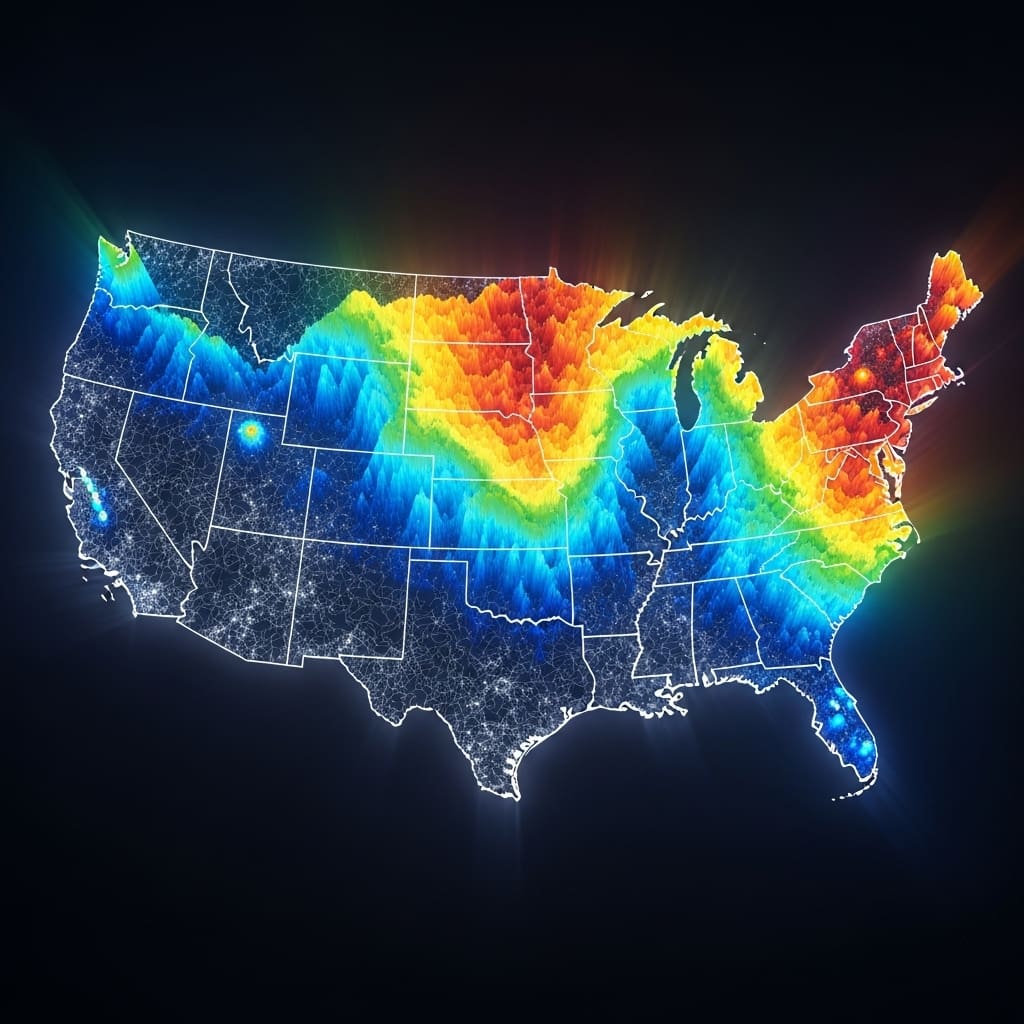
Understanding the factors that drive population growth across U.S. states remains a crucial challenge for policymakers and economists alike. Sebastian Kripfganz of the University of Exeter and Vasilis Sarafidis of Brunel University London, along with their co-authors, investigate these dynamics using a novel spatial econometric approach spanning 1965 to 2017. Their research uniquely recovers the network structure of state interactions directly from the data, rather than relying on pre-defined geographical assumptions, and combines this with advanced statistical techniques to account for complex interdependencies. This innovative framework allows for a more accurate assessment of how factors such as amenities, labour income, and productivity influence population shifts, revealing that spatial spillovers account for a substantial portion of overall growth impacts. The findings demonstrate broad convergence amongst states, with a small group experiencing continued divergence, and offer valuable insights into regional economic development.
US state population growth, utilising a dynamic spatial model encompassing data from 49 states between 1965 and 2017. The research team recovered the spatial network structure directly from the data itself, moving beyond traditional methods that rely on pre-defined criteria like geographic contiguity or distance. This innovative methodology combines a sophisticated instrumental variable estimator, allowing for varying effects across states and accounting for pervasive interconnectedness, delivering consistent and reliable results in a complex spatial panel model.
The study represents the first estimation framework in spatial econometrics to simultaneously integrate data-driven network structures, endogenous regressors, and interactive fixed effects within a unified setting. Experiments reveal broad, yet varied, conditional convergence in population growth, with approximately three-quarters of states exhibiting convergence while a smaller segment of high-growth states show mild divergence. The effects of key drivers, amenities, labour income, and migration frictions, remain consistently stable regardless of the network specification employed. However, the impact of productivity emerges only when the spatial network is estimated directly from observed data, highlighting the importance of accurately capturing inter-state relationships.
This finding suggests that productivity spillovers are not simply a function of geographic proximity, but are shaped by the underlying network of economic interactions between states. The research establishes that spatial spillovers are substantial, with indirect effects accounting for roughly one-third of the total impact on population growth and extending beyond immediately neighbouring states. This demonstrates that population changes in one state significantly influence growth patterns in more distant regions, underscoring the interconnectedness of the U. S. economy. By allowing for heterogeneous slopes and interactive fixed effects, the model provides a more nuanced understanding of how different states respond to economic forces and spatial dependencies.
This approach moves beyond simplistic assumptions of uniform effects, offering a more realistic portrayal of regional population dynamics. This breakthrough reveals a powerful new framework for analysing spatial processes, with implications extending beyond population studies to fields like regional economics, urban planning, and environmental sustainability. The ability to estimate spatial networks from data, rather than imposing them, offers a flexible and adaptable tool for understanding complex interdependencies in various contexts. The findings have direct relevance for policymakers seeking to address issues related to infrastructure development, housing strategies, and public service provision in the face of shifting population patterns. Ultimately, this work opens avenues for more informed and effective regional development planning, acknowledging the crucial role of spatial interactions and heterogeneous responses.
Spatial Network Modelling of US Population Change
The study investigates the drivers and spatial patterns of U. S. state population growth between 1965 and 2017, employing a dynamic spatial model across the 49 contiguous states. Researchers pioneered a methodology that infers the spatial network structure directly from the population data itself, departing from traditional approaches that rely on pre-defined criteria like contiguity or distance. This data-driven network estimation is central to capturing the complex interdependencies between states, allowing for a more nuanced understanding of population diffusion. The team engineered a novel estimation framework combining this inferred network with an instrumental variable estimator, accommodating heterogeneous slopes and interactive fixed effects within a spatial panel model.
This unified design achieves consistent estimation and inference, addressing challenges posed by endogenous regressors, a data-inferred network, and pervasive cross-state dependence. The approach enables researchers to simultaneously account for these complexities, representing a significant methodological innovation in spatial econometrics. Experiments employed a comprehensive dataset of state-level population figures alongside key economic and demographic variables, including amenities, labour income, and migration frictions. The system delivers robust results by assessing the impact of these drivers on population growth while explicitly modelling spatial spillovers.
Crucially, the study reveals that spatial spillovers are substantial, with indirect effects accounting for approximately one-third of the total impacts and extending beyond immediate neighbouring states. The research demonstrates that the effect of productivity on population growth only becomes apparent when the spatial network is estimated directly from the data, highlighting the importance of the innovative network inference technique. Findings indicate broad conditional convergence across states, with around 75 percent experiencing population convergence, while a smaller group exhibits mild divergence, providing valuable insights into regional economic dynamics and the forces shaping population distribution.
Data-Driven Networks Reveal US Population Dynamics
Scientists achieved a significant breakthrough in understanding U. S. state population growth through a dynamic spatial analysis spanning 1965 to 2017, encompassing 49 states. The research team recovered the spatial network structure directly from the data, rather than imposing pre-defined connections based on proximity or distance, and combined this with an instrumental variable estimator. This innovative approach allows for varying effects across states and accounts for interconnectedness, delivering consistent estimations and reliable inferences within a complex spatial panel. To the researchers’ knowledge, this work represents the first estimation framework in spatial econometrics to integrate all three of these elements, data-driven networks, endogenous regressors, and heterogeneous slopes, into a single cohesive model.
Experiments revealed broad, yet heterogeneous, conditional convergence in population growth, with approximately three-quarters of states exhibiting convergence patterns. Conversely, a small group of high-growth states demonstrated mild divergence, indicating varied responses to underlying economic forces. Coefficients for core drivers, amenities, labour income, and migration frictions, remained stable across different network specifications, highlighting their consistent influence on population dynamics. However, the effect of total factor productivity only became significant when the spatial network was estimated directly from the data, suggesting that network structure is crucial for capturing productivity’s impact.
Measurements confirm that spatial spillovers are substantial, with indirect effects accounting for roughly one-third of the total impacts on population growth, extending beyond immediate neighbouring states. The estimated interaction network is sparse, with a density of approximately 0.66%, yet it spans the entire nation and exhibits pronounced regional homophily, where links within the same division occur more than twice as often as random assignment would predict. Data shows that latent common factors explain at least 60% of the residual variance, even after controlling for state-specific and time-dependent effects, underscoring the importance of modelling both network dependence and pervasive cross-sectional comovement. The study’s dynamic spatial panel data model, applied to annual data from 1965-2017, precisely quantified the relationship between population growth and key drivers. Scientists recorded that the inclusion of interactive fixed effects effectively captures nationwide demographic and institutional shocks, while addressing endogeneity concerns related to spatial lags, lagged dependent variables, and correlated covariates. The team’s algorithmic extensions allow for time-varying spatial weighting matrices and provide routines for calculating spill-in and spill-out effects, enhancing the model’s flexibility and analytical capabilities.
👉 More information
🗞 Chasing Opportunity: Spillovers and Drivers of U.S. State Population Growth
🧠 ArXiv: https://arxiv.org/abs/2601.10444