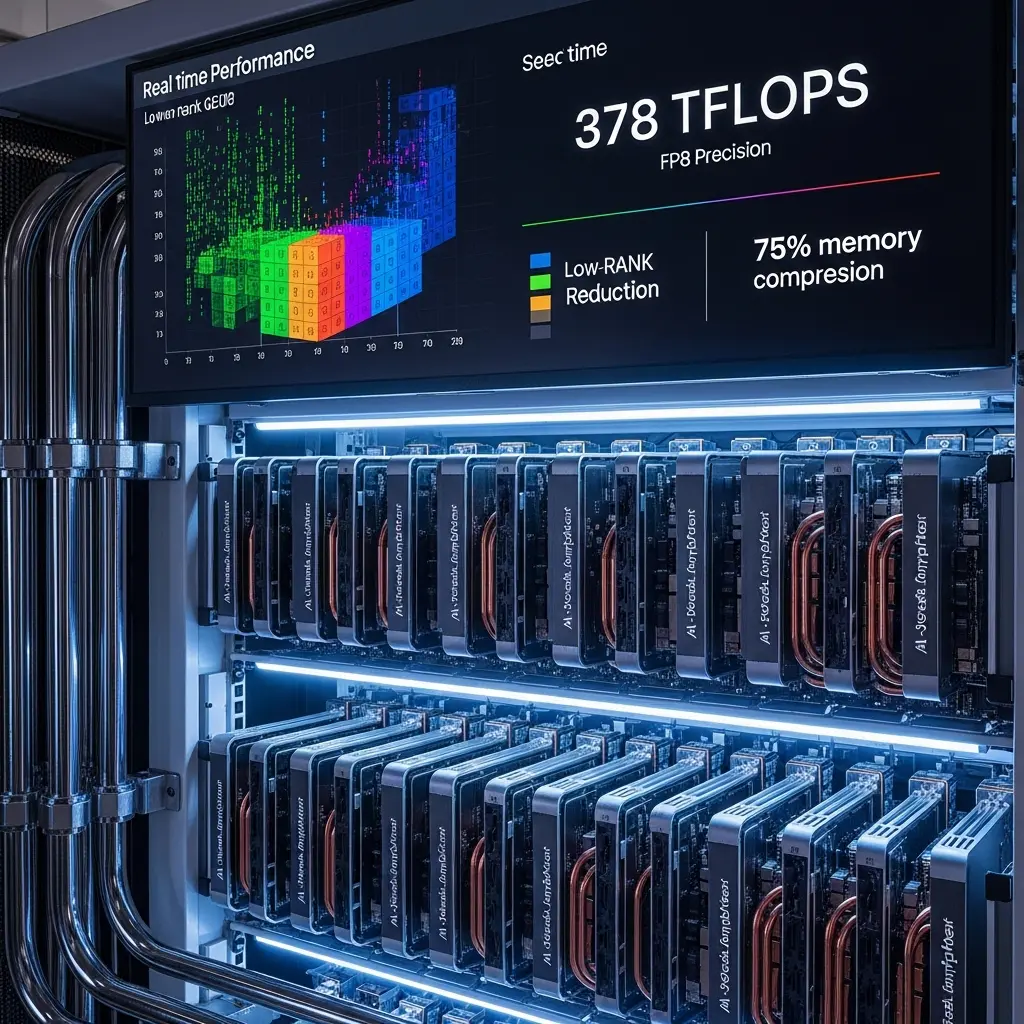
Large matrix multiplication underpins many modern machine learning applications, but its computational demands are increasingly straining available resources. Alfredo Metere from Metere Consulting, LLC, presents Low-Rank GEMM, a new method that dramatically improves efficiency by using low-rank approximations to reduce computational complexity. This approach achieves significant speed and memory savings, delivering up to 75% reduction in memory usage and substantial performance gains over standard methods on powerful hardware like the RTX 4090. By intelligently adapting to available accelerators and optimising for memory bandwidth, Low-Rank GEMM establishes a new performance benchmark for large matrix calculations, exceeding the speed of traditional implementations for matrices exceeding a size of.
Traditional matrix multiplication becomes a bottleneck due to its high computational and memory demands, especially as model sizes increase. LowRank GEMM addresses this challenge by reducing the size of matrices before multiplication using low-rank approximations, significantly reducing both computational cost and memory footprint. The system intelligently selects the best decomposition method and precision level based on the input matrix and hardware capabilities.
The results demonstrate that LowRank GEMM achieves up to 378 TFLOPS on NVIDIA RTX 4090 GPUs, delivering significant speedups, up to 7. 8x, compared to standard PyTorch FP32 implementations for large matrices. Furthermore, the low-rank approximation provides 75% memory savings, allowing for larger models and batch sizes. This automatic optimization, combined with a crossover point where LowRank GEMM outperforms traditional cuBLAS implementations for matrices larger than 10240×10240, has practical implications for training and deploying models with more parameters and layers, increasing batch sizes for faster convergence, and improving overall computational efficiency.
The method involves decomposing the input matrix into lower-rank representations, then performing multiplication on these smaller matrices, reducing the computational load. This system is optimized for NVIDIA GPUs, leveraging their capabilities for efficient matrix operations, and dynamically selects the best decomposition method and precision level based on the input matrix. Experiments conducted on an NVIDIA RTX 4090 GPU demonstrate a peak performance of 378 TFLOPS at a matrix size of 20480×20480, establishing LowRank GEMM as the fastest method for matrices exceeding 10240×10240. This represents a 7. 7x improvement over standard PyTorch FP32 and a 2. 8x improvement over optimized cuBLAS methods at this scale.
The system intelligently adapts to hardware capabilities, selecting optimal decomposition methods, such as SVD and randomized SVD, and precision levels based on matrix characteristics. Performance scaling was evaluated across matrix sizes ranging from 1024×1024 to 20480×20480, revealing a crossover point around 10000×10000 where memory bandwidth limitations favor the efficiency of low-rank approximation. For a 20480×20480 matrix, LowRank GEMM achieves 75% memory reduction, decreasing storage requirements from 5GB per matrix to 1. 25GB per matrix, effectively allowing 3. 25x larger models to fit within the same memory footprint.
Throughput analysis confirms the remarkable scaling, with LowRank GEMM achieving 378 TFLOPS at the largest matrix size tested. While low-rank approximation introduces a mean relative error of approximately 1-2%, this level of error is considered acceptable given the substantial computational savings and the controlled truncation of singular values that retain over 99% of the total energy. The research demonstrates that by utilizing FP16 for intermediate computations, the system balances performance, precision, and resource usage, while maintaining numerical stability and maximizing the benefits of modern hardware acceleration.
Low-Rank GEMM Achieves Peak Matrix Performance
Low-Rank GEMM presents a novel approach to large matrix multiplication, achieving significant performance gains by leveraging low-rank matrix approximations. This system attains up to 378 TFLOPS on matrices up to 20480×20480 using an NVIDIA RTX 4090, delivering 75% memory savings and a 7. 8x speedup compared to PyTorch FP32 for large matrices. The method intelligently adapts to hardware capabilities, automatically selecting optimal decomposition techniques, such as SVD, and precision levels based on matrix characteristics and available accelerators. Comprehensive benchmarking demonstrates that Low-Rank GEMM surpasses traditional cuBLAS implementations for matrices of size 10240 and above, achieving faster performance through memory bandwidth optimization rather than computational shortcuts.
This advancement enables more efficient training and deployment of modern deep learning models while maintaining sub-1% approximation accuracy. The authors acknowledge a limitation inherent in the hardware, noting that optimal performance relies on pre-computing low-rank factorizations, which may not be feasible for dynamic or streaming workloads. Future work could address this challenge to broaden the applicability of the system.
🗞 Low-Rank GEMM: Efficient Matrix Multiplication via Low-Rank Approximation with FP8 Acceleration
🧠 ArXiv: https://arxiv.org/abs/2511.18674