The demand for highly stable light sources grows as researchers pursue advancements in quantum communication and high-speed data transfer, and a new system addresses a critical challenge in distributing these sensitive signals over long distances. Stanley Johnson from the Inter-University Centre for Astronomy and Astrophysics, along with Sandeep Mishra and Anirban Pathak from the Jaypee Institute of Information Technology, and Subhadeep De, present a method for creating ultra-stable laser links using specialised fibre optics. Their system actively corrects for the natural drift in laser frequency, achieving a remarkable level of stability over both short and long distances, including a 71-kilometre spool fibre deployment. This innovation significantly improves the performance of quantum communication protocols, potentially increasing the effectiveness of twin-field quantum key distribution by reducing error rates and easing the demands on laser stabilisation techniques.
Phase coherent fibers (PCF) are essential for distributing nearly monochromatic photons, ultra-stable in their frequency and phases, which have demanding requirements for state-of-the-art networked experiments, quantum as well as very high-speed communications. This work reports the development of a novel system that produces PCF links and actively corrects the unavoidable slow frequency drift of the source laser. The developed PCF follows white phase noise limited σo × τ −1 stability behaviour, having σo values of 1. 9(2) × 10−16 and 2. 6(1) × 10−16 for 3. 3km field-deployed and 71km spool fibers, respectively. These results demonstrate a significant advancement in the stability and performance of long-distance photonic links for precision applications.
Stabilizing Fiber Links with Self-Referencing Laser System
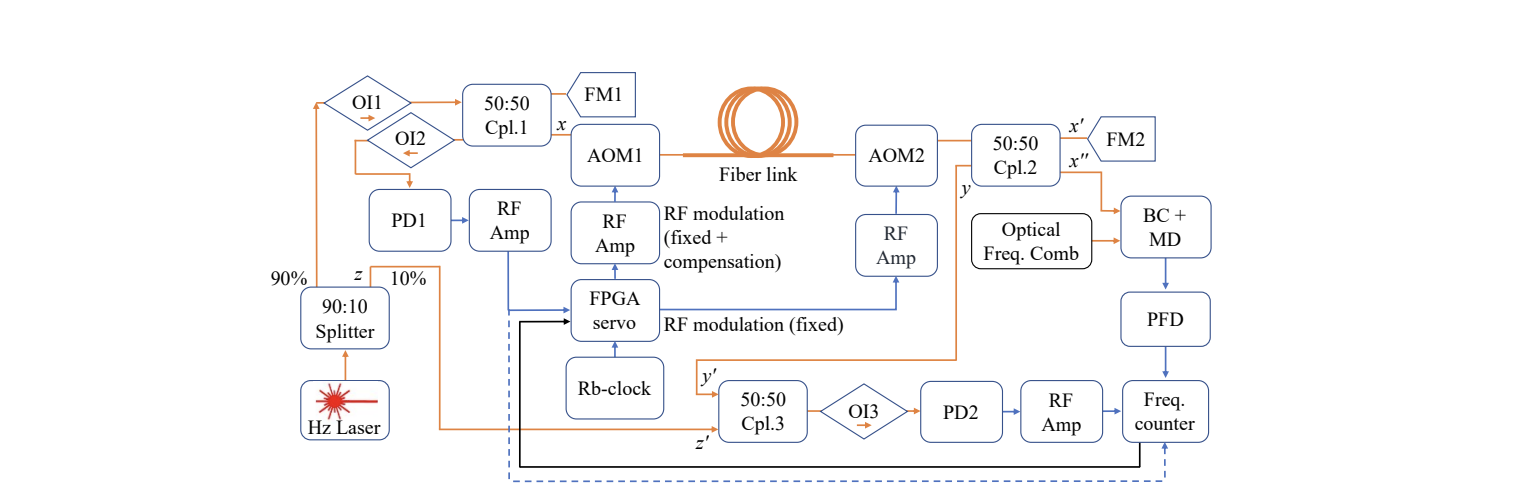
The team engineered a sophisticated system to produce phase coherent fiber (PCF) links, essential for distributing highly stable light for advanced experiments and high-speed communications. Central to this system is an ultra-stable laser operating at 1550nm, split into two paths to create a self-referencing stabilization loop. Ninety percent of the laser output travels through acousto-optic modulators (AOMs) and the fiber link, while the remaining ten percent serves as a nearly undisturbed reference signal. This reference beam is directed through a short fiber to generate an out-of-loop beat signal, enabling precise frequency monitoring at the remote end of the link.
The core of the stabilization process involves actively correcting both the laser’s frequency drift and the phase noise introduced by the fiber itself. One AOM incorporates corrections for fiber phase noise and laser drift, while the second distinguishes between genuine signal and unwanted backscattered light. Optical isolators suppress reflections, preventing unwanted resonances and ensuring signal integrity in the bi-directional transmission system. The system then utilizes an in-house developed field programmable gate array (FPGA) based servo, synchronized to a Rubidium clock, to analyze the beat signal and generate proportionate frequency corrections applied to the first AOM, actively stabilizing the PCF link.
To measure the slow frequency drift of the laser, the team implemented a novel out-of-loop technique using a stabilized optical difference frequency comb (DFC). An out-of-loop beat signal between the laser and the DFC output is generated, filtered, and amplified before being recorded with a precision frequency counter. This allows for accurate monitoring of the laser’s drift, typically less than 50 mHz/s, and enables further refinement of the stabilization process. The FPGA hardware, synchronized to a Rubidium clock, achieves an 85% suppression of phase noise at 20MHz, demonstrating low long-term frequency drift and enhancing the overall stability of the PCF link.
Stable Clocks Enable Quantum Networks
Research focuses on developing highly accurate and stable time/frequency transfer systems, and applying these technologies to build secure quantum communication networks. This involves creating ultra-stable optical clocks, based on elements like Yb+, Ca, and Sr, which serve as the reference for time and frequency. A key challenge is distributing this precise time/frequency information over long distances using optical fiber, complicated by fiber impairments and the need to maintain coherence. This research leverages these technologies to implement secure communication protocols, known as quantum key distribution (QKD), which are theoretically unbreakable.
The ultimate goal is to create a network of interconnected quantum nodes, enabling secure communication and distributed quantum computing. Several key technologies underpin this research. Atomic clocks, including those based on Yb+, Ca, and Sr, provide the foundation for precise timekeeping. Laser stabilization and noise reduction techniques, such as locking lasers to optical fiber delay lines and utilizing cubic cavities, are crucial for maintaining clock stability. Fiber optics and coherent communication methods, including single-sideband modulation and phase-coherent fiber, are employed to transmit signals over long distances.
Furthermore, the research utilizes quantum technologies like quantum key distribution, Bell-state measurements, quantum memory, and entanglement distribution. Specific research areas address long-distance time/frequency transfer, quantum network scalability, the coexistence of classical and quantum communication, and ensuring the security and robustness of quantum communication networks. Challenges include maintaining coherence over long fiber links, overcoming limitations in entanglement distribution and quantum memory, and integrating QKD with existing classical communication networks. The research also focuses on synchronizing atomic clocks over long distances and mitigating fiber impairments like chromatic dispersion and polarization mode dispersion.
This research is conducted by universities, research labs, and companies specializing in photonics, quantum technologies, and telecommunications. In summary, this work paints a picture of a vibrant and rapidly evolving field focused on building the infrastructure for a future quantum internet. The research is highly interdisciplinary, requiring expertise in atomic physics, optics, signal processing, and networking.
Stabilized Fiber Links for Quantum Communication
This research demonstrates a new system for establishing highly stable optical fiber links, crucial for advanced experiments in quantum communication and high-speed data transmission. The team developed a method to actively correct for both the inherent frequency drift of the laser source and the phase noise introduced by the optical fiber itself. Results show significant suppression of phase noise, up to 47. 5 decibels compared to standard fiber, and a reduction of laser frequency drift to minimal levels. This all-in-one solution improves the performance of quantum key distribution systems, potentially reducing error rates by nearly a factor of 73 when compared to unstabilized links.
The system achieves this stability through a combination of optical self-referencing and correction techniques, alongside a custom-built electronic servo system. By carefully controlling and compensating for frequency shifts, the team created a fiber link with dramatically improved coherence. While the current experiments focused on fiber lengths of 3. 3 and 71 kilometers, the principles established could be applied to longer distances. The authors acknowledge that further research is needed to optimize the system for different fiber types and environmental conditions, and to explore its potential in more complex quantum networks.
🗞 Frequency drift corrected ultra-stable laser through phase-coherent fiber producing a quantum channel
🧠 ArXiv: https://arxiv.org/abs/2509.08419