

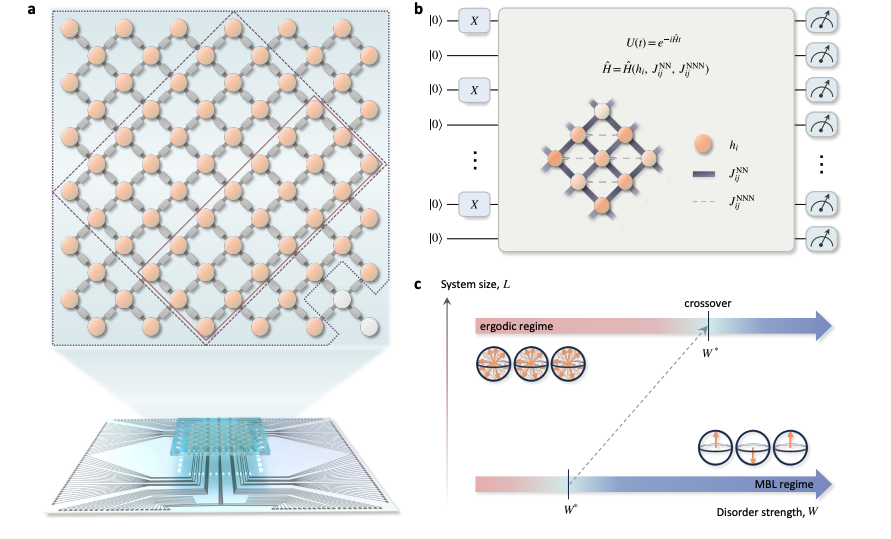
The behaviour of complex quantum systems, when subjected to disorder, presents a long-standing puzzle in physics, with researchers seeking to understand whether these systems will eventually reach a stable, predictable state or remain perpetually chaotic. Tian-Ming and colleagues at the University of Science and Technology of China, along with collaborators, now provide compelling evidence for a phenomenon called many-body delocalization in two dimensions, a state previously thought unstable in higher-dimensional systems. Using a sophisticated 70-qubit superconducting quantum simulator, the team demonstrates that, with carefully controlled disorder, this delocalized state persists, challenging existing theories predicting its rapid breakdown. This achievement not only confirms the existence of this elusive quantum state in a higher dimension, but also establishes a powerful, scalable platform for investigating the complex behaviour of quantum systems and exploring new phases of matter.
Surface Codes and the Challenge of Scalability
Quantum error correction is essential for building practical quantum computers, as quantum systems are highly susceptible to errors. Surface codes, a specific type of stabiliser code designed for a two-dimensional layout, are attractive because they can tolerate a relatively high error rate with simpler decoding methods. However, building surface codes requires a large number of physical qubits and precise control, presenting significant engineering challenges. Recent research focuses on optimising surface code performance by exploring different code designs and decoding strategies. Investigations into codes beyond the standard surface code, such as the XZZX code, aim to reduce the resources required and improve error correction.
The XZZX code shows promise with a potentially lower qubit overhead and higher error tolerance compared to the standard surface code, though its performance depends heavily on the specific types of errors present and the effectiveness of the decoding process. This work examines the XZZX code’s performance under realistic conditions, considering both independent and correlated errors, to determine if it can outperform the standard surface code and identify factors limiting its performance. The study uses numerical simulations to evaluate the XZZX code’s logical error rate, considering the physical qubit error rate, code size, and error correlations. The simulations incorporate a detailed model of physical qubit noise, including both amplitude and phase errors, and account for imperfections in measurements and control. The results demonstrate that the XZZX code can achieve a lower logical error rate than the standard surface code under certain conditions, but its performance is significantly affected by correlated errors.
Superconducting Quantum Simulation and Thermalization Studies
Researchers are building and experimenting with superconducting quantum processors to explore fundamental questions in quantum physics, including how quantum systems reach equilibrium and exhibit phase transitions. They are combining analog and digital approaches to quantum simulation, studying complex interactions within quantum systems, and investigating phenomena like Hilbert space fragmentation and non-Abelian anyons. A significant focus is on improving the precision of control pulses applied to qubits, utilising superconducting qubits as the physical platform for these experiments. Matrix product states (MPS) are used as a numerical method for simulating quantum systems and evolving them in time, with the Python framework Qutip used for simulating open quantum systems. This research combines analog and digital methods for quantum simulation, dedicating significant effort to calibrating and optimising the control pulses applied to the qubits.
Two-Dimensional MBL Breaks Down with Size
Researchers have demonstrated that many-body localisation (MBL), a phenomenon where strong disorder prevents energy distribution, is fragile in two dimensions, challenging existing theories about its stability. While extensively studied in simpler, one-dimensional systems, its existence and robustness in two dimensions have remained elusive due to computational and experimental challenges. This research provides compelling evidence that MBL in two dimensions is susceptible to breakdown as the system size increases. The team employed a sophisticated 70-qubit superconducting quantum simulator, a specially designed circuit that allows precise control over quantum interactions.
By carefully tuning the disorder within the system, they observed how the degree of localisation changed with increasing system size. The results reveal a clear trend: larger systems exhibit a more pronounced decay of the initial localised state, indicating a transition towards conventional thermal behaviour, even without introducing artificial thermal regions. Importantly, the observed delocalisation aligns with predictions from the “avalanche theory,” which suggests that MBL is inherently unstable in higher dimensions. This theory posits that even small disturbances can trigger a cascade of events, ultimately leading to the breakdown of localisation. The experimental findings support this idea, demonstrating that the boundary between localised and thermal states shifts to larger disorder strengths as the system grows, suggesting that maintaining MBL in larger two-dimensional systems requires increasingly strong disorder, potentially limiting its practical realisation. This research establishes a powerful platform for investigating complex quantum phenomena in higher dimensions and opens new avenues for exploring the interplay between disorder, interactions, and localisation.
Two Dimensions Drive Thermalization in Quantum Systems
Researchers are investigating whether many-body localisation (MBL) can exist in two-dimensional quantum systems. Using a 70-qubit superconducting simulator, the team explored the stability of the MBL regime and observed that increasing the system size leads to a decay in the imbalance, indicating a transition towards thermalisation. These findings provide evidence for many-body delocalisation in 2D, suggesting that the MBL phase is unstable and may not exist in the thermodynamic limit. The experiments demonstrate that while non-ergodic behaviour, characteristic of MBL, is initially observed, it is ultimately overcome by the system’s tendency to thermalise as size increases.
The researchers found no evidence of a stable MBL phase at any disorder strength within their simulations. This work establishes a scalable platform using superconducting circuits to study complex quantum dynamics beyond one dimension, potentially tackling problems intractable for classical computers. Future research could focus on improving the coherence of the system to observe faster decay of imbalance or explore other out-of-equilibrium phenomena, such as Hilbert-space fragmentation and quantum coarsening.
🗞 Many-body delocalization with a two-dimensional 70-qubit superconducting quantum simulator
🧠 DOI: https://doi.org/10.48550/arXiv.2507.16882


