Controlling the emission of light from nanoscale materials with magnetic fields represents a significant advance for technologies ranging from advanced sensors to biological imaging, and researchers are now reporting a breakthrough in this area using carbon-based quantum dots. Erin S. Grant, Joseph F. Olorunyomi, and Sam C. Scholten, alongside colleagues at RMIT University, demonstrate for the first time that the light emitted by these tiny carbon particles changes measurably when exposed to relatively weak magnetic fields. This observation of spin-dependent photoluminescence at room temperature, achieved through the synthesis of quantum dots using a variety of amino acids, offers a new way to manipulate and read signals from these biocompatible nanoparticles, potentially enabling in situ studies and improved imaging of biological samples. The team’s findings, which reveal a process resembling the radical pair mechanism, establish a foundation for incorporating magnetic control into a widely used class of luminescent materials.
Spin Interactions Detected Via Optical Resonance
Scientists are exploring the interplay between light and magnetism in nanoscale materials, particularly how these interactions can be harnessed for advanced sensing technologies. This research focuses on optically detected magnetic resonance, a technique that uses light to reveal the magnetic properties of materials at the nanoscale, and spin-correlated radical pairs, where the behavior of electrons is linked and sensitive to magnetic fields. The ultimate goal is to develop materials capable of highly sensitive magnetic sensing, with potential applications spanning biology, medicine, and materials science. Central to this work are carbon quantum dots, nanoscale particles exhibiting unique quantum properties, graphene, a two-dimensional carbon material with exceptional electronic properties, and hexagonal boron nitride, a similar material with distinct characteristics.
Amino acids serve as building blocks for synthesizing carbon quantum dots, influencing their properties, while ferritin, an iron-storage protein, provides a model system for studying magnetism. Graphitic carbon nitride, a polymeric material with photocatalytic abilities, is also under investigation. Researchers have observed that the luminescence of these materials changes when exposed to magnetic fields, suggesting interactions between electron spins within the materials. The emission wavelength of carbon quantum dots can be precisely controlled by adjusting the synthesis process and the amino acids used.
Importantly, researchers have detected optical signals in hexagonal boron nitride, indicating the presence of spin defects that can be detected with light. Evidence suggests that spin-correlated radical pairs play a crucial role in the magnetic properties of these materials, and the magnetic properties of ferritin fluctuate randomly, a phenomenon known as superparamagnetism. This research paves the way for developing nanoscale magnetic sensors with applications in biomedical imaging, quantum computing, and environmental remediation. The ability to detect magnetic fields at the nanoscale could enable new diagnostic tools, advanced data storage technologies, and more efficient methods for cleaning up pollutants. By heating crystalline amino acid powders, researchers rapidly convert them into carbon dots with tailored properties. The resulting carbon residue is then suspended in water, creating a stable solution that undergoes purification to yield the final product. This simplified technique allows for rapid material synthesis, with the unique characteristics of the resulting quantum dots determined by the specific amino acid used as a precursor.
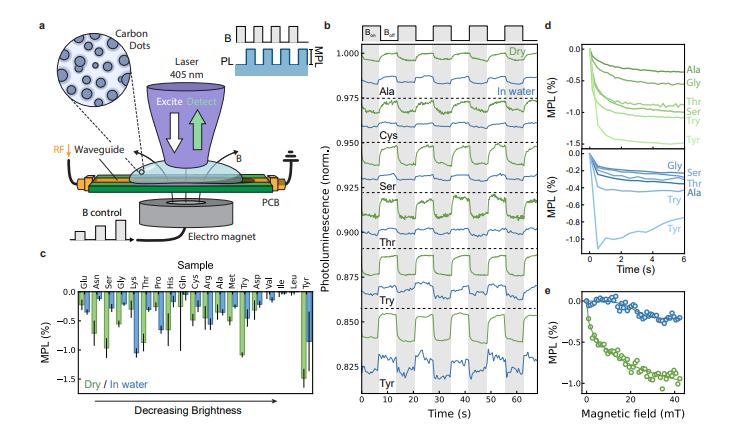
Detailed characterization reveals that several samples exhibit crystalline cores, similar to graphene, alongside surface functional groups that stabilize the particles. For example, quantum dots derived from glycine display crystalline cores approximately 20 nanometers in size, while those derived from tyrosine are smaller and more amorphous. The research team synthesized a series of 19 different quantum dots, each derived from a unique amino acid, and observed a clear effect where the emitted light changes in response to a magnetic field in up to 16 of these samples, with changes in luminescence reaching as high as 15 percent. This effect had previously been difficult to achieve at room temperature. Experiments revealed that the magnitude of the luminescence change varied significantly between the different amino acid-derived quantum dots, both in dry form and suspended in water.
Detailed analysis showed that quantum dots derived from glycine exhibited a substantial modulation of emitted light when exposed to an applied magnetic field. Further investigation using electron spin resonance detected a signal suggesting that a mechanism involving interacting electron spins is responsible for the observed effect. The presence of paramagnetic species decreases the luminescence change, indicating increased magnetic noise and interference with the signal. High-resolution analysis of the surface chemistry confirmed the formation of oxygen and nitrogen-containing groups, and fingerprinting demonstrated the reproducibility of the synthesis process. Detailed investigation confirms that interacting electronic spins within the quantum dots are responsible for this behavior, likely through a mechanism involving interacting electron pairs. The team further demonstrated the potential of these quantum dots as sensors by showing that the magnetic modulation of luminescence decreases in the presence of paramagnetic species, indicating a sensitivity to their surrounding environment. This opens possibilities for applications beyond conventional luminescence, offering an alternative to established spin-based sensors like diamond nanoparticles, with the advantage of scalable synthesis and biocompatibility. While the observed luminescence changes are currently modest, the researchers suggest that materials engineering and advanced excitation techniques could improve sensitivity. Future research directions include utilizing this effect as a readout modality in intracellular experiments, potentially for sensing bio-available iron or for background-subtracted imaging, complementing existing luminescence-based sensing methods.
🗞 Spin-dependent photoluminescence in carbon-based quantum dots
🧠 ArXiv: https://arxiv.org/abs/2510.24062