Quantum key distribution promises secure communication, but its real-world implementation faces ongoing challenges, particularly from potential attacks targeting the system’s hardware. Binwu Gao, Junxuan Liu, and colleagues from the National University of Defense Technology, alongside Ekaterina Borisova from the Russian Quantum Center and Hao Tan et al. from China Telecom Quantum Information Technology Group, now demonstrate a previously unrecognised vulnerability in a critical component, the dense wavelength-division multiplexer. Their research reveals that these devices, essential for combining signals in a quantum system, exhibit measurable changes in their spectral characteristics when subjected to laser attacks. This discovery establishes a new spectral side channel, which the team’s theoretical analysis shows can significantly reduce the secure transmission distance of a quantum key distribution system, potentially compromising its security and highlighting the need for robust hardware protection.
Their research reveals that these devices, essential for combining signals in a quantum system, exhibit measurable changes in their spectral characteristics when subjected to laser attacks.
This discovery establishes a new spectral side channel, which the team’s theoretical analysis shows can significantly reduce the secure transmission distance of a quantum key distribution system, potentially compromising its security and highlighting the need for robust hardware protection. Current research focuses intensely on mitigating these vulnerabilities, as a wide range of attacks can exploit imperfections in hardware and software, including Trojan-horse attacks, laser-seeding attacks, and bright light attacks. Detectors are a major weak point, and rigorous testing and certification are essential to ensure security. Spectrum analysis proves a powerful tool for detecting and characterizing attacks, particularly in long-distance Twin-Field QKD systems.
DWDM Vulnerability to Laser Injection Attacks
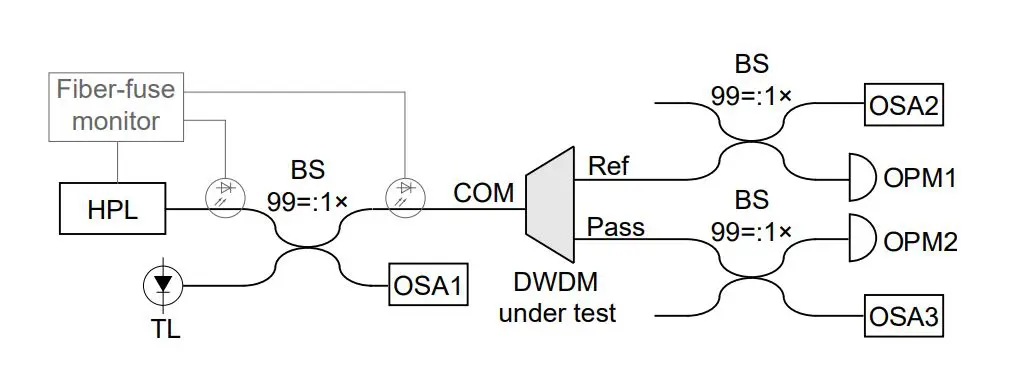
This study investigates the vulnerability of dense wavelength-division multiplexers (DWDMs), critical components in quantum key distribution (QKD) systems, to laser-injection attacks, a significant threat to practical security. Researchers engineered a detailed experimental setup to systematically examine how high-power laser illumination affects the spectral characteristics of DWDMs. The core of the method involves injecting a high-power laser into the common port of the DWDM, simulating an eavesdropper attempting to intercept quantum signals. The experimental setup features a high-power laser connected to the DWDM’s common port via a beam splitter, directing the majority of light towards the device while a small portion is diverted for spectral analysis.
Three optical spectrum analyzers monitor the spectral characteristics at various points, and optical power meters measure the power levels at the reflect and pass ports, providing quantitative data. Researchers verified the stability of the high-power laser and confirmed that other equipment exhibited no significant changes under high-power illumination, isolating the DWDM as the sole variable. The study tested six DWDM samples, each with central wavelengths of 1550. 32nm, providing a comprehensive assessment of DWDM vulnerability.
DWDM Spectral Shifts Under Laser Attack
Scientists have conducted a detailed investigation into the behavior of dense wavelength-division multiplexers (DWDMs) under laser-injection attacks, a critical concern for the practical security of quantum key distribution (QKD) systems. The work reveals that certain DWDM samples exhibit significant changes in their spectral features when subjected to high-power laser illumination exceeding a specific threshold. Experiments demonstrate that the wavelength of the injected laser can shift after passing through the DWDM, resulting in the appearance of additional spectral peaks at the output, providing a potential avenue for an eavesdropper to exploit vulnerabilities. Through theoretical analysis, scientists demonstrate that this spectral side channel can reduce the maximum secure transmission distance to below 66. 9% of its original value. Scientists systematically investigated how these components respond to high-power laser illumination, revealing that certain DWDMs exhibit significant changes in their spectral characteristics when exposed to sufficient light, creating a spectral side channel that compromises the security of the system. The findings highlight a critical security risk stemming from the first optical component exposed to external light in a typical system. The authors acknowledge that isolators, commonly used to protect systems, can themselves be vulnerable to attack, suggesting a layered approach with multiple isolators as a potential countermeasure. Future research will focus on understanding the underlying mechanism responsible for the observed spectral phenomena in DWDMs under laser attack, potentially leading to even more robust designs. This work provides valuable guidance for the development of more secure quantum communication systems and underscores the importance of considering component-level security.
👉 More information
🗞 Spectral side channels in quantum key distribution under laser damage
🧠 ArXiv: https://arxiv.org/abs/2512.11701