Selective control over the emission of valley-polarized excitons is critical for advancing valleytronics and optoelectronics. While directional routing of photoluminescence has seen progress, linking these effects to the degree of valley polarization and distinguishing true valley-dependent routing from spin-momentum coupling remains challenging. Here, Tobias Bucher, Jingshi Yan, Jan Sperrhake, and colleagues experimentally and numerically demonstrate a direct relationship between the intrinsic valley polarization of monolayer tungsten diselenide emitters and their far-field emission pattern. By utilizing gold nanobar antennas, they achieve valley-selective manipulation of emission, observing a 6% valley-selective circular dichroism in photoluminescence. Supported by a novel reciprocity-based numerical approach, this work reveals symmetry-protected, enhanced directional effects, establishing a robust platform for future valleytronic processing.
Nanobars Enhance Valley Polarization in WSe2
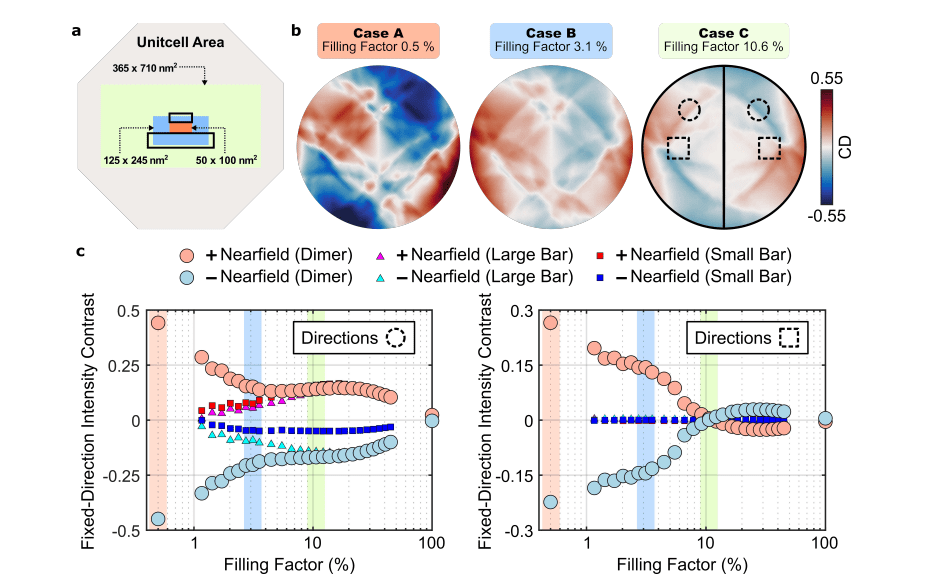
This research details how carefully designed plasmonic nanostructures, specifically nanobar dimers, enhance valleytronics in monolayer tungsten diselenide. Scientists demonstrate that these nanostructures improve the directional control of light emission linked to the valley degree of freedom of excitons, boosting the signal from valley-selective emitters. The nanobars exhibit extrinsic chirality, crucial for achieving directional emission, as their chiral properties arise from interaction with the substrate and incident light, rather than inherent material properties. Detailed analysis of emitted light at different angles reveals a robust asymmetry linked to this extrinsic chirality, confirming precise control over emission direction. Simulations and measurements show that the nanostructures influence the polarization state of emitted light, with optimal performance at smaller scales.
Nanoantennas Enhance Valleytronic Monolayer Interaction
Scientists engineered a novel platform for valleytronic processing by fabricating hybrid structures consisting of monolayer tungsten diselenide placed on arrays of gold nanoantennas. These nanoantennas, meticulously crafted using electron-beam lithography, feature parallel nanobars of differing sizes arranged in a square lattice. Researchers precisely controlled the resonance wavelengths by varying nanobar lengths, enabling systematic investigation of their optical properties. Using cathodoluminescence imaging, scientists investigated the optical nearfield response, revealing distinct emission profiles for each nanobar, with smaller nanobars exhibiting a dipole mode and larger nanobars displaying a linear quadrupolar mode. This configuration enables directional scattering dependent on the spin-orientation of rotating dipoles, realized through valley-selective excitonic emitters in the monolayer tungsten diselenide, and demonstrates a clear relationship between circular polarization and the direction of scattered light.
Valley Polarization Controls Emission Directionality
Scientists have directly linked the intrinsic valley polarization of excitons to the far-field emission pattern in monolayer tungsten diselenide, enabling precise assessment of valley-selective emission routing. This work demonstrates valley-selective manipulation of the angular emission pattern using gold nanobar dimer antennas at cryogenic temperatures, revealing a 6% valley-selective circular dichroism in photoluminescence. The team employed a novel numerical approach, based on the principle of reciprocity, to model valley-selective emission in periodic systems, confirming the experimental findings. Measurements conducted at extremely low temperatures revealed a pronounced degree of circular polarization in the photoluminescence signal, a result of suppressing intervalley scattering, and quantified the valley-dependence of the emission patterns, confirming that the nanoantenna array mediates valley-momentum coupling.
Valley Polarization Controls Light Emission Patterns
This research demonstrates a direct link between the intrinsic valley polarization of excitons in monolayer tungsten diselenide and the resulting far-field emission patterns, establishing a crucial step towards realizing practical valleytronic devices. By integrating this material with precisely fabricated gold nanoantenna dimer arrays, scientists achieved valley-selective manipulation of light emission at cryogenic temperatures, observing a circular dichroism in photoluminescence reaching 6%. This antisymmetric angular emission pattern arises from the nanoantennas’ ability to couple to valley-polarized excitons, effectively routing light emission based on the valley index of the excitons themselves. A novel numerical approach, grounded in the principle of reciprocity, supports these experimental findings and accurately models valley-selective emission within periodic nanostructures, offering robustness against variations in emitter distribution and emission angle.
👉 More information
🗞 Valley-dependent emission patterns enabled by plasmonic nanoantennas
🧠 ArXiv: https://arxiv.org/abs/2509.21023