The accurate modelling of anharmonic oscillators presents a significant challenge in physics, as these systems more realistically represent oscillatory phenomena than their simpler, harmonic counterparts, yet demand exponentially increasing computational resources. Saurav Suman from the National Institute of Technology Jamshedpur, Bikash K. Behera from Bikash’s Quantum (OPC) Private Limited, and Vivek Vyas from the Indian Institute of Information Technology Vadodara, alongside Prasanta k. Panigrahi from the Indian Institute of Science Education and Research Kolkata, demonstrate a novel approach to simulating these complex systems using quantum computation. The team successfully models an anharmonic oscillator with a three-qubit system on IBM’s platform, capturing crucial behaviours such as state revival, and extends this framework for scalability. Furthermore, they achieve highly accurate energy estimations using a Variational Eigensolver combined with variational Deflation, surpassing the precision of established classical methods like perturbation theory and the Wentzel-Kramers-Brillouin approximation, and establishing a powerful new tool for investigating complex systems with implications for chemistry and materials science.
Three Qubit Simulation of Quantum Anharmonicity
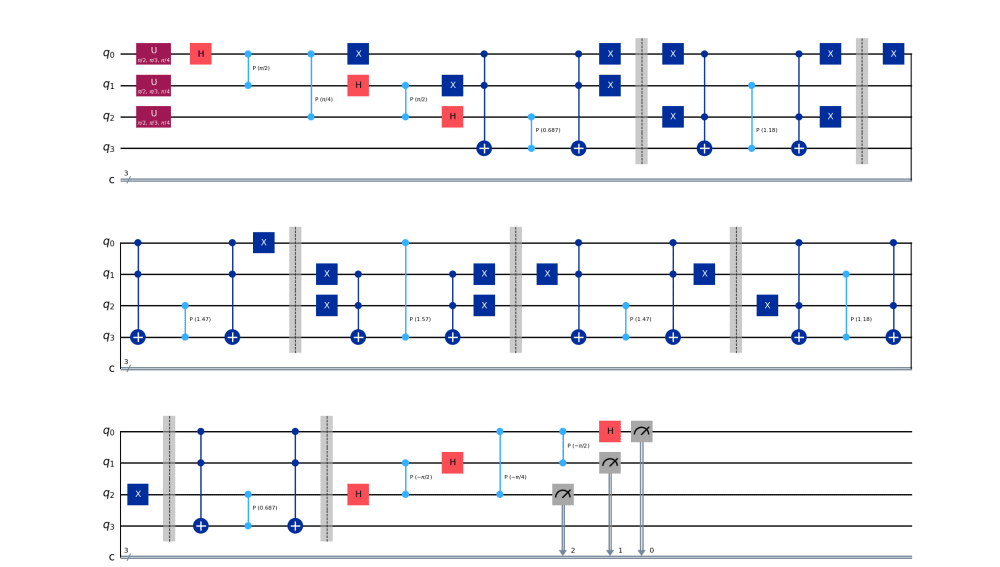
This research details the modeling of a quantum anharmonic oscillator using a 3-qubit system on IBM’s quantum computing platform. The study focuses on simulating the time evolution of the quantum particle and comparing the results with theoretical calculations. Anharmonic oscillators are crucial for understanding many physical phenomena, but their complexity makes accurate simulation difficult. The study demonstrates a method for modeling such systems on a quantum computer, potentially paving the way for more complex simulations. The continuous quantum anharmonic oscillator was discretized to make it suitable for representation on a quantum computer, and a quantum circuit implemented the time evolution operator of the anharmonic potential.
The simulation results were compared with calculations obtained using exact diagonalization, perturbation theory, and the WKB approximation. The simulation successfully captured the time-dependent oscillations in probability amplitudes, demonstrating the ability to model the dynamic behaviour of the anharmonic oscillator. VQE performed reasonably well against perturbation theory and the WKB approximation, but some discrepancies were observed at higher energy levels. The research identifies potential scalability challenges for VQE when applied to more complex systems, and identifies areas for future research, such as optimizing the variational ansatz and improving classical optimization strategies to enhance accuracy and scalability.
Anharmonic Oscillator Simulation with Three Qubits
Scientists have achieved a highly accurate quantum simulation of the anharmonic oscillator, a system crucial for modeling realistic physical phenomena, using a 3-qubit system implemented on IBM’s quantum platform. Researchers designed a filter-based quantum circuit to track the time evolution of the quantum anharmonic oscillator, successfully capturing key effects like quantum revivals. This hybrid quantum-classical approach yielded remarkably precise results, achieving an error of only 1.
11% when compared to exact diagonalization methods. Notably, the VQE-based energy estimation significantly outperformed classical approximations, demonstrating a 6. 71% error for perturbation theory and a 5. 36% error for the Wentzel-Kramers-Brillouin (WKB) approximation. These results confirm the potential of quantum simulation and VQE as powerful tools for investigating complex quantum systems, paving the way for future applications in quantum chemistry and materials science.
Quantum Anharmonic Oscillator Simulation with Three Qubits
Scientists have successfully modeled a discretized quantum anharmonic oscillator using a three-qubit system implemented on a quantum computing platform. This work demonstrates a method for simulating the time evolution of a quantum particle subject to an anharmonic potential, revealing complex oscillations in probability amplitudes that characterize these nonlinear systems. The developed quantum circuit framework offers a scalable approach to implementing the relevant unitary evolution operator, with potential for extension to higher-dimensional systems through parallel processing. Results indicate that VQE achieves high accuracy, with a mean absolute percentage error of only 1.
11% when compared to exact diagonalization, and outperforms both perturbation theory and the WKB approximation. While VQE slightly overestimates energy values, particularly at higher states, the method demonstrates strong correlation and reliability across the tested energy levels. This work establishes a promising foundation for investigating complex quantum systems and has implications for advancements in fields such as chemistry and materials science.
👉 More information
🗞 Quantum Simulation and Energy Estimation for Discretized Anharmonic oscillator
🧠 ArXiv: https://arxiv.org/abs/2509.20907