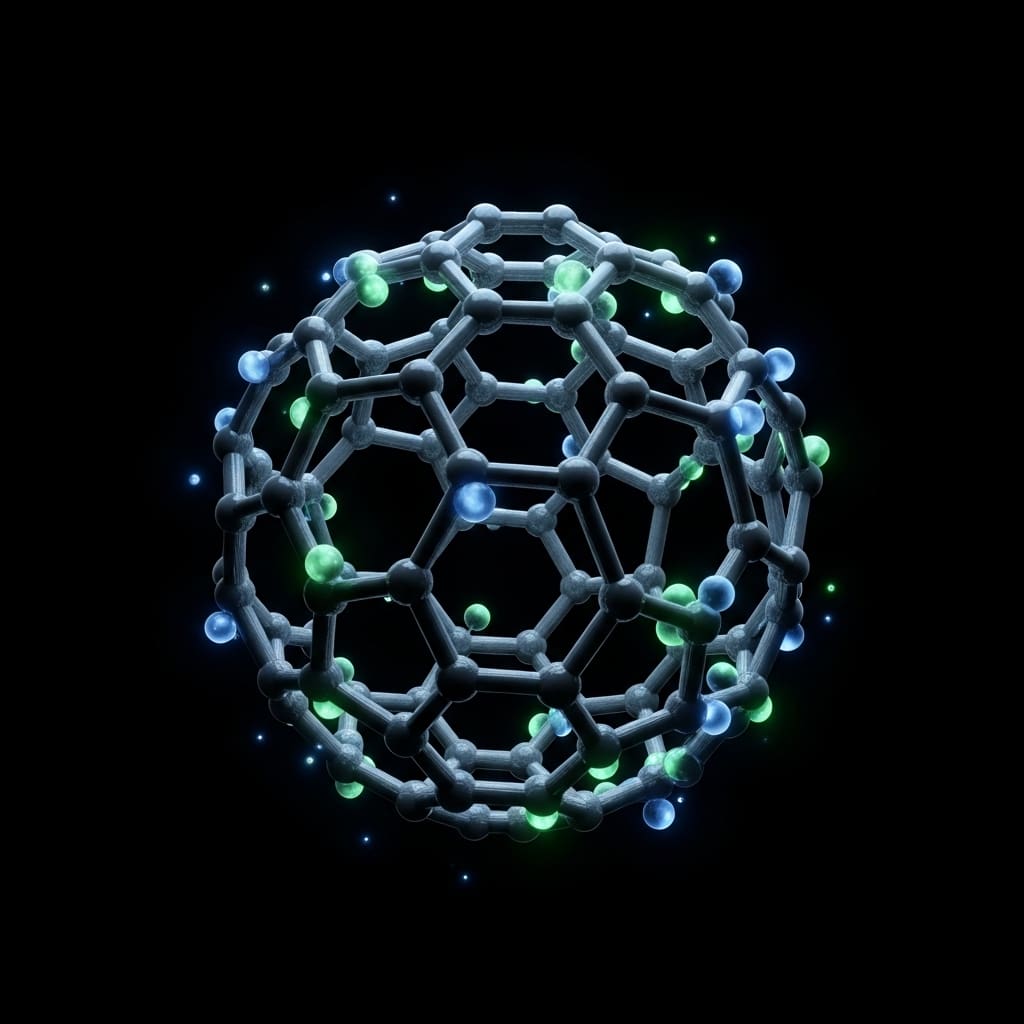
Scientists investigate the photoluminescent properties of fullerite C₆₀ following chemical interaction with hydrogen and nitrogen molecules, a process with implications for materials science and nanotechnology. Victor Zoryansky, Peter Zinoviev, and Yuri Semerenko, all from the B. Verkin Institute for Low Temperature Physics and Engineering of the National Academy of Sciences of Ukraine, detail the spectral-luminescent registration of fullerite saturated with these gases at low temperatures. Their research demonstrates, for the first time, the photoluminescence of weakly saturated fulleranes C₆₀Hₓ and identifies the presence of azafullerene dimers within nitrogen-saturated fullerite, offering new insights into the formation of these novel compounds and refining our understanding of the transition from physisorption to chemisorption in fullerene systems.
This work demonstrates the creation and characterisation of novel fullerene derivatives exhibiting unique photoluminescent properties at extremely low temperatures, specifically, 20 Kelvin.
Previously established research indicated a transition point, termed the adsorption crossover, where fullerite shifts from simply absorbing gases into its structure to chemically interacting with them at around 250°C for hydrogen and 420°C for nitrogen under a pressure of 30 atmospheres. Building on these findings, researchers have now directly observed the photoluminescent radiation emitted by these newly formed compounds, revealing details about their composition and structure.
The study focused on achieving chemical interaction between fullerite and the gases, exceeding the adsorption crossover temperatures to facilitate the formation of new substances. Through careful control of temperature and pressure, researchers were able to induce these reactions.
Fullerite saturation and low-temperature photoluminescence analysis techniques
Spectral-luminescent registration in counting mode underpinned this work, employing low temperatures of 20 K to analyse single crystals of C60 saturated with both molecular hydrogen and nitrogen. Prior investigations established the adsorption crossover temperature, the point where intercalation shifts from physisorption to chemisorption, at approximately 250°C for hydrogen and 420°C for nitrogen within fullerite C60.
Consequently, saturation procedures were meticulously controlled at 300°C for hydrogen and 450°C for nitrogen, maintained under a consistent pressure of 30 atmospheres. This precise temperature control was crucial to promote chemical interaction between the impurity molecules and the fullerite matrix, facilitating the formation of novel compounds.
To generate weakly saturated fulleranes, C60HX, hydrogen gas was introduced near the established sorption crossover temperature, allowing for controlled intercalation. The resulting low-temperature photoluminescence was then identified, representing the first such detection for these materials. Analysis focused on the “blue” shift observed at the beginning of the emitted spectrum, enabling a more accurate classification of the generated fullerane material within the fullerane series.
This spectral shift provides insight into the electronic structure and degree of hydrogenation. Furthermore, the study detected radiation from azafullerene dimers, also known as biazafullerene (C59N)2, within the reaction products of C60 and nitrogen. For polycrystalline samples saturated with nitrogen, the characteristic luminescence of biazafullerene, peaking at 1.53 eV, was found to dominate the short-wave portion of the emission spectrum. This dominance suggests a strong correlation between nitrogen saturation and the formation of this specific dimer, influencing the overall photoluminescent properties of the synthesized complex.
Low-temperature photoluminescence characterisation of hydrogen and nitrogen saturated fullerites
At a low temperature of 20 K, studies of fullerite C60 saturated with hydrogen and nitrogen revealed distinct photoluminescent radiation from newly formed substances. The adsorption crossover temperature, marking the shift from physisorption to chemisorption, was determined to be approximately 250°C for hydrogen and 420°C for nitrogen at a pressure of 30 atm.
Saturation was performed at 300°C for hydrogen and 450°C for nitrogen, facilitating chemical interaction between the impurity molecules and the fullerite matrix. Analysis of weakly saturated fulleranes C60HX, created via gas-phase hydrogen saturation near the sorption crossover temperature, identified their low-temperature photoluminescence for the first time.
A “blue” shift observed at the beginning of the emission spectrum allowed for precise classification of the material within the initial segment of the fullerane series. This spectral shift indicates a change in the electronic structure of the fullerane, providing insight into the degree of hydrogen saturation.
Spectroscopic data also confirmed the presence of azafullerene dimer (C59N)2 within the reaction products of C60 and nitrogen. For polycrystalline samples saturated with nitrogen, luminescence from the biazafullerene, peaking at 1.53 eV, dominated the short-wave portion of the emission spectrum. This strong emission at 1.53 eV serves as a clear signature of biazafullerene formation and its influence on the overall photoluminescence of the nitrogen-saturated fullerite. The intensity and shape of the short-wave emission were entirely determined by this characteristic luminescence.
The Bigger Picture
Scientists have long sought to manipulate the properties of fullerenes, those intriguing “buckyball” molecules, by trapping atoms or molecules within their cage-like structures. This work represents a subtle but significant advance in that endeavour, demonstrating the creation and characterisation of novel fullerene-based compounds saturated with both hydrogen and nitrogen.
The challenge has always been to move beyond simply embedding these gases and instead induce genuine chemical interaction, forming new materials with predictable and useful properties. Previous attempts revealed a clear temperature threshold beyond which these interactions occurred, but controlling the process to create specific compounds remained elusive.
The ability to reliably produce and analyse these weakly saturated fulleranes and azafullerene dimers opens up possibilities beyond fundamental materials science. While the immediate applications aren’t yet clear, the precise control over fullerene saturation demonstrated here could eventually inform the development of new sensors, catalysts, or even components for advanced optical devices.
The identification of luminescence shifts provides a crucial diagnostic tool for verifying the composition and structure of these complex materials. However, it’s important to acknowledge that this research focuses on single crystals under very specific, low-temperature conditions. Scaling up production and maintaining stability at ambient temperatures represent significant hurdles.
Furthermore, the precise nature of the chemical bonding within these fulleranes and dimers requires further investigation. Future work will likely centre on exploring a wider range of saturating gases and refining the control over saturation parameters to tailor the resulting material’s properties. The broader field may see a convergence of these “bottom-up” fullerene modification techniques with “top-down” approaches like functionalisation, creating even more complex and potentially transformative materials.
👉 More information
🗞 Photoluminescent registration of fullerite C_{60}_{60} derivatives during chemical interaction with H_{2}_{2} and N_{2}_{2} molecules
🧠 ArXiv: https://arxiv.org/abs/2602.10135