

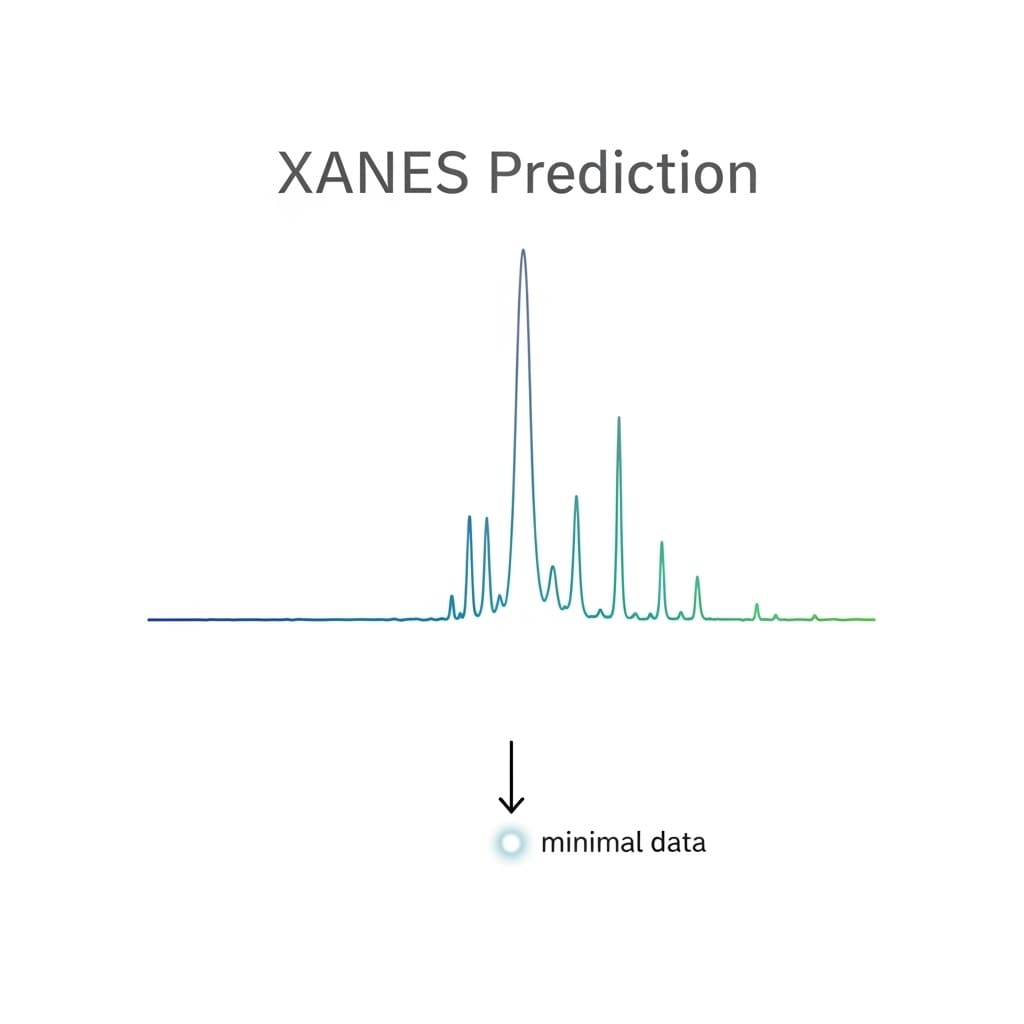
Understanding the atomic and electronic structure of materials relies heavily on analysing X-ray absorption near-edge structure, or XANES, but accurately simulating these spectra is often slow and computationally demanding, particularly when studying dynamic processes. Zichang Lin, Wenjie Chen, and Yitao Lin, from Tsinghua University, and their colleagues have developed a new approach that overcomes these limitations by employing artificial intelligence. The team constructed a crystal graph neural network, initially trained on extensive simulated data for 48 different elements, to predict XANES spectra with remarkable accuracy. Crucially, they then refined this model using a small set of experimental data through a transfer learning strategy, significantly improving its ability to match real-world observations and reducing errors in predicting key spectral features by around 55% for elements like sulphur, titanium, and iron, paving the way for rapid and reliable materials analysis.
It is usually too complex to give the needed accuracy and timeliness when a large amount of data needs to be analysed, such as for in-situ characterisation of battery materials. To address these problems, artificial intelligence (AI) models have been developed for XANES prediction. However, existing models are trained using simulated data, resulting in significant discrepancies between the predicted and experimental spectra, and their universality across different elements has not been well studied.
XAS Characterization of Minerals and Materials
Research focuses heavily on X-ray absorption spectroscopy (XAS) and its applications in characterizing the local structure and electronic properties of diverse materials, including minerals, catalysts, energy materials, and nanomaterials. Computational methods, such as Density Functional Theory, are used to model XAS spectra, determine local structure, and aid in materials discovery. Machine learning techniques, including t-SNE and PCA, are employed to analyse XAS data and extract meaningful information, often leveraging materials databases like the Materials Project and AFLOWLIB.
Crystal Graph Networks Predict XANES Spectra Accurately
Scientists have achieved a breakthrough in predicting X-ray absorption near-edge structure (XANES) spectra, a technique crucial for understanding the atomic and electronic structure of materials, by developing a crystal graph neural network model, named CGXAS. Training this model on a comprehensive dataset of 341,405 simulated XANES spectra, encompassing 48 different elements, resulted in a remarkably low average relative square error of 0.020223 in predicting XANES features. This universal model, CGXAS Uni, demonstrated superior accuracy and versatility compared to element-specific models. Experiments revealed the power of transfer learning to refine the model’s predictions using limited experimental data, addressing the common discrepancy between simulated and real-world spectra.
Calibrating CGXAS Uni with small datasets, containing just 48 spectra for sulfur, 40 for titanium, and 45 for iron, significantly reduced edge energy misalignment errors by approximately 55% for the K edge XANES of these elements. Measurements confirm that the resulting CGXAS Exp models accurately predict XANES features, bridging the gap between computationally efficient simulations and precise experimental observations. This delivers a new method for fast, universal, and experiment-calibrated XANES prediction, opening up possibilities for real-time analysis of materials, particularly in complex systems like battery materials, and enabling more efficient in-situ characterization.
AI Predicts XANES Spectra Across Elements
Scientists have developed a new approach to predicting X-ray absorption near-edge structure (XANES) spectra, which provide valuable insights into the atomic and electronic structure of materials. Recognizing the limitations of existing simulation methods in terms of both accuracy and speed when analysing large datasets, the team created an artificial intelligence model capable of universal XANES prediction across 48 different elements. This model, initially trained on simulated data, achieves a remarkably low error rate and demonstrates the potential for rapid analysis of complex materials. The research team further refined their model using transfer learning, calibrating it with a limited set of experimental XANES data, and significantly reduced discrepancies between predicted and experimental spectra for elements such as sulfur, titanium, and iron. This calibration process decreased errors in predicting key spectral features by approximately 55%, demonstrating the model’s ability to adapt to real-world data and improve predictive power. The success of this method stems from training the model on a diverse, universal dataset, allowing it to learn fundamental relationships between material structure and XANES spectra, regardless of the specific element being studied.
👉 More information
🗞 Universal and Experiment-calibrated Prediction of XANES through Crystal Graph Neural Network and Transfer Learning Strategy
🧠 ArXiv: https://arxiv.org/abs/2512.23449

