

Robust environmental perception presents a significant challenge for agricultural robots, often hampered by visual obstructions and sensor contamination, but researchers are now exploring radar as a resilient alternative. Ruibin Zhang and Fei Gao, both from Zhejiang University and the Huzhou Institute, lead a team that introduces a novel framework, Sem-RaDiff, for detailed 3D environmental understanding using radar data. This new approach overcomes limitations of existing methods by employing a diffusion model to filter noise and generate highly accurate 3D semantic point clouds, even in cluttered agricultural settings. The team demonstrates that Sem-RaDiff not only outperforms current techniques in structural and semantic prediction, but also substantially reduces computational demands and memory usage, paving the way for more reliable and efficient agricultural robotics. Importantly, the method successfully reconstructs and classifies delicate structures like poles and wires, which typically elude perception by other systems, signifying a major step forward in dense and accurate 3D radar perception.
Deep Learning Improves Sparse Radar Perception
Recent advancements in millimetre-wave radar perception are significantly improving the ability of autonomous systems to understand their surroundings. Researchers are increasingly focusing on deep learning techniques to overcome the inherent limitations of radar data, which tends to be sparse and noisy. These techniques enhance point cloud data, enabling more accurate object identification and scene understanding, crucial for applications like self-driving cars and robotics. Diffusion models are currently the dominant approach, proving highly effective at enhancing point cloud density, generating synthetic data for training, predicting free space for safe navigation, and improving the accuracy of object labelling.
Variations of these models are being explored, often guided by data from other sensors like LiDAR or cameras. Furthermore, transformer architectures are gaining prominence for their ability to capture long-range dependencies within point cloud data, allowing for a more comprehensive understanding of the scene. These advancements are particularly important for dealing with sparse radar data, where upsampling and denoising techniques are crucial. By combining these techniques, the goal is to create robust and reliable perception systems that can operate effectively in challenging conditions, paving the way for more advanced autonomous systems.
Radar Perception for Robust 3D Mapping
Researchers have developed a novel 3D environmental perception system using radar technology, designed to overcome the limitations of cameras and LiDAR in challenging agricultural settings. Recognizing that optical sensors are susceptible to degradation from dust and dirt, the team focused on radar’s ability to penetrate obstructions and provide reliable data acquisition. The system processes raw radar data through a series of modules that enhance signal quality and generate detailed 3D semantic point clouds, providing a comprehensive understanding of the environment. Initially, the system employs parallel frame accumulation, a technique that significantly improves the signal-to-noise ratio, enabling clearer target identification.
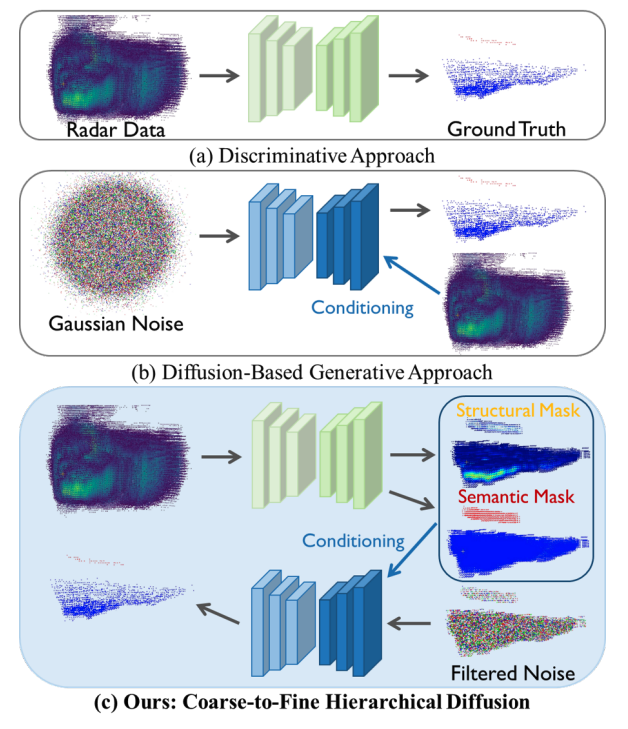
Subsequently, a diffusion model-based hierarchical learning framework filters out unwanted signals and generates fine-grained 3D semantic point clouds, creating a detailed map of the surroundings. Finally, a specifically designed sparse 3D network efficiently processes the large volumes of raw radar data, reducing computational and memory costs. Extensive testing in real agricultural fields demonstrates that this method achieves superior structural and semantic prediction performance compared to existing techniques. Notably, the system successfully reconstructs and accurately classifies thin structures like poles and wires, features that typically pose challenges for other perception systems, highlighting its potential for dense and accurate 3D radar perception in complex environments.
Radar Perception Overcomes Agricultural Sensor Limitations
Researchers have developed a novel radar-based 3D environmental perception system designed to overcome the limitations of cameras and LiDAR in challenging agricultural settings. The team addresses the critical issue of sensor contamination, where onboard sensors can be rendered ineffective by dirt or occlusion, by leveraging radar’s ability to penetrate obstructions. This new approach delivers dense and accurate semantic perception, crucial for the autonomous navigation of agricultural robots. The method incorporates three key modules working in concert to enhance radar data quality and interpretability.
First, a parallel frame accumulation technique improves the signal-to-noise ratio of raw radar data, extracting meaningful signals from noisy environments. Second, a diffusion model-based hierarchical learning framework filters out unwanted signals and generates fine-grained 3D semantic point clouds, creating detailed environmental maps. Finally, a specifically designed sparse 3D network efficiently processes the large-scale radar data, optimizing computational resources. Extensive testing in real agricultural fields demonstrates the superiority of this method compared to existing approaches. Results show the framework achieves improved structural and semantic prediction performance while simultaneously reducing computational costs and memory usage. Notably, the system successfully reconstructs and accurately classifies thin structures like poles and wires, which typically pose a significant challenge for other perception systems. This breakthrough highlights the potential of dense and accurate 3D radar perception for robust and reliable agricultural automation.
Sem-RaDiff Enables Robust Agricultural 3D Perception
Researchers have introduced Sem-RaDiff, a novel approach to 3D environmental perception using millimetre-wave radar, specifically designed for agricultural applications. The method addresses the challenges of noisy and large-scale radar data through a combination of techniques, including parallel data accumulation, a sparse neural network, and a framework integrating both discriminative and generative models. Experimental results, validated on a newly created dataset of real-world agricultural fields, demonstrate that Sem-RaDiff outperforms existing methods in both 3D structure reconstruction and semantic prediction, while also reducing computational demands. Notably, the system achieves accurate reconstruction and classification of thin structures, such as poles and wires, which pose difficulties for conventional sensors. The researchers acknowledge that further work is needed to optimise Sem-RaDiff for onboard deployment on agricultural robots, with plans to explore techniques like model pruning and quantization to improve efficiency. Future efforts will also focus on expanding the available radar dataset to include more diverse agricultural scenarios and annotations, fostering further research in this area and enabling the development of autonomous navigation systems for agricultural robots.
🗞 Sem-RaDiff: Diffusion-Based 3D Radar Semantic Perception in Cluttered Agricultural Environments
🧠 ArXiv: https://arxiv.org/abs/2509.02283


