

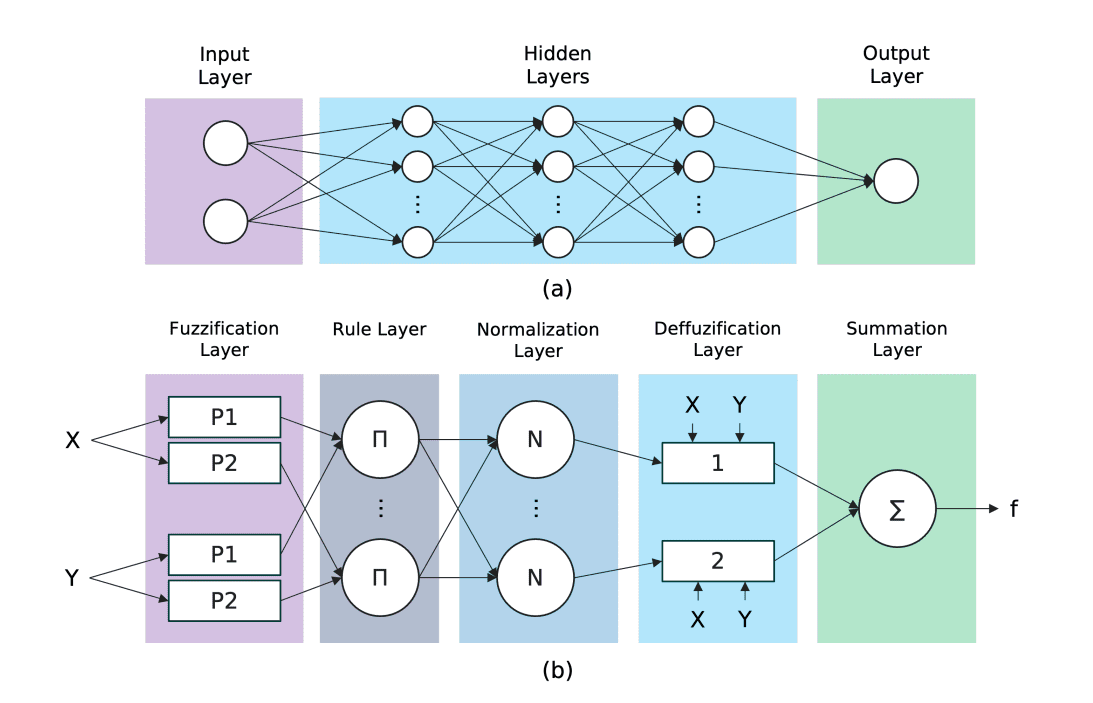
Predicting the probability distributions of quantum wavefunctions presents a significant challenge in computational and materials science, often requiring a compromise between predictive power and understanding. Pedro H. M. Zanineli, from the Brazilian Nanotechnology National Laboratory and Universidade Federal do ABC, alongside Matheus Zaia Monteiro, Vinicius Francisco Wasques, Francielle Santo Pedro Simões, and Gabriel R. Schleder, investigate the performance of both Artificial Neural Networks and Adaptive Neuro-Fuzzy Inference Systems in modelling these distributions for the hydrogen ion. Their research demonstrates that while neural networks achieve higher accuracy, they demand considerably more computational resources, whereas the fuzzy inference system offers a unique advantage through interpretability. By encoding spatial electron localisation and reflecting superposition principles within its fuzzy rules, this approach provides a novel, data-driven perspective on fundamental quantum mechanical concepts like orbital hybridisation and electron delocalisation, offering a pathway towards more transparent and insightful quantum simulations.
This robust dataset then served as the foundation for exploring the trade-offs between accuracy and interpretability in wavefunction prediction. The study demonstrates that while ANNs achieve superior predictive accuracy, ANFIS offers significant advantages in interpretability and computational efficiency.
To establish a rigorous comparison, the team trained both ANNs and ANFIS models on the same dataset. The ANNs, requiring 2,305 parameters, achieved a determination coefficient (R²) of 0. 99, while ANFIS models utilized between 39 and 45 parameters with an accuracy of 0. 95. Crucially, the researchers investigated the interpretability of each model, discovering that the Gaussian membership functions within the ANFIS framework encoded spatial electron localization near proton positions, directly mirroring Born probability densities.
The study further revealed that the fuzzy rules within ANFIS reflected the superposition principles governing quantum mechanics. Analysis of these rules demonstrated that those prioritizing the internuclear direction aligned with the system’s one-dimensional symmetry, offering a novel, data-driven perspective on orbital hybridization consistent with Linear Combination of Atomic Orbitals theory. Researchers quantified electron delocalization trends using the variances of the membership functions, and identified areas for improvement in predicting sharp features in the probability distributions. Experiments showed that ANFIS, employing either Gaussian or Generalized Bell membership functions, provided a parameter-efficient alternative to ANNs while still achieving substantial accuracy.
Results demonstrate that ANFIS with Gaussian membership functions achieved an R² of 0. 9831, showcasing its ability to approximate the wavefunction with fewer computational resources. The Generalized Bell membership function achieved an R² of 0. 9582, demonstrating its potential for accurate wavefunction modeling. This research demonstrates the successful application of both ANNs and ANFIS to model the probability distributions of the dihydrogen ion.
While ANNs achieved higher accuracy, ANFIS offered a compelling advantage in interpretability and parameter efficiency. Specifically, the Gaussian membership functions within ANFIS encoded spatial electron localization around proton positions, mirroring established Born probability densities and reflecting the underlying principles of superposition. The research reveals that ANFIS effectively captures the system’s one-dimensional symmetry through its fuzzy rules, offering a novel data-driven perspective on orbital hybridization, and quantifies electron delocalization trends via membership function variances. The team found that Gaussian and Generalized Bell functions outperformed Sigmoid functions, and that performance improved with increasing training data, demonstrating the scalability of the approach. Looking ahead, the team suggests extending ANFIS to multi-electron systems and integrating domain-specific constraints, such as kinetic energy terms, to further bridge the gap between data-driven models and fundamental physics. This work advocates for hybrid approaches in computational simulations, balancing the need for precision with the value of explainability to accelerate scientific discovery.
👉 More information
🗞 Fuzzy Neural Network Performance and Interpretability of Quantum Wavefunction Probability Predictions
🧠 ArXiv: https://arxiv.org/abs/2511.05261


