The pursuit of compact, high-performance lasers operating in the mid-infrared region drives innovation in fields ranging from environmental monitoring to medical diagnostics, and now, a team led by Alexandre Parriaux from the Université de Neuchâtel and Ina Heckelmann, Mathieu Bertrand, and Jérôme Faist from ETH Zurich reports a significant advance in laser stability. Researchers have developed a free-running ring quantum cascade laser exhibiting an exceptionally narrow linewidth, measuring just 50kHz, a sixfold improvement over existing lasers operating at wavelengths above 7 micrometres. This achievement, detailed by the team including Thomas Südmeyer, unlocks new potential for high-resolution spectroscopy and frequency modulation techniques, promising more sensitive and precise measurements in a range of scientific and industrial applications. The laser’s enhanced stability represents a crucial step towards realising more compact and versatile mid-infrared instruments.
Summary of the Research Paper: Free-running ring quantum cascade laser with 50kHz linewidth.
This study reports the development and characterization of a free-running ring quantum cascade laser (QCL) achieving an exceptionally low linewidth of 50 kHz. This performance marks a significant advancement for mid-infrared lasers, approaching the coherence of stabilized systems and enabling new possibilities for high-resolution spectroscopy, frequency modulation, and precision optical measurements.
Key highlights of the work include:
-
Ultra-Low Linewidth: The free-running ring QCL demonstrates a linewidth of 50 kHz, substantially narrower than typical free-running QCLs and comparable to stabilized lasers.
-
Ring Laser Design: The ring cavity design extends the effective cavity length, promoting narrower spectral emission and enhanced coherence.
-
Simplicity: Operating in a free-running configuration, the laser eliminates the need for external stabilization, reducing system complexity.
-
Potential Applications: The low-linewidth QCL is ideal for high-resolution spectroscopy, optical frequency combs, coherent sensing, and optical communications, where precise frequency control is critical.
By combining a ring cavity architecture with careful design and fabrication, this research demonstrates a simplified approach to achieving ultra-low linewidth mid-infrared lasers, opening new avenues for scientific and industrial applications requiring high spectral purity and coherence.
Low-Noise Mid-Infrared Laser Performance Demonstrated
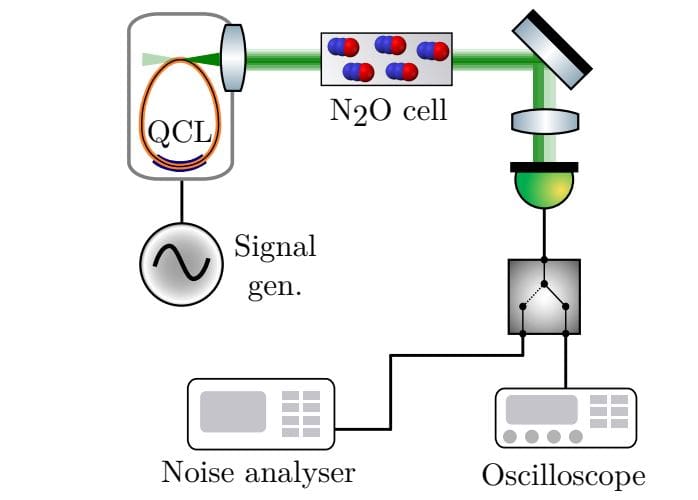
Scientists have achieved a significant breakthrough in mid-infrared laser technology, demonstrating a free-running ring quantum cascade laser resonator with remarkably low noise characteristics. The research team meticulously characterized the laser’s frequency noise, employing a gas cell filled with N₂O to convert frequency fluctuations into measurable voltage changes. Experiments revealed a full width at half maximum of only 50kHz at a 1-second integration time, representing at least a sixfold improvement over existing state-of-the-art quantum cascade lasers operating above 7μm. This substantial reduction in noise establishes a new performance benchmark for lasers in this spectral region., The team’s innovative approach involved utilizing frequency modulation spectroscopy on N₂O, not only to validate the laser’s potential for high-resolution spectroscopy but also to establish precise frequency calibration for accurate noise measurements.
By applying a 5V peak ramp to the laser driver, corresponding to a 35mA current modulation, researchers observed multiple absorption lines, enabling them to convert time-domain oscilloscope readings into an optical frequency axis. This meticulous calibration process ensured the accuracy of the subsequent noise characterization., Measurements confirm the laser’s suitability for demanding applications requiring narrow linewidths and low noise, such as high-resolution metrology and sensitive spectroscopic analysis. The demonstrated 50kHz linewidth at 1-second integration time signifies a substantial advancement, opening new possibilities for mid-infrared laser technology and paving the way for more precise and sensitive instruments in various scientific and industrial fields.
50kHz Linewidth Cascade Laser Demonstrated
This research demonstrates a significant advancement in the performance of quantum cascade lasers, specifically achieving a linewidth of approximately 50kHz at a one-second integration time. This represents at least a sixfold improvement over existing state-of-the-art cascade lasers operating in the mid-infrared spectral region above seven micrometers. The team characterized the noise properties of a ring quantum cascade laser resonator emitting a single frequency mode, establishing a new benchmark for low-noise laser operation., The improved laser performance opens new possibilities for high-resolution spectroscopy and frequency modulation applications in the mid-infrared, a region crucial for identifying molecular signatures. Researchers successfully demonstrated the laser’s utility in frequency modulation spectroscopy, highlighting its potential for sensitive detection and analysis.
While the current device exhibits limited output power due to its ring geometry, the authors acknowledge that integrating a passive waveguide could substantially increase power levels in future iterations., The authors note that the current work focused on free-running operation, and further research could explore radio-frequency injection to generate a quantum walk frequency comb. Additionally, future studies will investigate the noise characteristics of devices with increased output power. The data supporting these findings are openly available, facilitating further investigation and development within the scientific community.
👉 More information
🗞 Free-Running Ring Quantum Cascade Laser with 50 kHz Linewidth
🧠 ArXiv: https://arxiv.org/abs/2512.14433