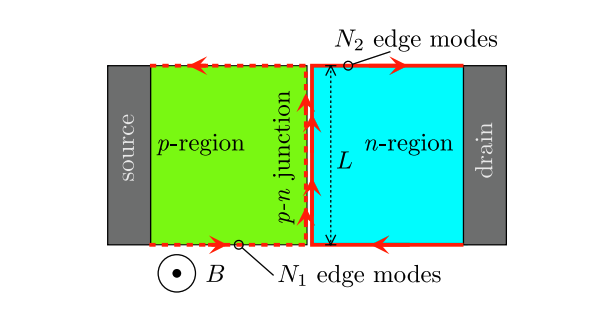
The flow of electrons in two-dimensional materials exhibits fascinating behaviour in the quantum Hall effect, where charge travels along chiral edge channels, effectively splitting into multiple pathways. C. W. J. Beenakker investigates how these channels distribute electric charge and, crucially, how imperfections affect this distribution, leading to measurable ‘partition noise’. This research demonstrates a surprising finding: that ‘pure dephasing’, a type of quantum decoherence previously thought to reduce noise, actually enhances it, increasing the power of the partition noise by up to 50% for two modes. This counterintuitive result, explained through the principles of monitored quantum transport, fundamentally alters our understanding of quantum electron flow and its sensitivity to environmental disturbances.
Partition noise arises when a flow of discrete particles splits into different paths, generating time-dependent current fluctuations, a form of shot noise. In quantum electronics, the wave nature of the electron modifies this effect through quantum interference between the different paths. The research investigates how this wave-particle interplay influences partition noise in quantum systems, demonstrating that partition noise can actually increase with the number of available paths, a counterintuitive finding. Specifically, the noise power increases by up to 50% for two modes, with a general enhancement factor of 1 + 1/N in the strong-dephasing limit, stemming from the self-averaging of quantum trajectories.
Weak Measurement Transfer Statistics Are Universal
Scientists have revealed that the statistics governing how quantum states are transferred through a series of weak measurements exhibit a surprising level of simplicity. Weak measurements, designed to minimally disturb a quantum system, allow researchers to probe its behavior repeatedly. This work demonstrates that, under specific conditions, the probability of successful transfer becomes independent of the strength of individual measurements and even the specific measurement outcomes, simplifying the analysis of complex quantum systems and providing deeper insight into the limits of predictability in quantum mechanics. The team calculated the second moment of the transfer probability, finding it becomes independent of measurement strength and specific outcomes when averaging over many measurements.
This simplification arises from the underlying mathematical properties of the measurement process, described using concepts from linear algebra and probability theory. Further analysis revealed that the distribution of probabilities converges to a log-normal distribution in the limit of many weak measurements, providing a powerful tool for understanding fluctuations in transfer probabilities. These findings have significant implications for the study of open quantum systems, which interact with their environment. Weak measurements offer a way to probe these systems without significantly disturbing them, allowing researchers to gain valuable insights into their dynamics. The universality of the transfer statistics simplifies the analysis of these systems and allows for more general predictions, providing a foundation for understanding the behavior of complex quantum systems.
Dephasing Surprisingly Enhances Partition Noise
Scientists have discovered a counterintuitive effect in quantum Hall systems, revealing that pure dephasing can actually increase partition noise, a measure of charge fluctuations. Typically, noise decreases with dephasing, but this work establishes that, under specific conditions, noise power can increase by up to 50% for two modes, with a general enhancement factor of 1+1/N in the strong-dephasing limit, arising from the self-averaging of quantum trajectories. The team calculated the variance of transfer probability, finding it decreases exponentially with system length and measurement strength, but this decrease is offset by the dephasing-induced increase in noise. Analysis of multi-mode systems reveals a relation between transport properties and ensemble-averaged phase-coherent transport, confirming that the noise power is equal to the phase coherent noise power plus the variance of the coherent conductance. Further calculations establish that for strong dephasing, the noise power and Fano factor follow specific formulas, predicting values that align well with numerical simulations. These results are particularly relevant to graphene p-n junctions, where experiments have shown noise levels below theoretical predictions, potentially due to inelastic scattering, but this work provides a framework for understanding the role of pure dephasing in these systems.
Dephasing Enhances Partition Noise in Channels
Researchers have demonstrated that, contrary to expectations, pure dephasing can actually increase partition noise in quantum Hall edge channels. This work investigates how charge partitioning behaves when electrons travel along these channels, revealing that while inelastic scattering typically reduces noise, a purely quantum effect, the loss of phase coherence without energy loss, can enhance it. Specifically, the team found that noise power increases by up to 50% for two modes, with a general enhancement factor of 1+1/N, where N represents the number of chiral modes. This counterintuitive finding stems from the self-averaging of quantum trajectories, offering a refined understanding of noise in these systems. The team predicts a phase coherent Fano factor between previously established semiclassical and strong dephasing limits for a specific experimental setup, highlighting the importance of considering pure dephasing effects when analyzing quantum transport. Previous theoretical studies suppressed both sample and time fluctuations, whereas this work demonstrates that pure dephasing primarily affects sample fluctuations, leaving time-dependent fluctuations, and thus noise, unaffected, and potentially amplified, providing a new perspective on decoherence processes and their impact on quantum transport phenomena in graphene-based p-n junctions.
🗞 Pure dephasing increases partition noise in the quantum Hall effect
🧠 ArXiv: https://arxiv.org/abs/2509.10242