

The fragility of quantum information represents a major obstacle to building practical quantum computers, as even slight disturbances can destroy the delicate quantum states used to store data. Shruti Shirol, Sean van Geldern, Hanzhe Xi, and Chen Wang, all from the University of Massachusetts-Amherst, now demonstrate a significant step towards overcoming this challenge by achieving error correction without the need for complex, active control. Their team preserves a quantum bit of information beyond the natural limit imposed by signal decay, extending its lifetime by approximately five percent, using a novel approach that relies on encoding information across multiple photons. This achievement showcases the potential of passive error correction strategies, offering a promising pathway towards more robust and scalable quantum technologies by reducing the demanding hardware requirements often associated with active methods.
Codes that encode information in multiple quantum states offer a pathway to preserve data beyond the limitations of individual quantum excitations, but typically demand precise control of the system. This work demonstrates a steady-state, driven quantum system, comprising a superconducting cavity and a transmon qubit, that preserves a logical qubit for a duration approximately 5% longer than the natural limit imposed by the lifetime of individual photons. This realisation of continuous quantum error correction at a critical operating point underscores the competitiveness of passive correction strategies while simplifying some of the demanding hardware requirements of active approaches.
Hybrid Circuit QED for Stabilized Qubits
The study pioneered a new approach to quantum error correction by building a steady-state, driven quantum system designed to preserve logical qubit information beyond the limitations of individual photon lifetimes. Researchers engineered a three-dimensional hybrid circuit QED architecture, fabricating a transmon qubit on a sapphire chip and coupling it to high- and low-quality resonators. This chip was meticulously constructed using established microfabrication techniques, creating a Josephson junction with precisely controlled aluminum and aluminum oxide layers to ensure optimal qubit performance. The fabrication process included smoothing surface irregularities to maximize the internal quality of the system’s resonators.
To establish the quantum system, the team employed a specialized package featuring a vertical cylindrical waveguide and a horizontal cylindrical tunnel for inserting the sapphire chip. The transmon qubit was capacitively coupled to both a storage resonator and a readout resonator, with a small, unintended coupling between the storage and readout modes. Fine-tuning of the coupling strength was achieved by carefully adjusting the pressure on the chip using a deformable material. The entire assembly was then mounted within a carefully shielded enclosure inside a dilution refrigerator, achieving high qubit and cavity coherence values.
Significant effort was dedicated to minimizing environmental noise, with the incorporation of filters and absorbing materials demonstrably improving qubit relaxation and reducing spurious excitation rates. Microwave control signals were generated using advanced mixing techniques, and the readout signal was amplified in two stages, first at low temperature and then at room temperature. The resulting readout fidelity reached 88%, sufficient for the quantum error correction experiment, though future improvements using a more sensitive amplifier are envisioned. Precise parameter choices, including frequency placements and coupling strengths, were critical to the success of the experiment.
Active and Passive Error Correction Compared
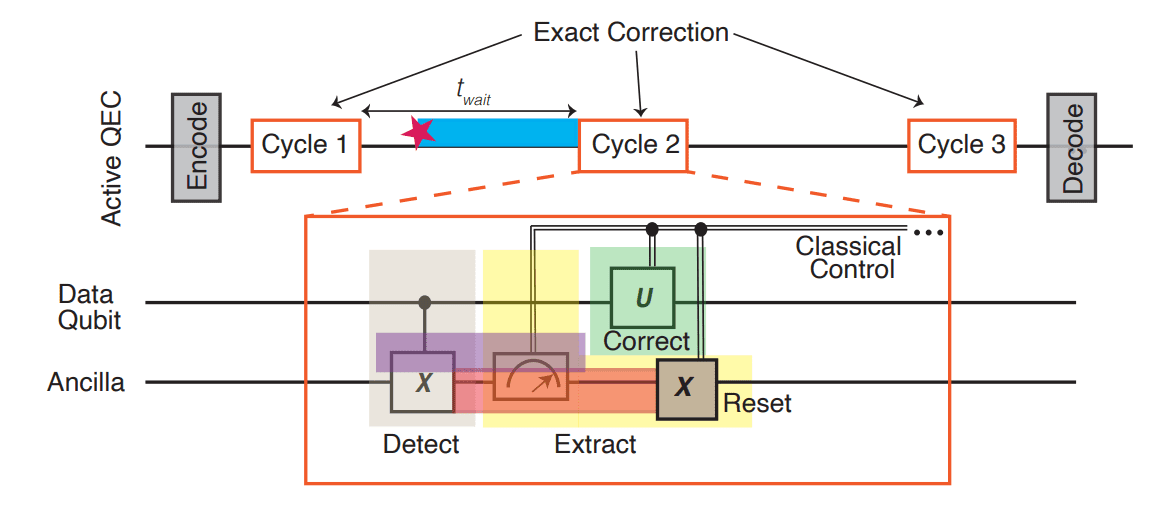
This research compares two distinct approaches to quantum error correction: active correction, which relies on discrete, cycle-based operations, and passive correction, which utilizes continuous dissipation. The analysis reveals that passive correction can offer advantages in certain scenarios, particularly when employing specific encoding schemes. The team investigated the impact of various error sources, including qubit decay, dephasing, and imperfect recovery operations, on the performance of each approach. The results suggest that for a particular encoding, the passive approach demonstrates superior performance, though the active scheme can achieve comparable results with optimized parameters, such as smaller encoding and reduced correction frequency.
Logical Qubit Lifetimes Exceed Fundamental Limit
This research demonstrates a significant advance in quantum memory technology, achieving logical qubit lifetimes that exceed the fundamental limit imposed by the lifetime of individual excitations. By employing a binomial encoding within a steadily driven superconducting system, the team preserved quantum information for a period approximately 5% longer than previously possible. This result highlights the potential of passive strategies for quantum error correction, offering a promising alternative to complex active control methods. The experiment successfully created a system where the logical qubit is protected under specific conditions, effectively extending the duration of coherent quantum storage.
While a complete thermodynamic description remains a challenge, this work represents the first demonstration of quantum information persisting beyond the excitation lifetime within a quasi-equilibrium environment. The team acknowledges the presence of a heating effect, the underlying mechanism of which requires further investigation to fully optimize continuous quantum error correction techniques. Future research directions include stabilizing the system’s quantum state through enhanced dissipation and incorporating logical gate operations, paving the way for more complex quantum computations.
👉 More information
🗞 Passive quantum error correction of photon loss at breakeven
🧠 ArXiv: https://arxiv.org/abs/2510.19794