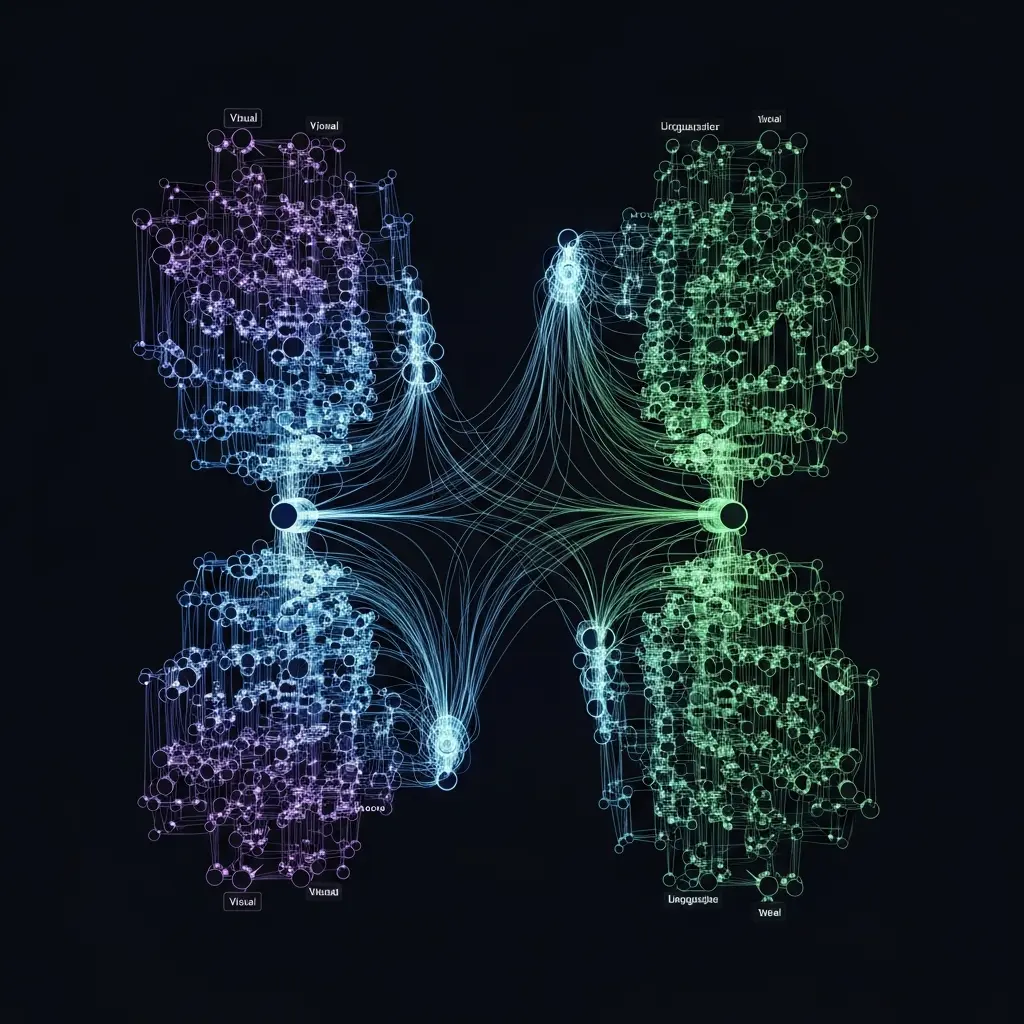
Vision-language models frequently struggle when confronted with concepts unseen during training, leading to a breakdown in accurate cross-modal alignment. Philip Xu, Isabel Wagner from the University of Basel, and Eerke Boiten from De Montfort University, present a new framework , Multi-Agent Cooperative Learning , designed to address this challenge. Their research introduces a system where four distinct agents, representing image, text, name, and coordination, work together to counteract imbalances between visual and linguistic information through structured communication. This collaborative approach, incorporating adaptive balancing and enhanced context exchange, demonstrably improves performance on the challenging VISTA-Beyond dataset, achieving precision gains of up to five percent and offering a significant step towards more robust and reliable vision-language understanding.
This approach focuses on enabling VLMs to move beyond closed-loop recognition towards open-world understanding, a critical step in advancing multimodal artificial intelligence. The study introduces a multi-agent feature space name learning framework, coupled with a context exchange-enhanced few-shot learning algorithm, and an adaptive dynamic balancing mechanism to facilitate improved performance. Evaluation on the VISTA-Beyond dataset demonstrates that MACL significantly improves performance in both few-shot and zero-shot settings, achieving precision gains of between 1% and 5% across a range of domains. These contributions represent a substantial advancement in the field of visual language understanding and multi-agent learning.
Addressing Out-of-Distribution Concept Alignment in VLMs
Out-of-Distribution Concept Alignment in VLMs
Recent advances in visual language models (VLMs) such as CLIP, BLIP and Dense-CLIP have demonstrated strong performance in zero-shot and few-shot learning through large-scale image-text pair pre-training. These models excel at recognising concepts present in their training data (Seen Concepts, SC) and form the basis of many cutting-edge VLMs. However, a significant challenge arises when deploying these models in real-world scenarios involving out-of-distribution concepts (OOD), those not encountered during pre-training. Research indicates a breakdown in cross-modal alignment is the primary obstacle when processing OOD concepts.
Systematic analysis reveals that while visual encoders effectively extract features for OOD concepts, resulting in distinct clustering in feature space, text encoders struggle to generate meaningful semantic representations for unfamiliar vocabulary. This disparity stems from the differing mechanisms of each encoder; visual encoders leverage pixel-level features with strong generalisation capabilities, whereas text encoders rely heavily on pre-trained vocabulary, creating blind spots for unseen words. Existing methods like prompt engineering, parameter-efficient fine-tuning, and full model adaptation prove limited in addressing OOD concepts due to their failure to account for dynamic inter-modal interaction and adaptive processing. These conventional approaches often treat visual and language processing as independent processes, failing to establish a flexible cross-modal connection and exacerbating the modal imbalance problem.
Leveraging Distributed Networks Like the Human Brain
Consequently, they underperform when confronted with entirely new concepts. The research draws inspiration from the human cognitive system, where distributed neural networks collaborate, with specialised regions focusing on specific functions like vision and language, integrating information through dense connections. To address these limitations, the researchers propose MACL (Multi-Agent Collaborative Learning), a system comprising four core agents. This collaborative framework aims to reconstruct VLMs as networks of specialised agents, each dedicated to specific tasks and possessing adaptive capabilities, potentially offering a more effective solution to OOD concept learning than traditional fine-tuning methods. The research introduces a system of four core agents, image, text, name, and coordination, that work together to mitigate imbalances between visual and linguistic data through structured message passing. This collaborative approach enables the creation of a multi-agent feature space and incorporates a context exchange enhanced algorithm for improved performance. Experiments conducted on the VISTA-Beyond dataset demonstrate that the MACL framework significantly enhances performance in both few-shot and zero-shot learning scenarios.
Quantifying Cross-Modal Alignment Improvements with New Framework
Results show precision gains ranging from 1 to 5 percent across a diverse set of visual domains, indicating a substantial improvement in the model’s ability to generalize to unseen concepts. The team measured cross-modal alignment breakdown in baseline models, revealing significant discrepancies for OOD concepts, while the MACL framework demonstrably restored alignment across all concepts tested. Detailed analysis of the feature space revealed that the baseline model exhibited dimensions with values of d=1.5, d=0.5, d=1.8, d=9.5, and d=3.9, indicative of misalignment. In contrast, the MACL framework achieved dimensions of d=0.5, d=0.3, d=0.8, d=0.5, and d=0.3, confirming a substantial reduction in feature space disparity and improved cross-modal alignment.
Visualizations further illustrate how the framework effectively bridges visual and semantic representations, particularly when encountering entirely novel concepts. The architecture of the MACL framework centers around four specialized agents, each with a unique function and memory state. The Image Agent focuses on visual processing, the Text Agent generates text representations, the Name Agent specializes in concept name learning, and the Coordinator Agent manages the collaborative process. Each agent, represented by the function Ai : Ii × Mi →Oi × M′ i, dynamically updates its memory state, allowing for distributed collaborative learning and overcoming the limitations of traditional single-model approaches. This approach addresses the issue of cross-modal alignment collapse by employing four distinct agents, image, text, name, and coordination, that work together through structured message passing. The framework incorporates a context exchange mechanism and an adaptive balancing system to optimise contributions from each agent, ultimately enhancing performance on out-of-distribution data. Experiments conducted on the VISTA-Beyond dataset demonstrate that MACL achieves consistent gains in both zero-shot and few-shot learning scenarios, with precision improvements ranging from one to five per cent across various visual domains.
Validating Components and Outlining Future Research Directions
Ablation studies confirm the importance of each agent and component within the framework, indicating that removing any single element leads to a reduction in overall performance. The authors acknowledge that the current work is limited to a specific dataset and task configuration, and future research could explore the generalizability of MACL to other multimodal learning problems. Further investigation into the optimal configuration of agents and the development of more sophisticated coordination strategies are also suggested as potential avenues for continued development.
🗞 Multi-Agent Cooperative Learning for Robust Vision-Language Alignment under OOD Concepts
🧠 ArXiv: https://arxiv.org/abs/2601.09746