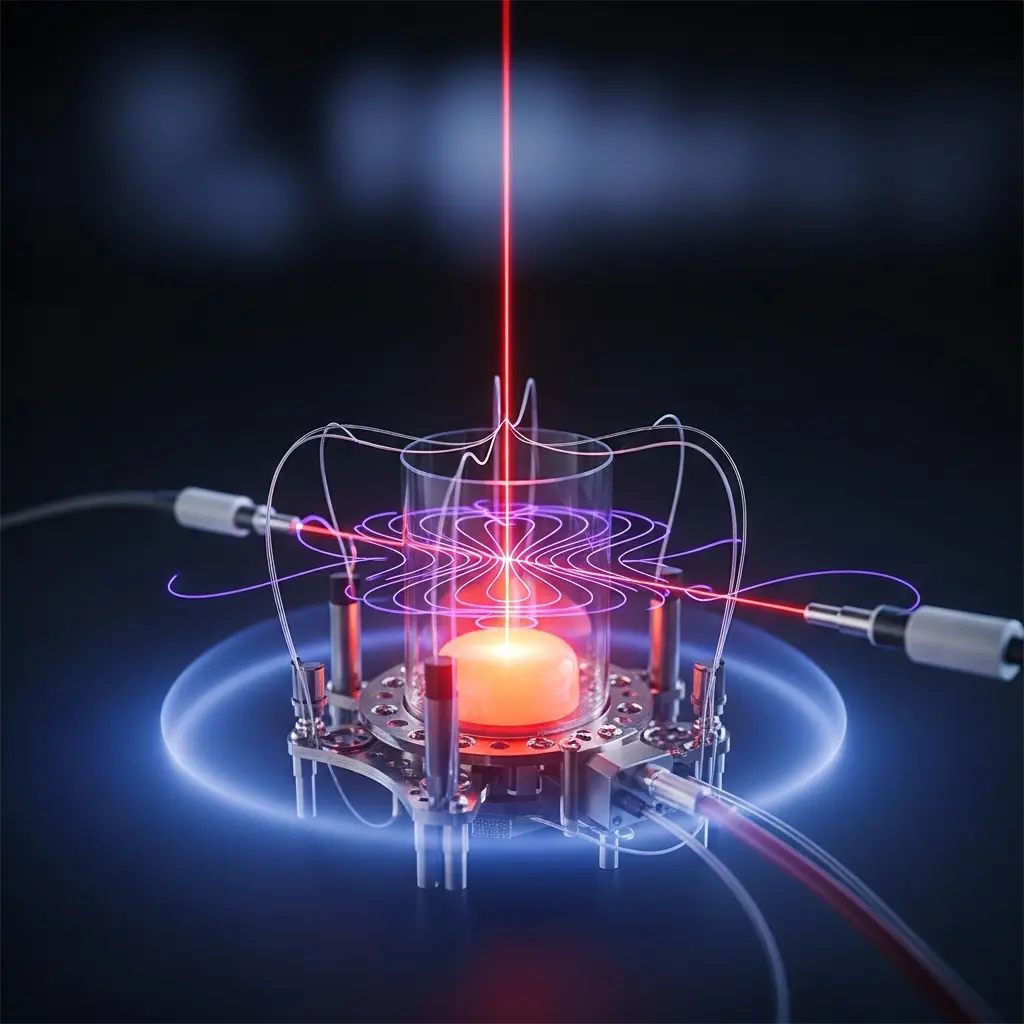
Detecting faint magnetic fields is crucial for applications ranging from medical imaging to materials science, and researchers continually seek more sensitive methods for doing so. Now, J. M. Wollenberg, F. Perona, and A. Palaci, alongside colleagues at various institutions, demonstrate a significant advance in this field with a technique called laser intracavity absorption magnetometry. This innovative approach builds upon established spectroscopy methods, employing a self-sustaining diode laser to dramatically amplify the signal from nitrogen-vacancy centres in diamond, effectively creating a highly sensitive magnetometer that operates without the need for extreme conditions. The team achieves a remarkable 475-fold enhancement in contrast and 180-fold improvement in magnetic sensitivity compared to traditional methods, paving the way for future devices capable of detecting incredibly weak magnetic fields and opening new possibilities for quantum sensing.
Laser Intracavity Sensing with Nitrogen-Vacancy Centres
Intracavity absorption spectroscopy, a technique for detecting weak absorption signals, has been extended to magnetometry using nitrogen-vacancy (NV) centres in diamond as the sensing element. This approach integrates the NV centre into a laser cavity, enhancing the absorption signal and improving magnetic field sensitivity, allowing detection of fields through changes in the NV centre’s optical properties. The team demonstrates a novel method for optical quantum sensing, achieving enhanced sensitivity for applications in materials science and biomedicine.
Laser intracavity absorption magnetometry (LICAM) is applicable to a wider range of optical quantum sensors, including optically pumped magnetometers. Researchers demonstrate highly sensitive magnetometers operating under ambient conditions using an electrically driven diode laser, achieving a 475-fold enhancement in optical contrast and a 180-fold improvement in magnetic sensitivity compared to conventional methods. These results align with a rate-equation model for single-mode diode lasers, confirming the theoretical basis of the observed enhancements. The system exhibits a projected shot-noise-limited sensitivity in the picotesla per root hertz range, with potential for further improvements through realistic device modifications.
Resonator-Enhanced Magnetometry with NV Centers
This research enhances the sensitivity of nitrogen-vacancy (NV) center-based magnetometry by integrating NV centers with optical micro-ring resonators. NV centers, point defects in diamond, are quantum sensors sensitive to magnetic fields, and their performance is improved by integrating them with resonators that enhance light-matter interaction. This amplification of the optical signal is crucial for improving the magnetometer’s sensitivity.
The on-chip integration of NV centers and micro-ring resonators creates a compact and efficient device with improved sensitivity and potential applications in biomagnetic field detection, materials science, and quantum information processing. The system utilizes diamond with NV centers and silicon nitride for the micro-ring resonator, employing a stabilized diode laser to excite the NV center and measure changes in fluorescence in response to magnetic fields.
Laser Intracavity Absorption Boosts Magnetometry Sensitivity
This research introduces laser intracavity absorption magnetometry (LICAM), a new approach that significantly enhances the sensitivity of nitrogen-vacancy (NV) centres in diamond. By integrating the NV centre detection scheme within a self-sustaining laser diode, the team achieves a substantial improvement in magnetic field detection, with a 475-fold increase in contrast and a 180-fold improvement in sensitivity. The experimental findings confirm that these enhancements result from intracavity absorption effects.
The current compact system, measuring under 3x 2x 2 cubic centimeters, has potential for further miniaturization through on-chip integration, potentially leading to millimeter-scale sensors. While current sensitivity is limited by external factors, projections suggest that sensitivities reaching the femtotesla range are attainable with improvements to device parameters and optimized control. The principles of LICAM are broadly applicable to a wide range of optically interactive quantum sensors, opening avenues for diverse sensing applications.
🗞 Laser intracavity absorption magnetometry for optical quantum sensing
🧠 ArXiv: https://arxiv.org/abs/2512.24951