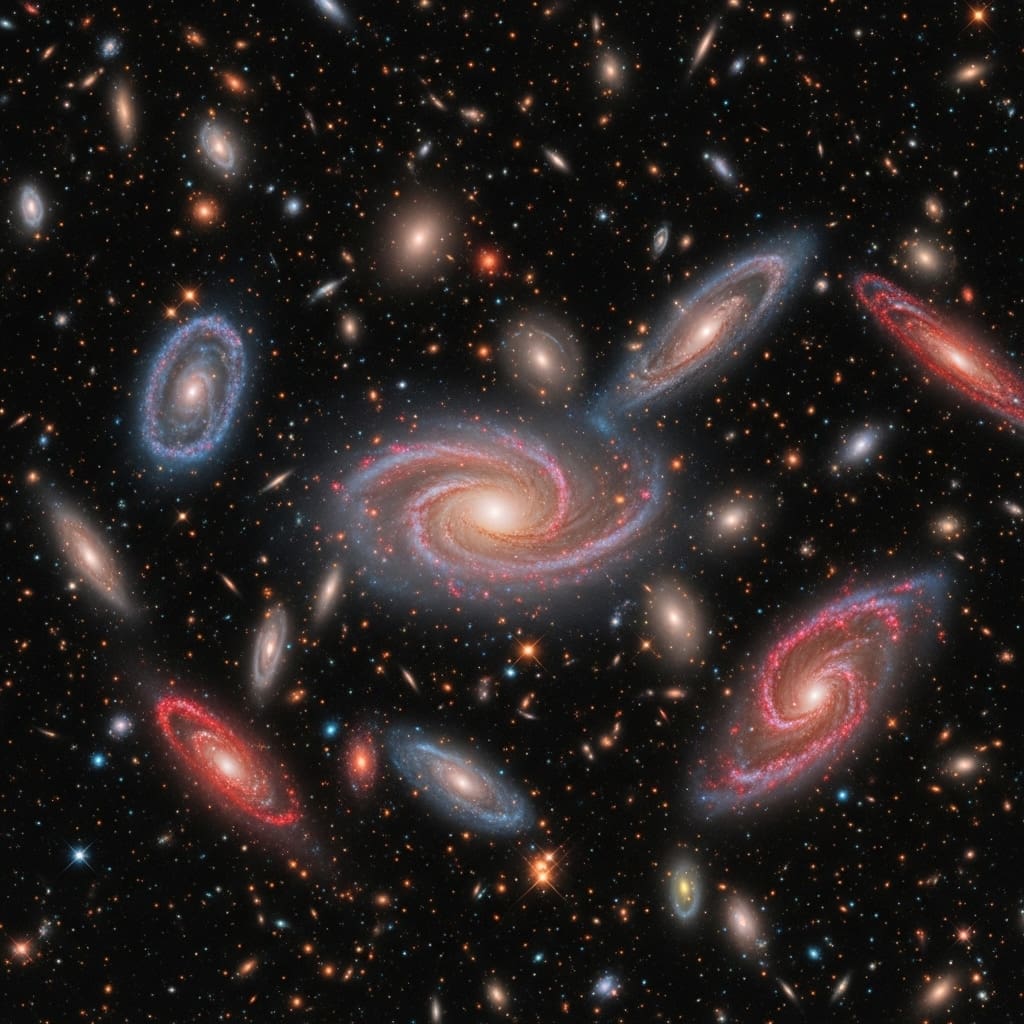
Scientists are now able to peer further back into the universe’s infancy thanks to a new comprehensive dataset from the James Webb Space Telescope’s (JWST) Advanced Deep Extragalactic Survey (JADES). Benjamin D Johnson, Brant E Robertson (University of California, Santa Cruz), Daniel J Eisenstein, Sandro Tacchella and Dávid Puskás (Kavli Institute for Cosmology, University of Cambridge), alongside Qiao Duan and et al, have released the fifth data release (DR5) showcasing deep infrared imaging from the GOODS-S and GOODS-N fields, covering 469 arcmin² in up to 18 filters. This release, compiled from over 800 hours of JWST observations and co-reduced data from 19 other programmes, provides unprecedented photometric precision and astrometric alignment, enabling detailed studies of the earliest galaxies and potentially revealing insights into the very first stars and structures to form in the cosmos.
Detailed tests were performed on the final data products to rigorously characterise photometric properties, the point-spread function, and astrometric alignment, ensuring the highest possible data quality. Mosaics are released for individual programs and epochs, as well as combined mosaics, specifically designed to facilitate studies of photometric variability and enable the deepest possible photometric measurements of distant objects. This innovative approach allows astronomers to identify subtle changes in brightness over time and to precisely measure the properties of extremely faint and distant galaxies.
This work establishes a new benchmark for deep-field infrared imaging, providing an unparalleled view of the universe’s infancy. The study reveals a wealth of new data on galaxies forming within the first 300 million years after the Big Bang, challenging existing models of galaxy formation and evolution. Scientists are already discovering unexpectedly mature galaxies in the early universe, as well as unusual chemical abundance patterns and evidence of supermassive black holes at redshifts previously inaccessible to observation. The research culminated in deep and well-characterized mosaics covering 469 arcmin², with at least 8 filters of coverage across 250 arcmin². This release incorporates over 800 JWST mission hours of NIRCam imaging, alongside co-reductions of data from 19 other programs within these premier deep fields. The team engineered a sophisticated NIRCam pipeline beginning with precise ramp fitting to calibrate individual exposures. Researchers incorporated co-reductions of data from 19 other programs within these premier deep fields, significantly expanding the available dataset for astronomical study.
Experiments revealed detailed mosaics constructed from individual programs and epochs, facilitating photometric variability studies and achieving the deepest possible photometry ever obtained in these fields. The team measured photometric properties, point-spread function characteristics, and astrometric alignment with exceptional precision, ensuring the reliability of the data products. Detailed tests confirmed the high quality of the final mosaics, paving the way for groundbreaking investigations into early galaxy formation and evolution. Scientists recorded an overabundance of massive quiescent galaxies at high redshift, challenging existing models of galaxy formation. Tests prove the data’s suitability for a wide range of scientific investigations, from studying the faintest galaxies to tracing the evolution of cosmic structures. The resulting NIRCam images are publicly available on MAST as High Level Science Products under accession number 10. The resulting mosaics cover 469 arcmin² with data from at least one filter, and 250 arcmin² with coverage from at least eight filters. Researchers meticulously processed the data, addressing issues identified in earlier releases and implementing custom algorithms for crosstalk correction, noise reduction, and outlier rejection.
Detailed tests were performed to characterise the photometric properties, point-spread function, and astrometric alignment of the final data products. The team created mosaics for individual programs and combined mosaics to enable studies of photometric variability and achieve the deepest possible photometry. The authors acknowledge that residual diffraction spikes may affect some analyses, and suggest that further handling of these features may be best done on subregion mosaics before co-addition. Future research will undoubtedly benefit from these mosaics, leveraging years of multi-wavelength data already collected on these well-studied fields, and the team hopes this data will be a compelling resource for the wider astronomical community.
👉 More information
🗞 JWST Advanced Deep Extragalactic Survey (JADES) Data Release 5: NIRCam Imaging in GOODS-S and GOODS-N
🧠 ArXiv: https://arxiv.org/abs/2601.15954