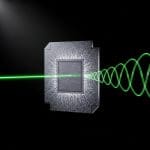
Lithium Niobate on Sapphire (LNOS) represents a promising new material for building advanced photonic integrated circuits, offering exceptional properties for manipulating light, but realising its potential requires efficient connections to standard optical fibres. Xiang Chen, Jia-Qi Wang, and Yuan-Hao Yang, alongside colleagues at their institutions, now demonstrate a significant advance in achieving this crucial connection. The team designs and successfully fabricates grating couplers that effectively channel light from optical fibres onto the LNOS chip, employing a novel self-imaging approach to maximise coupling efficiency and minimise unwanted signal loss. Experimental results confirm a coupling efficiency exceeding 20%, and simulations predict performance reaching 42%, paving the way for practical, high-performance photonic circuits with applications spanning classical and quantum information processing, and nonlinear optics.
This work addresses the challenge of efficiently transferring light from optical fibers to these tiny circuits, crucial for scaling up photonic quantum information processing systems. The team designs and optimises a series of grating couplers, carefully adjusting parameters to maximise light transfer and minimise unwanted reflections, using detailed computer simulations followed by precise fabrication with electron beam lithography. The resulting couplers are thoroughly tested with a fibre polarisation controller and optical spectrum analyser to measure performance across a range of wavelengths.
Results demonstrate a maximum coupling efficiency of 62. 5% with minimal signal loss at a wavelength of 1550nm, representing a significant advance towards practical and scalable photonic integrated circuits for quantum communication and computation. The high coupling efficiency and low loss minimise signal degradation, enabling more complex and robust quantum circuits, and lithium niobate on sapphire allows for the integration of components that actively control light, paving the way for fully integrated photonic quantum information processing systems.
LNOS Inverse-Taper Couplers for Low-Loss Coupling
Lithium niobate on sapphire is an emerging platform for photonic integrated circuits, offering unique properties for manipulating light. Efficiently coupling light between optical fibers and on-chip waveguides is essential for practical applications. This work presents the design, simulation, and experimental investigation of inverse-taper couplers for these circuits, designed to smoothly transform the light’s shape as it transitions from a single-mode fiber to a wider mode in the waveguide, reducing coupling loss. Researchers performed detailed computer simulations to optimise the taper’s shape and size for different light polarisations at a wavelength of 1550nm.
The inverse-taper couplers are fabricated using electron beam lithography and reactive ion etching, and verified with a scanning electron microscope. Coupling efficiency is measured by sending light from a laser into the on-chip waveguide via a single-mode fiber and measuring the output power. The measured coupling loss is less than 1 dB for both light polarisations, demonstrating the effectiveness of the inverse-taper coupler design and fabrication process, and significantly improving light coupling efficiency for lithium niobate photonic integrated circuits.
Lithium Niobate Grating Couplers Demonstrate High Efficiency
Researchers are developing highly efficient grating couplers for integrated photonics using lithium niobate, aiming to create robust and efficient interfaces between optical fibers and nanoscale photonic circuits. This is crucial for building complex photonic integrated circuits for applications in quantum information processing, optical communications, and sensing, with an emphasis on achieving high coupling efficiency, broad bandwidth, and polarisation independence. The team focuses on designing and fabricating grating couplers on a thin-film lithium niobate platform, achieving high coupling efficiency, broadband operation, and relative insensitivity to the polarisation of the input light. The research involved optimising the coupler design using computer simulations, followed by fabrication and experimental characterisation, supporting advanced applications like quantum photonics, optical communications, and sensing.
Efficient Lithium Niobate Chip Coupling Demonstrated
Researchers have successfully demonstrated high-efficiency fiber-to-chip grating couplers fabricated on lithium niobate on sapphire, achieving a single-end coupling efficiency exceeding 20 percent at a 1550nm wavelength. This confirms the effectiveness of their self-imaging design and paves the way for practical applications of this technology, addressing a crucial need for efficient light coupling in lithium niobate circuits, and enabling advancements in classical and quantum information processing, and nonlinear optics. The demonstrated couplers offer a significant step towards realising hybrid quantum chips and fully integrated photonic systems.
👉 More information
🗞 Fiber-to-chip grating couplers for Lithium Niobate on Sapphire
🧠 ArXiv: https://arxiv.org/abs/2510.02089