Controlling quasiparticles within two-dimensional semiconductors represents a crucial step towards advanced optoelectronic devices, influencing everything from light emission to data storage, yet achieving both reversibility and high densities of these quasiparticles has proven challenging. Debasish Biswasray, Yogendra Singh, Amar Jyoti Biswal, and Bala Murali Krishna Mariserla, all from the Ultrafast Physics Group at the Indian Institute of Technology Jodhpur, now demonstrate a novel doping method that overcomes these limitations. Their research successfully converts excitonic charge states in monolayer tungsten diselenide using a simple, reversible process involving water-rinsed polyvinyl alcohol, and further enhances quasiparticle densities by applying strain through a unique two-dimensional microsphere array. This innovative technique achieves nearly complete conversion between trions and excitons without external electrical fields, delivering stable trions with a high free electron density and boosting trion emission by over forty percent, establishing a promising pathway for next-generation technologies.
Tuning Excitons in Two-Dimensional Materials
Research focuses on two-dimensional (2D) materials, such as tungsten disulfide, to enhance their optical and electronic properties for applications in optoelectronics and sensing. A key area of investigation involves manipulating excitons, which are electron-hole pairs, to control characteristics like binding energy and lifetime. Scientists employ a variety of methods to modify these materials, including strain engineering, doping, and creating heterostructures by stacking different 2D materials. Strain engineering, involving stretching or compressing the material, alters its bandgap and optical properties.
Doping introduces impurities to change carrier concentration and conductivity. Heterostructures, formed by layering materials, create novel properties through interactions at the interface, leading to charge transfer and new exciton formation. Electric fields, chemical functionalization, dielectric environments, quantum confinement, and defect engineering also play a role in property manipulation. Tungsten disulfide is a frequently studied material, often paired with hexagonal boron nitride, which serves as a protective dielectric layer and aids in property tuning. Researchers observe effects such as tunable exciton binding energy, bandgap engineering, charge transfer in heterostructures, enhanced light-matter interaction, and the potential for valleytronics, a field focused on manipulating exciton valley index for information storage. Characterization techniques include optical and Raman spectroscopy, atomic force microscopy, transmission electron microscopy, and scanning tunneling microscopy.
PVA Doping and Strain Control Quasiparticles
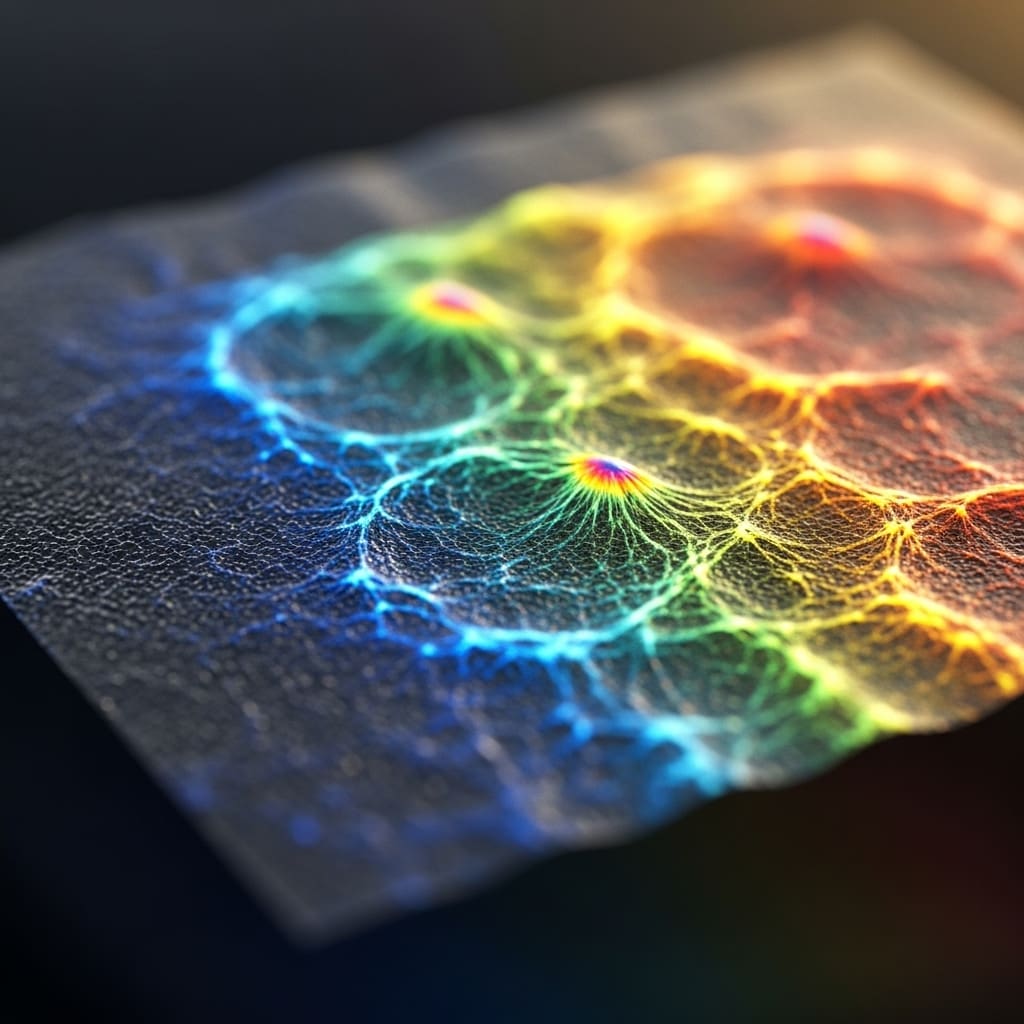
Scientists have developed a new technique to control quasiparticle densities in monolayer tungsten diselenide, a 2D semiconductor crucial for optoelectronics and quantum photonics. This method utilizes water-rinsed poly(vinyl alcohol), or PVA, to introduce free electrons into the material, overcoming limitations of conventional doping methods. To further increase quasiparticle densities, researchers applied periodic biaxial strain using a two-dimensional silica microsphere array. This innovative approach achieves nearly 100% reversible conversion between trions and excitons, eliminating the need for electrostatic gating.
The resulting thermally stable trions exhibit a substantial binding energy. Measurements reveal a high free electron density at room temperature, demonstrating the effectiveness of the doping and strain application. Strain-induced funneling of the PVA-injected electrons substantially increases the density of excitonic quasiparticles, boosting trion emission. This establishes a versatile platform for manipulating excitonic charge states and enhancing quasiparticle density, paving the way for innovations in optical data storage, quantum-light sources, and advanced display technologies.
Tungsten Diselenide Doping Achieves Full Reversibility
Scientists achieved nearly 100% reversible conversion between trion and exciton states in monolayer tungsten diselenide using a novel doping technique, removing the need for electrical gating. This breakthrough involves doping the material with a water-rinsed polyvinyl alcohol film and applying periodic biaxial strain using a 2D silica microsphere array. The work provides a versatile platform for manipulating excitonic charge states and boosting quasiparticle density within two-dimensional materials. Experiments revealed that the PVA doping process introduces free electrons into the material, confirmed by the emergence of a distinct emission peak.
Raman spectroscopy confirmed n-type doping through a shift in the material’s vibrational modes, indicating increased free electron density. Measurements confirm a high free electron density at room temperature, alongside thermally stable trions exhibiting a large binding energy. Investigations into temperature-dependent behavior demonstrated controlled exciton-trion interconversion, with precise control over quasiparticle populations. Furthermore, strain-induced funneling of the PVA-injected electrons substantially increases the excitonic quasiparticle densities, boosting trion emission. This approach promises significant advancements in data storage, light-emitting technologies, and display applications by enabling precise control over fundamental material properties at the nanoscale.
Strain-Controlled Excitons and Trions in Monolayer Material
Researchers successfully demonstrated a method for controlling excitonic quasiparticles within monolayer tungsten diselenide, achieving efficient conversion between different charge states. This work combines doping with a water-rinsed polymer, polyvinyl alcohol, and the application of periodic strain using a silica microsphere array, resulting in nearly complete reversibility in switching between trion and exciton states without electrical gating. The technique yields remarkably stable trions, exhibiting a substantial binding energy and a high concentration of free electrons at room temperature. The application of strain further enhances the density of these quasiparticles, leading to a 41% increase in trion emission through a process where strain directs the flow of injected electrons. Investigations into the relationship between laser power and trion density revealed a predictable increase, indicating a saturation point for the strain-induced funnelling effect. This approach establishes a robust chemical doping strategy for creating stable and reversible excitonic species in two-dimensional materials, potentially paving the way for advanced optoelectronic devices.
👉 More information
🗞 Reversible Excitonic Charge State Conversion and High Quasiparticle Densities in PVA-doped Monolayer WS on 2D Microsphere Array
🧠 ArXiv: https://arxiv.org/abs/2512.23500