Quantum networks promise unparalleled security for communication, but connecting multiple users efficiently remains a significant challenge, particularly over free-space links. Ayan Kumar Nai from the Physical Research Laboratory and Indian Institute of Technology Gandhinagar, alongside G. K. Samanta, now demonstrate a breakthrough in this area, realising a fully connected, twelve-channel quantum network using a single entanglement source. This innovative system establishes seamless quantum key distribution (QKD) connections between six users, achieving record coincidence rates and a sifted key rate exceeding 400 kbps between any pair of nodes. By employing a passive, scalable architecture, the team overcomes limitations of previous designs, paving the way for resource-efficient and widely deployable free-space quantum networks that could integrate with existing fibre infrastructure.
Multi-user Quantum Networks via Multiplexing Techniques
Scientists are developing multi-user quantum networks based on entanglement distribution, aiming to create a secure communication system for many users without relying on vulnerable trusted nodes. This research explores techniques to increase network capacity, including space-division multiplexing, which uses multiple paths for signals, and wavelength-division multiplexing, which uses different colours of light. Researchers are also developing bright, robust sources of entangled photons to power these networks. Quantum key distribution secures communication by using the principles of quantum mechanics to distribute encryption keys; any eavesdropping attempt disturbs the quantum state, alerting legitimate parties.
Entanglement, a key quantum phenomenon, links particles even at a distance, instantly correlating their states and forming the basis for many quantum communication protocols. The research focuses on eliminating the need for trusted nodes, a security risk in traditional quantum networks, by employing innovative network designs and technologies. This work has demonstrated the feasibility of building quantum networks connecting a significant number of users, while maintaining high bit rates for secure key distribution. Researchers have successfully implemented space-division multiplexing using multi-core fibres to increase network capacity and have developed entangled photon sources with improved tolerance to environmental noise.
They are also exploring architectures that eliminate beam splitters, simplifying the system and potentially enhancing security, and have demonstrated satellite-to-ground quantum key distribution in real-time. Challenges remain in maintaining quantum states over long distances due to signal loss and decoherence, and scaling up these networks presents complex engineering hurdles. Integrating quantum networks with existing communication infrastructure is also essential for practical deployment. Future research focuses on developing quantum repeaters to overcome distance limitations, exploring advanced modulation techniques to increase channel capacity, and combining different quantum technologies for more versatile networks. Ultimately, this research aims to establish standards for interoperability, paving the way for practical, secure, and scalable quantum networks for multi-user communication.
Six-Node Quantum Network via Space Division Multiplexing
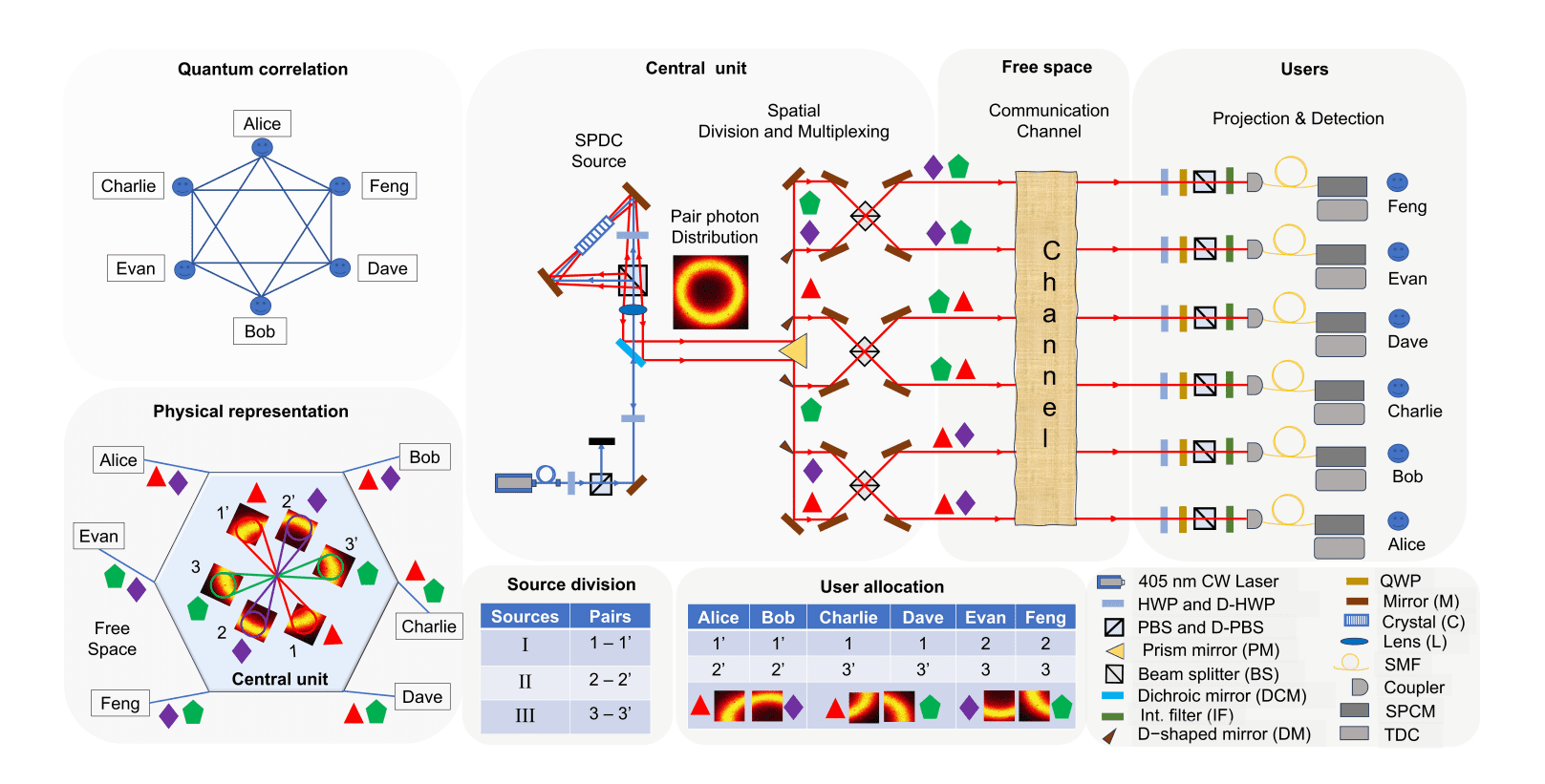
Scientists engineered a free-space quantum network connecting six users through a fully connected, twelve-channel system originating from a single entanglement source. This network pioneered a space division multiplexing architecture to overcome limitations of traditional peer-to-peer quantum key distribution, achieving record coincidence rates exceeding 150,000 per second between any node pair and a sifted key rate exceeding 400 kilobits per second. This approach simplifies deployment and enhances scalability for future networks by eliminating the need for active switching. The central unit generates entangled photon pairs using a continuous-wave laser operating at a specific wavelength.
A half-wave plate and polarization beam splitter control the laser output, which pumps a specially designed crystal within a polarization Sagnac interferometer. A lens focuses the pump beam onto the crystal, producing the entangled photon pairs through a process called spontaneous parametric down-conversion. The system then separates the resulting emission from the pump beam and divides it into six sections, each forming an entangled photon source. These sections are multiplexed using beam splitters, and mirrors direct the beams along optical paths to the six users. Each user’s receiver incorporates a projection and detection module consisting of wave plates, a polarization beam splitter, an interference filter, and a single-photon counting module.
The outputs from these modules are processed by a computer for data analysis. Researchers carefully characterised the entangled photon sources, tuning the system to maximise the spatial sectioning and achieve strong correlations between opposite sections. By optimising the system, they achieved high coincidence rates and negligible correlations between non-opposite sections. Single-photon detection rates were consistently high, indicating efficient coupling, and polarization correlation visibility exceeded 93% across all bases, confirming a violation of classical limits. These results demonstrate the successful generation of high-quality entanglement and the feasibility of a scalable, multi-user quantum network.
Six-User Quantum Network Demonstrates High Key Rate
Scientists have demonstrated a fully connected, twelve-channel quantum key distribution network connecting six users, all derived from a single entanglement source. This breakthrough achieves record coincidence rates ranging from 200,000 to 400,000 per second between any pair of nodes, enabling a sifted key rate exceeding 400 kilobits per second. The team generated three independent entangled photon sources from a single setup, confirming reliable and high-quality entanglement generation. Characterisation of the sources revealed high coincidence counts between diametrically opposite sections and negligible counts between non-opposite sections.
Measurements of single-photon detection rates from the six spatial subsections were consistently high, corresponding to efficient coupling. Polarization correlation visibility exceeded 93% across all bases, and the measured Bell parameter reached 2. 63, clearly violating classical limits. Quantum state tomography confirmed the generated state corresponds to a maximally entangled Bell state with a high fidelity of 98%. Further investigation of the twelve-channel network revealed strong correlations between users, while minimal correlations were observed between users connected via the same output port of a beam splitter, indicating no direct communication link. Digital delays between photon pairs across different user combinations did not significantly affect the noise-limited range of coincidence counts. This work delivers a fully passive, scalable architecture for free-space quantum networks, opening new possibilities for resource-efficient and secure communication.
Twelve-Channel Quantum Network Demonstrates Secure Communication
This research demonstrates a scalable quantum network architecture utilising spatial division and beam-splitter-based multiplexing from a single entangled photon source. The team successfully established a fully connected, twelve-channel network capable of supporting quantum key distribution between six users, achieving a sifted key rate exceeding 400 kilobits per second and a secure key rate of 76 kilobits per second across all user pairs. This approach overcomes limitations inherent in wavelength division multiplexing, specifically spectral channel constraints and inter-channel crosstalk, by eliminating the need for narrowband filters and complex spatial coupling optics while maintaining high photon collection efficiency. The developed network exhibits a high degree of adaptability, allowing users to be added or removed without altering the core optical setup, making it suitable for real-world deployment.
Researchers indicate that scalability can be further enhanced by increasing the diameter of the photon source and pump power, potentially enabling even more communication channels without compromising data rates. Furthermore, integration with existing wavelength division multiplexing devices or beam splitters offers a clear pathway towards constructing even larger quantum networks. These results establish a versatile and efficient platform for multi-user quantum communication, paving the way for a next-generation global quantum network. The authors acknowledge that further improvements in photon source efficiency and detector sensitivity would enhance network performance. They also note the potential for exploring different entanglement sources and detection schemes to optimise the system for specific applications.
👉 More information
🗞 Free-space multi-user quantum network with high key rate
🧠 ArXiv: https://arxiv.org/abs/2511.00466