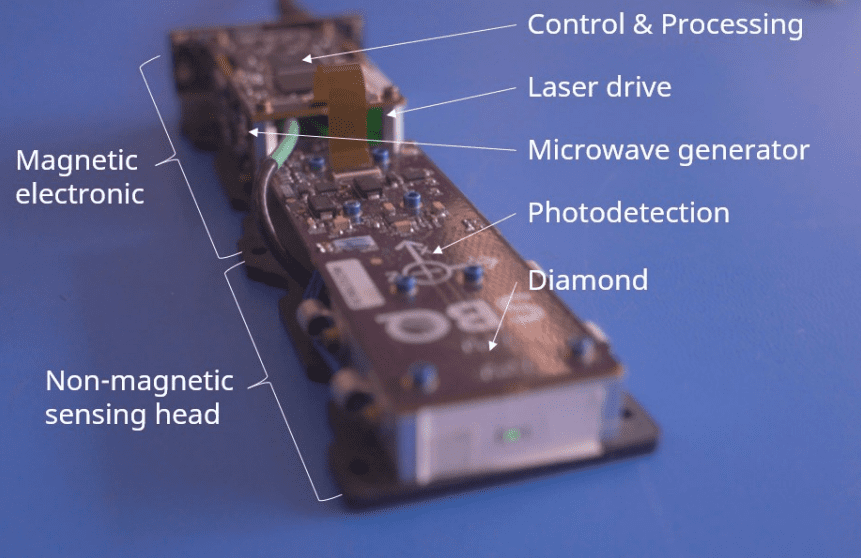
Nitrogen-vacancy (NV) center magnetometry holds immense promise for sensitive detection of magnetic fields, but current systems typically remain confined to laboratory environments. Vincent Halde, Olivier Bernard, Mathieu Brochu, and colleagues at SBQuantum now overcome this limitation by presenting a fully portable, hand-held NV-based magnetometer. This device achieves a vector sensitivity of approximately 400 picotesla per square root of Hertz, with heading errors below 5 nanoteslas even in Earth’s magnetic field, and boasts a wide signal bandwidth enabling recalibration and operation on moving platforms. Crucially, the team demonstrates the system’s robustness through rigorous environmental qualification testing, including exposure to thermal stress, vibration, and radiation, alongside successful field deployments in challenging conditions such as the Canadian Arctic, drone surveys, and high-altitude balloon flights, establishing a versatile tool for a wide range of applications.
Portable Diamond Vector Magnetometry Demonstrated
This research details the development and testing of a portable, absolute vector magnetometer based on nitrogen-vacancy (NV) centers in diamond. The sensor offers potential for a wide range of applications, from space exploration to terrestrial surveys. The core technology utilizes NV centers in diamond as the magnetic field sensing element, offering high sensitivity and the potential for miniaturization. Crucially, the sensor aims for absolute vector magnetometry, meaning it doesn’t require external references or calibration for direction, unlike many traditional magnetometers. A fiber-coupled design enables a compact and robust system for laser delivery and signal collection.
The sensor achieves a sensitivity of 30 pT/√Hz, with ongoing efforts to reach 50 pT/√Hz, and demonstrates sub-nanotesla stability, crucial for accurate measurements. It offers complete portability for field deployments and can measure all three components of the magnetic field simultaneously. Extensive testing showcases the sensor’s versatility through rigorous laboratory calibration and characterization. Successful drone surveys captured magnetic signatures from a meteorite impact site, while high-altitude weather balloon flights at 32km and low temperatures demonstrated robustness in extreme conditions.
The sensor is designed for space deployment, with a launch planned for early 2025, and has been demonstrated in terrestrial surveys for geological mapping. Key innovations include bias-field-free operation, improving stability and accuracy, and high miniaturization for integration into various platforms. The research team aims to further improve sensitivity, stability, and bandwidth, and plans to develop sensor arrays for enhanced magnetic intelligence. This research represents a significant advancement in quantum sensing technology, with potential to revolutionize space exploration through precise magnetic field mapping of planets and moons. It also offers benefits for geophysics, including geological surveys, mineral exploration, and earthquake monitoring, as well as archaeology through detection of buried structures and artifacts. Furthermore, the sensor could enable high-precision navigation systems and provide magnetic anomaly detection for defense applications.
Portable Magnetometer Survives Extreme Conditions and Calibrates In-Field
The research team has developed a fully portable, hand-held magnetometer based on nitrogen-vacancy (NV) center technology, achieving a vector sensitivity of approximately 400 pT/sqrt(Hz). This new instrument demonstrates heading errors below 5 nT in Earth’s magnetic field and possesses a wide signal bandwidth enabling both on-field recalibration and operation on moving platforms. Extensive testing confirms the system’s robustness, including survivability in temperatures ranging from -65°C to 125°C for over 335 hours each, and resistance to mechanical stresses up to 50g peak acceleration. The magnetometer also withstood radiation exposure of 40 krad from protons at 105 MeV and 46 krad from gamma rays, validating its suitability for space deployment.
Calibration procedures utilizing machine learning have significantly improved performance, correcting for scale and orthogonality to near-ideal values. Before calibration, scale factors ranged from 1. 00209 to 1. 00950, while orthogonality varied up to 860E-5 radians; after machine learning compensation, these values were reduced to 0. 99997 to 1.
00014 and below 4E-5 radians respectively. Non-linearity evaluations, using controlled ramps from -50 μT to +50 μT, yielded a standard deviation of 7. 5 nT. Crucially, the magnetometer maintains nanotesla-level accuracy during dynamic motion, demonstrated through a hand-executed spin calibration routine with rotation periods of approximately 10 seconds. Raw data showed Total Magnetic Intensity (TMI) variations of around 1 μT, but after spin calibration, fluctuations were limited to within 20 nT, corresponding to a dynamic heading error below 20 nT. Field deployments in extreme conditions, including the Canadian North, further validated the instrument’s robustness and operational readiness for applications like mineral exploration and contributions to the World Magnetic Model.
Portable Magnetometer Achieves High Sensitivity and Robustness
This research demonstrates a significant advance in quantum sensing technology, culminating in a fully portable and robust nitrogen-vacancy (NV) based magnetometer. The team successfully developed a handheld device capable of detecting magnetic fields with a sensitivity of approximately 400 pT/sqrt(Hz), while maintaining heading accuracy below 5 nT in Earth’s magnetic field. This level of performance, combined with a wide signal bandwidth enabling on-field recalibration, represents a substantial improvement over existing laboratory-bound systems and opens new possibilities for real-world applications. The magnetometer’s robustness was confirmed through rigorous environmental qualification testing, including exposure to thermal stress, vibration, and radiation, simulating conditions encountered in low Earth orbit. Successful field deployments in challenging environments, such as northern Canada, on drones, and from high-altitude balloons, further validate its practical utility.
👉 More information
🗞 Who Let the Diamonds Out?
🧠 ArXiv: https://arxiv.org/abs/2509.19179