

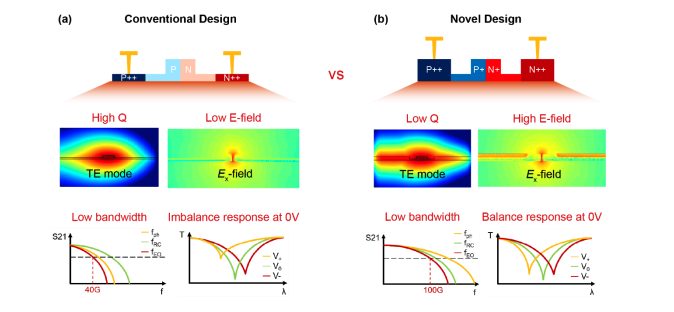
The relentless demand for faster and more efficient data transfer in artificial intelligence applications drives the search for innovative optical interconnects, and researchers are now reporting a significant advance in this field. Fangchen Hu, Fengxin Yu, and Xingyu Liu, alongside colleagues including Aoxue Wang and Haiwen Cai from Fudan University and Zhangjiang Laboratory, present a new silicon microring modulator capable of transmitting data at an impressive 400 gigabits per second. This device overcomes previous limitations in both speed and energy efficiency, achieving record performance through a novel design incorporating heavily-doped trenches within a standard silicon platform. The modulator’s ability to operate in multiple modes, supporting both energy-efficient and ultrafast connections, establishes it as a promising solution for scaling up next-generation optical networks essential for demanding AI workloads.
Self-Biasing Silicon Microring Modulator Design
Researchers have engineered a silicon microring modulator that addresses the growing demand for high-speed, low-power optical interconnects, crucial for applications like artificial intelligence. The team developed a modulator using a depletion-mode P-N junction, a design choice that reduces power consumption and improves signal linearity. This modulator minimizes the need for external bias voltages, further contributing to energy efficiency, and achieves a data rate of 32 gigabits per second with an exceptionally low energy consumption of 0. 97 femtojoules per bit. This combination of speed and efficiency is significant, as high data rates often require increased power.
The modulator operates with a low driving voltage of 0. 43 volts, simplifying driver circuitry and reducing overall power dissipation. Its compact size, with a radius of 8 micrometers, allows for dense integration in optical circuits, and reliable performance is demonstrated through bit error rates below 1×10 -12 , ensuring accurate data transmission. The design is also scalable for Wavelength Division Multiplexing (WDM), enabling high-capacity optical connections by transmitting multiple data channels on a single fiber; the team demonstrated architectures supporting 2 terabits per second with six rings and 1 terabit per second with sixteen rings.
The core advantage of this design lies in its depletion-mode operation, which generally results in lower capacitance and faster switching speeds compared to other approaches. The self-biasing feature simplifies the design and minimizes power consumption, while the 8-micrometer radius strikes a balance between compactness and performance. WDM compatibility allows for multiple channels to be multiplexed onto a single fiber. Comparative analysis demonstrates that this modulator achieves a competitive combination of speed, power efficiency, and driving voltage compared to other published results. The 0.
97 fJ/bit energy efficiency is particularly noteworthy, ranking among the lowest reported in the field, and the 0. 43V driving voltage is also highly competitive. The demonstrated WDM architectures are a significant advantage, enabling high-capacity optical interconnects, and the work successfully utilizes PAM4 and PAM6 modulation formats, essential for achieving high data rates. Detailed analysis confirms the modulator’s low energy consumption and self-biasing operation. Further comparisons of P-N junction-based modulators showcase the advantages of the current design in terms of speed, efficiency, and driving voltage.
The device requires no Digital Signal Processing (DSP) for operation. In conclusion, this research presents a significant advancement in silicon photonics. The developed modulator offers a compelling combination of high speed, low power consumption, and scalability, making it a promising candidate for future optical interconnect applications.
Silicon Microring Modulator for Ultrahigh-Bandwidth Links
Researchers engineered a novel silicon microring modulator (MRM) on a 300-millimeter silicon platform to address the growing demand for ultrahigh-bandwidth optical interconnects, crucial for artificial intelligence networks. The team overcame a key trade-off between modulation efficiency and bandwidth by fabricating a device with a heavily-doped trench-integrated structure, enabling both outstanding performance and remarkable uniformity across the entire wafer. This innovative design supports dual operation modes: self-biasing for energy-efficient scale-up and depletion driving for ultrafast scale-out links, optimizing the device for diverse applications. The method achieves error-free 32-Gbps NRZ transmission over 2 kilometers of standard single-mode fiber with only 0.
43-Vpp drive and zero electrical bias, yielding an exceptionally low energy efficiency of 0. 97 fJ/bit. At higher signal swings, the device further supports 280-Gbps PAM4 and error-free 80-Gbps NRZ optical modulation, demonstrating its versatility. For scale-out interconnects, the team achieved open eye diagrams at 200 Gbps (NRZ), 360 Gbps (PAM4), and a record 400 Gbps (PAM6), establishing the first wafer-scale silicon MRM solution capable of reaching 400 Gbps. Scientists harnessed a depletion-mode MRM operated in reverse-bias with large swing voltages to ensure high extinction ratios, crucial for ultrafast optical modulation. The electrical integrated circuit was flip-chip bonded directly atop the photonic integrated circuit to minimize interconnect parasitic effects, further enhancing performance.
Silicon Modulator Achieves 32 Gbps Error-Free Transmission
Researchers have developed a new silicon microring modulator that significantly advances optical interconnect technology, addressing the growing demand for bandwidth in artificial intelligence networks. This device overcomes previous limitations by achieving both high modulation efficiency and an exceptionally wide bandwidth, paving the way for 400 Gbps-per-wavelength operation. The breakthrough centers on a novel design incorporating a heavily-doped trench structure fabricated on a 300-millimeter silicon platform, ensuring both outstanding performance and uniformity across the entire wafer. The team demonstrated dual operation modes, optimizing the device for both energy-efficient scale-up interconnects and ultrafast scale-out links.
In tests, the modulator supports error-free 32-Gbps NRZ transmission over 2 kilometers of single-mode fiber with only 0. 43-Vpp drive and zero electrical bias, achieving an energy efficiency of 0. 97 fJ/bit. At higher signal levels, the device further supports 280-Gbps PAM4 and error-free 80-Gbps NRZ optical modulation, demonstrating its versatility. For scale-out applications, the modulator achieves open eye diagrams at 200 Gbps.
🗞 400-Gbps/ Ultrafast Silicon Microring Modulator for Scalable Optical Compute Interconnects
🧠 ArXiv: https://arxiv.org/abs/2509.01555


