Quantum Key Distribution (QKD) networks promise unconditionally secure communication, but efficiently routing cryptographic keys across complex, multi-hop networks presents significant challenges. Ivan Cvitic, Dragan Perakovic, and Armando Nolasco Pinto, from the University of Zagreb and University of Aveiro, comprehensively survey the landscape of routing approaches for terrestrial, satellite, and hybrid QKD infrastructures. Their work analyses 26 distinct routing strategies proposed over the last decade, revealing that dynamic, key-aware algorithms can substantially reduce service failures compared to traditional methods. This research demonstrates the potential of multi-path routing to enhance network resilience, and highlights the emerging role of software-defined networking in managing the complexities of hybrid QKD networks, ultimately offering practical insights for building adaptable and scalable quantum communication systems.
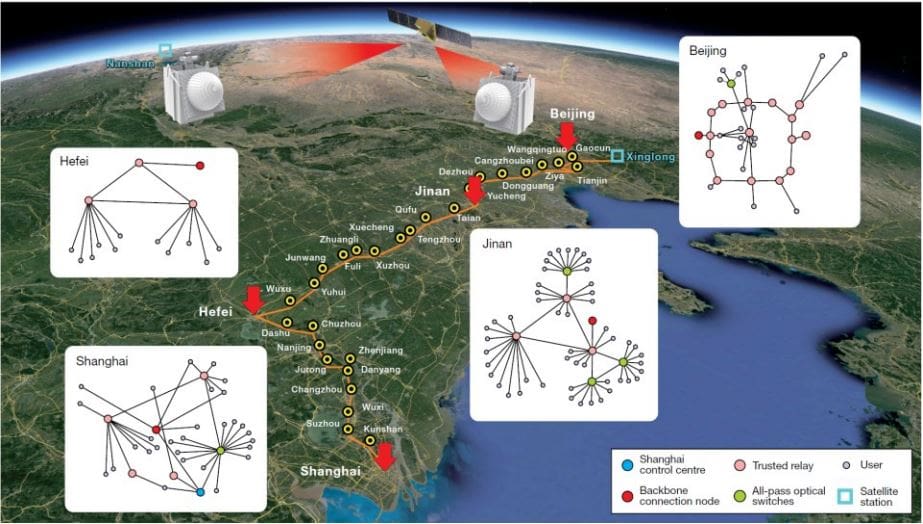
Scientists are developing methods to efficiently relay cryptographic keys across networks, recognizing that QKD links generate secure keys at a limited rate, making key availability a crucial factor in routing decisions. The research examines how these strategies address the unique challenges of QKD, where keys are a consumable resource and each relay introduces a potential security vulnerability. QKD networks can be implemented using various topologies, including direct point-to-point links, networks utilizing trusted relays to extend range, ring networks offering redundancy, and highly connected mesh networks.
Combining QKD with Post-Quantum Cryptography enhances security and resilience against future attacks on classical cryptography. Software-Defined Networking is crucial for managing and optimizing these networks, allowing for dynamic routing and resource allocation. Researchers are investigating several routing strategies, starting with basic shortest-path methods, but recognizing their limitations in QKD networks. Key rate-aware routing prioritizes paths with higher key generation speeds, while Quality of Service routing considers both key rate and key quality. Multi-path routing utilizes multiple paths between nodes to increase redundancy and improve key rates, and Virtual Network Functions provide flexible network services.
Topology abstraction simplifies complex networks, and Reinforcement Learning learns optimal routing policies based on network conditions. Optical path switching dynamically configures connections to optimize key rates, and collaborative routing coordinates key distribution among multiple nodes. Several network simulators, including NS-3 and OMNeT++, are available for testing and analyzing QKD network performance. Emerging trends include utilizing satellites to extend network range, integrating terrestrial and satellite systems, combining QKD with PQC, leveraging SDN for network management, and employing artificial intelligence to develop intelligent routing algorithms. Standardization efforts are underway to promote interoperability and adoption. Scientists investigated methods for efficiently relaying cryptographic keys across multi-hop networks, recognizing that QKD links generate secure keys at a finite rate, making key availability a crucial factor in routing decisions. The study meticulously examined how these strategies address the unique challenges of QKD, where keys are a consumable resource and each relay introduces a potential security vulnerability. Researchers evaluated strategies based on their ability to minimize service rejection rates and maximize network resilience.
Dynamic, key-aware routing algorithms demonstrably reduce service rejection rates by 25 to 40 percent compared to static shortest-path methods, achieved by incorporating real-time key pool availability and link error rates into routing calculations. Multi-path strategies improve resilience against compromised nodes by distributing keys across disjoint routes, although this approach increases key consumption. The study further investigated Software-Defined Networking frameworks, identifying them as essential enablers for flexible, Quality of Service-aware routing in hybrid networks integrating terrestrial fibers and intermittent satellite links. Scientists assessed how these frameworks coordinate the usage of quantum channels alongside classical networks, enabling efficient key management and adaptation to fluctuating network conditions. Dynamic, key-aware routing algorithms demonstrably reduce service rejection rates by 25 to 40 percent compared to static shortest-path methods, achieved by incorporating real-time key pool availability and link error rates into route calculations. Multi-path strategies further enhance resilience against compromised nodes by distributing keys across separate routes, although this increases key consumption. Investigations into satellite QKD networks reveal that low Earth orbit satellites exhibit periodic visibility windows with ground stations, best represented by time-expanded graphs where each edge corresponds to a contact opportunity during a specific time slot.
Researchers developed a topology abstraction method to construct a static logical layer, enabling the application of classical routing algorithms for determining optimal contact sequences for key relaying. In contrast, geostationary Earth orbit satellites provide near-continuous connectivity but suffer from lower key rates, necessitating strategies that balance link availability, throughput, and latency in hybrid networks. Hybrid QKD networks, combining terrestrial and satellite components, require algorithms that select among heterogeneous paths with different trust levels and performance profiles. Experiments demonstrate dynamic switching between satellite and fiber links, optimizing key delivery while adhering to orbital dynamics and visibility windows.
Researchers propose frameworks to maximize key delivery, and heuristic methods for resource allocation under service-level guarantees. Adaptive link weighting and time-sensitive key stability models have been proposed to optimize path selection. The study demonstrates that traditional shortest-path routing methods often prove inadequate for QKD networks due to unique constraints related to limited and perishable cryptographic keys. In contrast, dynamic, key-aware algorithms, coupled with Software-Defined Networking-based control frameworks, offer improved adaptability and performance by responding to changes in key availability and link status. The investigation reveals that multi-path strategies and SDN-enabled control are essential for achieving both robustness and scalability in large QKD networks, particularly those integrating satellite links.
These approaches address the complexities introduced by time-dependent connectivity and the need for cross-layer optimization. Researchers highlight the importance of real-time awareness of quantum link status, integration with classical control planes, and security-aware path selection to minimize trust exposure. Acknowledging current limitations, the research identifies several key areas for future work. These include unifying routing, key management, and service orchestration into a single adaptive framework and developing standardized interfaces to ensure interoperability across diverse quantum network architectures. Future systems will likely benefit from predictive or AI-enhanced routing, capable of forecasting link availability and proactively rerouting traffic before failures occur. This work provides a valuable foundation for engineering practical, scalable, and reliable QKD networks suitable for real-world deployment.
👉 More information
🗞 Overview of Routing Approaches in Quantum Key Distribution Networks
🧠 ArXiv: https://arxiv.org/abs/2511.15465