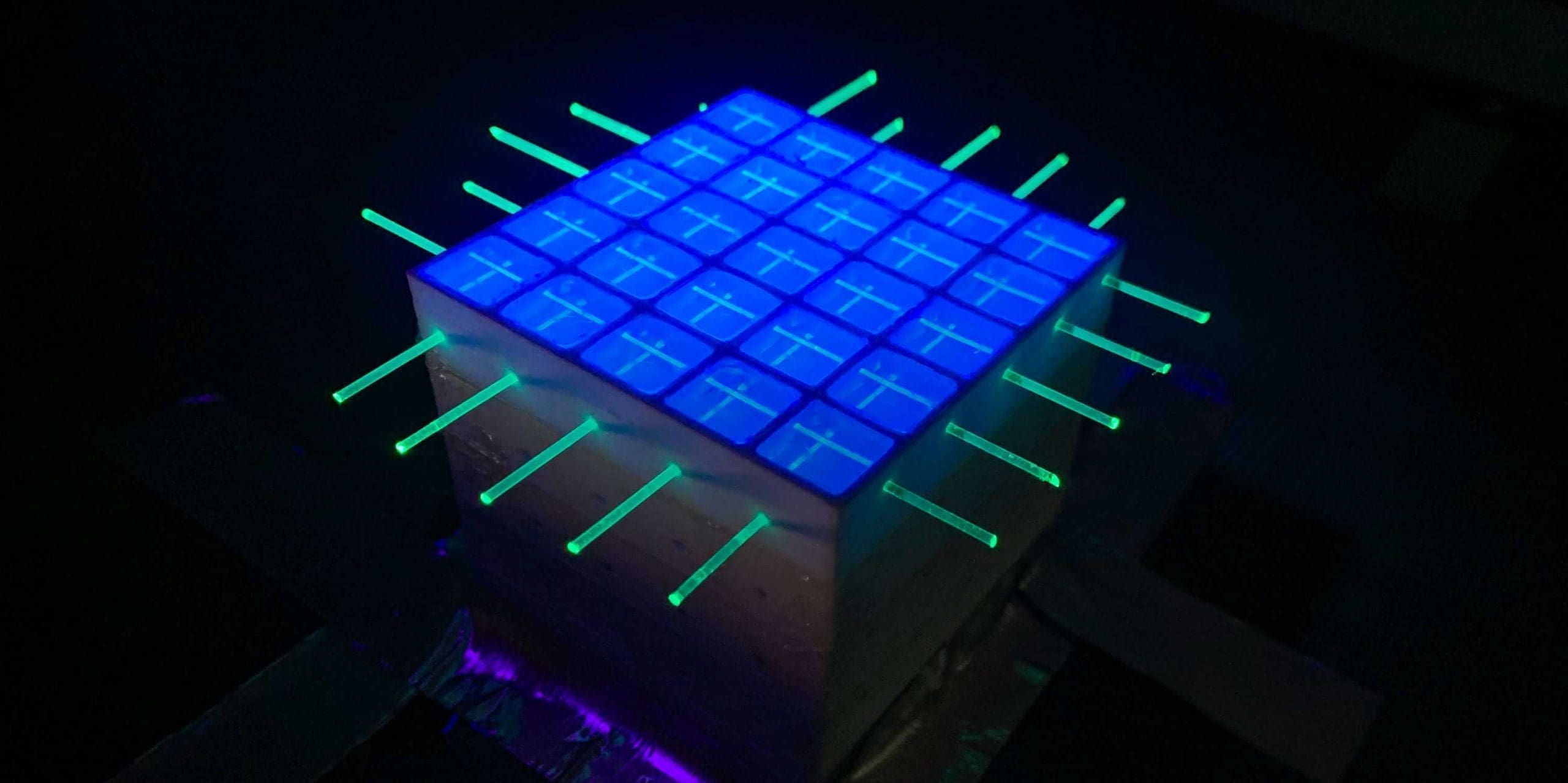
Researchers have developed an innovative method using additive manufacturing, specifically fused injection modeling (FIM), to create 3D-printed plastic scintillator detectors for particle physics. This technique combines fused deposition modeling (FDM) with injection molding to produce a prototype named SuperCube, featuring 125 optically isolated voxels arranged in a 5x5x5 configuration. The SuperCube successfully detected charged particles from cosmic rays and test beams at CERN, demonstrating its ability to reconstruct particle tracks and measure energy loss.
Performance metrics, including scintillation light yield and crosstalk between voxels, were comparable to traditional methods, with acceptable levels of optical isolation. This advancement paves the way for scaling up detector sizes, potentially enhancing experiments like T2K by capturing more interaction events, thus enabling significant progress in particle physics research.
The article explores the innovative use of Fused Injection Modeling (FIM), a method that merges Fused Deposition Modeling (FDM) with injection molding to create advanced particle detectors. This approach leverages FDM’s capability to produce complex structures without support materials and combines it with injection molding for precise material integration.
Weber leads a project aiming to automate production and scale up to detectors with millions of voxels. This scalability is vital for experiments like T2K, which require extensive data collection areas. Current production time constraints (six minutes per voxel) highlight the need for faster, automated solutions.
Specialized materials are being developed to optimize light emission efficiency and stability, crucial for detector performance and longevity. Beyond particle physics, FIM technology could revolutionize fields like medical imaging, offering high-resolution tracking capabilities.
In conclusion, FIM represents a significant leap in detector manufacturing, balancing complexity with performance. Future success hinges on overcoming production challenges and advancing material science to enable large-scale applications.
More information
External Link: Click Here For More