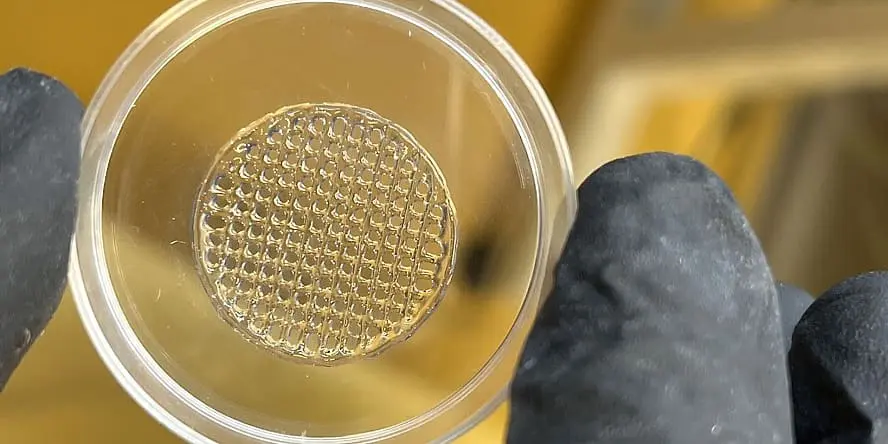
A research collaboration between TU Graz in Austria and the Vellore Institute of Technology (VIT) in India has developed a 3D-printed skin model incorporating living cells to test cosmetic nanoparticles, such as those in sunscreens, eliminating the need for animal testing. This innovation addresses restrictions imposed by Directive 2010/63/EU on animal testing within the EU. The skin models replicate human skin’s three-layer structure and biomechanics using hydrogels printed with living cells.
Researchers have successfully stabilized these hydrogels under mild conditions without toxic chemicals, ensuring cell survival and growth. Initial tests in cell culture confirm the materials’ non-cytotoxicity and mechanical stability. Future steps involve testing nanoparticles on these models, leveraging TU Graz’s expertise in material research and VIT’s molecular biology skills to further optimize hydrogel formulations and validate their use as an alternative to animal experiments.
3D-Printed Skin Imitation Developed for Cosmetic Testing
A team of researchers from TU Graz and VIT in India has developed a 3D-printed skin model with living cells to test nanoparticles in cosmetics without resorting to animal testing. This innovation addresses the restrictions imposed by Directive 2010/63/EU, which limits animal testing for cosmetics within the EU.
The skin models are crafted using hydrogels printed with living cells, replicating the three-layer structure of human skin. This approach aims to provide a reliable alternative for assessing the absorption and toxicity of cosmetic nanoparticles, such as those found in sunscreens.
Central to this development is the formulation of hydrogels that support cell survival and growth. The researchers achieved this through cross-linking methods that are both mild and free from cytotoxic chemicals, ensuring the stability and suitability of the models for testing purposes.
The collaboration between TU Graz and VIT leverages their respective expertise in material research and molecular biology to further refine the hydrogel formulations. Their goal is to validate these models as effective alternatives to animal testing, paving the way for more ethical and efficient cosmetic testing practices.
Hydrogels with Living Cells for Skin Mimicry
Developing hydrogels for skin mimicry is a critical component of this research. Hydrogels are water-based materials that provide an ideal environment for living cells to survive and grow. Researchers at TU Graz have formulated hydrogels that can be 3D-printed, enabling the creation of complex tissue structures that replicate human skin’s biomechanics and layered architecture. These hydrogels are designed to support cell viability while maintaining structural integrity, making them suitable for testing cosmetic nanoparticles.
To ensure stability and functionality, the hydrogels undergo cross-linking processes. This step strengthens the material without introducing cytotoxic chemicals, preserving the health of embedded cells. The mild nature of these methods ensures that the hydrogels remain biocompatible, offering a reliable platform for toxicity studies.
Future applications of this research extend beyond cosmetics, potentially into medical fields, offering a precise and efficient method for toxicity studies. This interdisciplinary approach not only contributes to safer cosmetic products but also advances sustainable and ethical testing practices.
Future Optimization of Hydrogel Formulations
The development of hydrogel-based skin models offers promising applications beyond cosmetics, particularly in medical research and toxicology studies. These models can serve as effective platforms for evaluating how drugs interact with human skin, aiding in developing targeted therapies.
In the medical field, these models hold the potential for advancing wound healing treatments and testing drug delivery systems. Simulating human skin’s structure and function provides a controlled environment to assess efficacy and safety without relying on animal testing.
Scalability is another key aspect, as these models can be produced in large quantities to meet diverse research needs. Collaborations with pharmaceutical companies could accelerate their integration into medical research, enhancing the efficiency of drug development processes.
Ultimately, the broader adoption of hydrogel-based skin models across various industries has the potential to significantly reduce reliance on animal testing, promoting more ethical and sustainable research practices.
More information
External Link: Click Here For More