Researchers successfully implement a stable three-dimensional velocity feedback cooling technique for levitated mechanical systems, enabling independent control of motion along all axes. This advancement minimises interference between cooled oscillatory modes, a crucial step towards generating non-classical states of motion in these systems.
The pursuit of isolating and controlling motion at the nanoscale presents significant challenges, yet offers potential advances in sensing, fundamental physics and quantum technologies. Researchers are increasingly turning to optically levitated particles, where a tiny object is suspended using light, to create systems sensitive enough to detect incredibly weak forces. Achieving precise control over all three dimensions of motion within these levitated systems is crucial, but complicated by unwanted interactions between the different axes. A team led by J.M.H. Gosling, A. Pontin, and including F. Alder, M. Rademacher, T.S. Monteiro, and P.F. Barker, from University College London and CNR-INO, detail in their work, “Feedback cooling scheme for an optically levitated oscillator with controlled cross-talk”, a stable and robust three-dimensional velocity feedback cooling scheme designed to minimise these interactions and independently cool the oscillatory modes of a levitated particle. This allows for greater precision in controlling the particle’s movement and paves the way for exploring non-classical states of motion within these novel systems.
Researchers report a stable, three-dimensional velocity feedback cooling scheme for optically levitated nanoparticles, representing an advancement in precision control of these microscopic systems. Optical levitation utilises the momentum transfer from photons to suspend and manipulate particles, eliminating contact with solid surfaces and minimising environmental disturbances. This new scheme demonstrably reduces cross-talk between the cooled axes of motion, a critical factor in achieving high levels of control and measurement accuracy.
The work builds upon established optomechanical techniques, notably the millikelvin cooling demonstrated by Li, Kheifets, and Raizen, and the subsequent achievement of sub-Kelvin parametric cooling by Gieseler et al. Parametric cooling involves modulating a trapping potential to extract energy from the particle’s motion, while millikelvin cooling refers to achieving temperatures on the order of one thousandth of a Kelvin. This latest development refines these approaches by addressing the issue of correlated motion between the particle’s x, y, and z axes.
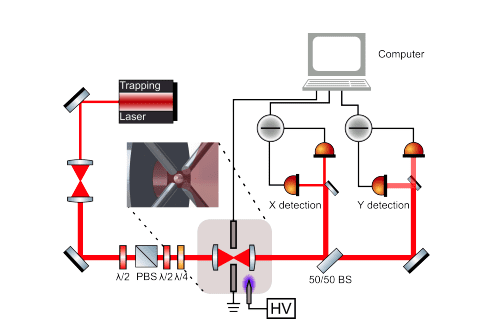
Minimising cross-talk is essential because unwanted motion in one direction introduces noise and imprecision into measurements along other axes. The researchers achieve this through a carefully designed velocity feedback loop, where the particle’s position is continuously monitored and corrections are applied to damp unwanted motion. Accurate position sensing forms the cornerstone of this feedback mechanism, requiring high-resolution detection of the particle’s location in three dimensions.
The system accounts for external forces that can affect the particle’s motion, including gas drag – the resistance from residual gas molecules – and thermal fluctuations arising from the inherent randomness of atomic motion. These factors are carefully modelled and compensated for within the control scheme, ensuring stable and reliable cooling. Data analysis utilises the pyr software package, a tool designed for processing and interpreting experimental results from optomechanical systems.
This improved level of control over nanoparticle motion opens avenues for exploring fundamental physics, including investigations into the quantum behaviour of macroscopic objects. Furthermore, the enhanced sensitivity of the system holds promise for detecting weak forces, potentially contributing to the search for dark matter, a mysterious substance that constitutes a significant portion of the universe’s mass. Related work by D.C. Cole et al on spatial mode decomposition, a technique for separating different modes of light, informed the development of the optical trapping system.
Future research directions include exploring non-classical states of motion, where the particle exhibits behaviours not predicted by classical physics. Improving the sensitivity of force measurements remains a key objective, as does investigating the ultimate limits of quantum control achievable within this system. These investigations will contribute to a deeper understanding of the interplay between quantum mechanics and macroscopic systems.
👉 More information
🗞 Feedback cooling scheme for an optically levitated oscillator with controlled cross-talk
🧠 DOI: https://doi.org/10.48550/arXiv.2506.17172