The behaviour of waves in disordered materials represents a fundamental problem in physics, and recent research explores this phenomenon in complex, non-Hermitian systems, which defy conventional descriptions. C. Wang and X. R. Wang, along with their colleagues, investigate how waves become localized in three-dimensional materials containing ‘exceptional points’, locations where standard physical rules break down. Their work reveals that these systems exhibit distinct types of localization, characterised by unique critical exponents that govern the transition from extended to localized wave behaviour. Significantly, the team demonstrates that the presence of exceptional points creates new universality classes, expanding our understanding of disordered systems beyond previously established classifications and offering insights into a wider range of physical phenomena.
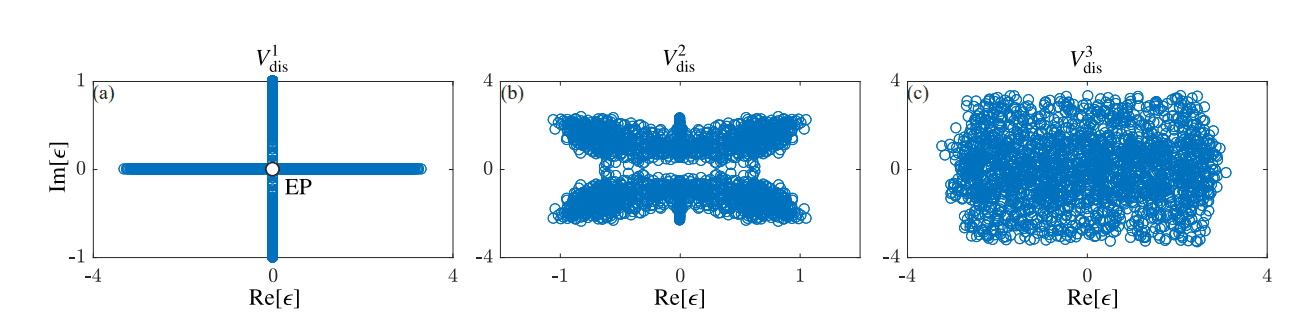
The investigation focused on systems possessing specific symmetries, revealing unique localization behaviour near an exceptional point, a singularity in the system’s energy landscape. The team identified a universal critical exponent governing this localization, remarkably independent of the type of disorder present, and observed differing characteristics away from the exceptional point, with distinct critical exponents.
This work extends the established classification of non-Hermitian systems, demonstrating that exceptional points introduce new universality classes, categories defining the system’s behaviour near a transition. Further investigation of systems with differing symmetries revealed additional, distinct universality classes. The authors acknowledge that their findings are specific to the model Hamiltonian and the chosen type of disorder, representing a focused exploration of these complex systems. Future work could broaden the investigation to encompass different system structures and disorder distributions, providing a more comprehensive understanding of localization in non-Hermitian environments.
Non-Hermitian Physics, Topology and Anderson Localization
This compilation presents a comprehensive overview of research related to non-Hermitian physics, Anderson localization, and related topics, highlighting key themes and providing context for understanding the scope of the research covered.
I. Core Concepts and Theoretical Foundations (Non-Hermitian Physics and Symmetry): These studies lay the groundwork for understanding non-Hermitian systems, particularly those exhibiting parity-time (PT) symmetry, where the system remains invariant under combined parity and time reversal. This symmetry can lead to real energy spectra even with complex potentials. Researchers also explore how topological properties manifest in non-Hermitian systems, often linked to exceptional points. Further work examines different symmetry classes in disordered systems and their connection to random matrix theory, crucial for understanding the statistical properties of eigenvalues and eigenvectors.
II. Anderson Localization and Disordered Systems: Foundational papers detail Anderson localization, the phenomenon where electron wavefunctions become localized due to disorder, leading to a loss of conductivity. Researchers focus on the critical behaviour near the Anderson transition, using scaling theory to describe it. Investigations extend to Anderson localization in two and three dimensions, which is more complex than in one dimension, often considering the effects of magnetic fields and spin-orbit coupling. The interplay between disorder, random matrix theory, and the resulting localization phenomena is also explored.
III. Exceptional Points and Their Applications: These studies define and explore the properties of exceptional points, singularities in the parameter space of a non-Hermitian Hamiltonian. Researchers demonstrate that exceptional points can be exploited for enhanced sensing and amplification due to their extreme sensitivity to perturbations. Further work explores the creation of novel topological metamaterials with unique properties using exceptional points.
IV. Computational Methods and Tools: Researchers utilize software packages like Kwant for simulating quantum transport in various systems, including those with disorder. Standard tools for numerical computation and data analysis, such as SciPy and Numerical Recipes, are also employed.
V. Specific Research Areas and Extensions: Studies combine non-Hermitian physics with topological materials, investigating how disorder and non-Hermitian effects interact to influence localization. Researchers explore the role of quantum noise in exceptional point-based sensors and investigate localization phenomena in the context of the Kitaev model, a model for topological superconductivity. Overall, this compilation represents a thorough collection of references covering a wide range of topics at the intersection of non-Hermitian physics, disordered systems, and topological materials, valuable for researchers working in these areas.
Non-Hermitian Anderson Localization and Universality Classes
This research demonstrates that disordered three-dimensional non-Hermitian systems exhibit Anderson localization, a phenomenon where waves become trapped due to interference effects from disorder. The team investigated systems possessing specific symmetries, revealing unique localization behaviour near an exceptional point in the complex energy plane. They identified a universal critical exponent governing this localization, independent of the specific type of disorder, and observed distinct localization characteristics away from the exceptional point, with differing critical exponents.
Importantly, the study extends the established classification of non-Hermitian systems, demonstrating that the presence of exceptional points introduces new universality classes not previously accounted for. Further investigation of systems lacking certain symmetries, but retaining others, revealed additional distinct universality classes. The authors acknowledge that their findings are specific to the model Hamiltonian employed and the chosen type of disorder, representing a focused exploration of these complex systems. Future work could broaden the investigation to encompass different Hamiltonian structures and disorder distributions, providing a more comprehensive understanding of localization in non-Hermitian environments.
👉 More information
🗞 Universality classes of Anderson localization transitions in disordered three-dimensional non-Hermitian systems with exceptional points
🧠 ArXiv: https://arxiv.org/abs/2509.23932