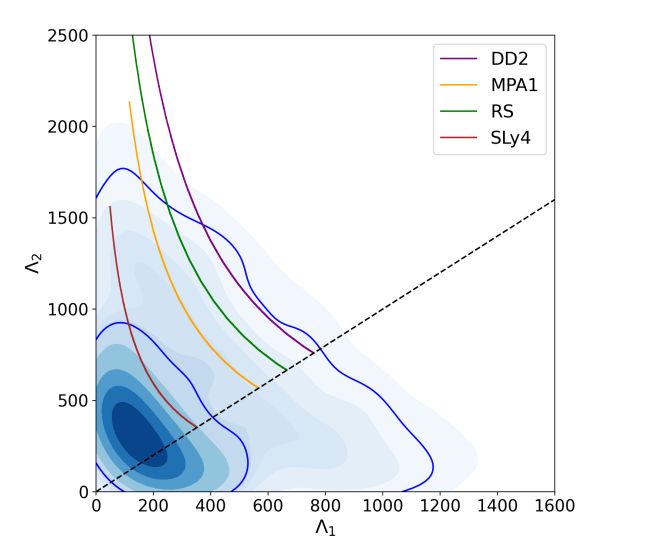
The search for gravitational waves emitted from merging compact objects currently relies on comparing incoming signals with pre-calculated templates, but these templates often overlook crucial details about the internal structure of neutron stars. Lorenzo Piccari and Francesco Pannarale, from the Dipartimento di Fisica, Università di Roma “Sapienza” and INFN Sezione di Roma, demonstrate that ignoring the way neutron stars deform under tidal forces significantly reduces the sensitivity of these searches, particularly for binary neutron star systems. Their work introduces a new technique for building more accurate template banks that incorporates these tidal deformabilities as key parameters, moving beyond the simplification of point-like objects. By adopting a physically motivated approach informed by observations of gravitational wave event GW170817 and constraints on neutron star equations of state, the researchers achieve a substantial reduction in the number of additional templates needed for a comprehensive search, improving the efficiency and effectiveness of gravitational wave astronomy.
Gravitational Wave Detection and Template Bank Creation
This body of work details a comprehensive investigation into gravitational wave detection, encompassing data analysis techniques, waveform modeling, and specific search strategies. Scientists continually refine methods for identifying faint gravitational wave signals amidst noisy data, a process fundamentally reliant on matched filtering, where incoming signals are compared to a library of predicted waveforms. A crucial aspect of this process involves creating template banks, extensive collections of theoretical waveforms that cover the expected range of signal parameters. Efficient template bank construction is paramount, and researchers have developed innovative approaches to optimize template placement and minimize computational cost.
Modern research focuses on improving the efficiency of these template banks, employing techniques like kernel density estimation to adaptively generate proposals for new templates. Scientists also explore stochastic methods for searching continuous or low-mass compact binary signals. Waveform modeling plays a central role, with the Effective One Body (EOB) approach emerging as a dominant technique. Researchers continually refine EOB models to incorporate complex effects like spin and tidal interactions, calibrating them with highly accurate numerical relativity simulations. Understanding the internal structure of neutron stars is critical, as it dictates their response to tidal forces, and scientists model tidal deformability, incorporating neutron star interior physics into waveform models to improve the accuracy of predictions.
Investigations into the equation of state of dense matter within neutron stars utilize sophisticated techniques like Skyrme parametrization and density functional theory. Researchers focus on key parameters like the symmetry energy to constrain the properties of matter at extreme densities. This work extends to specific search strategies, targeting binary black hole mergers, binary neutron star systems, and even massive black hole binaries. Current trends include hybrid waveform models that combine the strengths of EOB and numerical relativity, higher-order corrections to improve accuracy, and the application of machine learning for surrogate modeling and accelerating waveform generation. Combining gravitational wave observations with electromagnetic and neutrino data, known as multi-messenger astronomy, represents a significant frontier in the field.
Tidal Deformability Improves Gravitational Wave Searches
Scientists achieved a significant reduction in the number of templates required for gravitational wave searches by incorporating neutron star tidal deformability into template bank construction, a crucial step for detecting binary neutron star and neutron star-black hole systems. Traditional searches utilize template banks that assume point-like masses, neglecting the subtle effects of tidal deformation caused by the gravitational interaction between inspiralling neutron stars. This work demonstrates that neglecting these effects reduces search sensitivity, particularly for binary neutron star systems where tidal effects are most pronounced. Analysis revealed that a minimum match of 0.
965 is required to ensure that at least 90% of signals are detected, a standard criterion for template bank performance. However, incorporating tidal deformability significantly complicates template bank construction, increasing the dimensionality of the parameter space that must be searched. Previous attempts to account for tidal effects increased the number of templates by 33% compared to point-like template banks, creating a substantial computational burden. To address this challenge, scientists developed a new technique that leverages constraints on the neutron star equation of state, derived from the observation of GW170817 and its electromagnetic counterpart.
By integrating these constraints into a stochastic template placement algorithm, the team substantially reduced the number of additional templates needed. Specifically, the new method requires only 8. 2% more templates, a dramatic improvement over the 33% increase observed in prior work. This breakthrough delivers a more efficient and sensitive approach to gravitational wave astronomy, enhancing the potential for detecting and characterizing compact binary systems. The technique was implemented using the PyCBC software package.
Tidal Deformability Limits Gravitational Wave Searches
This research demonstrates that current methods for searching gravitational waves from compact binary systems may overlook signals due to the neglect of neutron star tidal deformability. The team investigated how ignoring the effects of these deformations, changes in shape caused by gravitational coupling during inspiral, reduces the sensitivity of searches, particularly for binary neutron star systems where tidal effects are most pronounced. To address this limitation, the researchers developed a new technique for constructing template banks that incorporates neutron star tidal deformabilities as a key parameter. Their approach utilizes a physically motivated prior, informed by neutron star mass and constraints from observations of gravitational wave event GW170817, to significantly reduce the number of additional templates required compared to previous methods.
This refined technique requires only 8. 2% more templates, a substantial improvement over the 33% increase proposed in earlier work. The authors acknowledge that their analysis is representative of the current observational run and that future improvements in detector sensitivity may require further refinement of the template construction process. Future research could focus on extending this method to neutron star-black hole systems and exploring the impact of different equation of state models on the accuracy and efficiency of gravitational wave searches.
Tidal Deformability in Template Bank Construction
Scientists developed a novel technique for constructing template banks used in gravitational wave searches, specifically addressing the limitations of current methods that treat neutron stars as point particles. Existing searches, while effective for black hole mergers, neglect the finite size effects of neutron stars, potentially reducing sensitivity to signals near the detection threshold. This work pioneers a method to incorporate neutron star tidal deformability, the degree to which a star bulges under gravitational influence, as a key parameter within the template bank construction process. The team addressed the challenge of accurately representing tidal deformability by moving beyond a uniform distribution of values, which previous attempts employed.
Instead, they adopted a physically motivated approach, linking tidal deformability to the mass of the neutron star and constraints derived from the observation of GW170817, a binary neutron star merger with a detected electromagnetic counterpart. This method leverages the known properties of neutron star matter to refine the parameter space, significantly reducing the number of additional templates required for a comprehensive search. The innovation reduces the need for additional templates by 8. 2%, streamlining the search process without sacrificing sensitivity. This improvement is crucial for detecting weaker signals and probing the equation of state of matter within neutron stars, a key goal of gravitational wave astronomy. The approach enables more precise measurements of tidal deformability, offering insights into the internal structure of these dense celestial objects.
🗞 Accounting for Tidal Deformability in Binary Neutron Star Template Banks
🧠 ArXiv: https://arxiv.org/abs/2509.24461