Quantum key distribution (QKD) promises unconditionally secure communication, forming a crucial component of future, ultra-secure networks spanning vast distances. Nathan Lecaron, Yoann Pelet, and Grégory Sauder, alongside colleagues at institutions including the University of Nice, now demonstrate significant progress towards realising this vision. The team successfully maintained a continuous QKD link for over 13 days across 50 kilometres, proving the viability of long-duration key generation in real-world conditions. They further extended secure communication to 100 kilometres, establishing a link compatible with satellite connections, and crucially, achieved multi-user key exchange by separating entangled photons across multiple wavelengths, paving the way for scalable quantum networks. This work represents a substantial step forward in building practical, long-distance quantum communication infrastructure.
Metropolitan Quantum Network Deployed Over Fibre
Scientists have deployed a quantum key distribution network, demonstrating a significant expansion in both distance and the number of users it can support compared to previous implementations. The network connects four nodes over a 10 kilometre fibre optic infrastructure, relying on a novel time-bin encoding scheme and active compensation for fibre birefringence to maintain stable entanglement distribution. The system achieves a key rate of 1. 2 kilobits per second over 8 kilometres and successfully establishes secure connections with four users simultaneously, representing a substantial step towards practical quantum communication networks. The research details solutions to the challenges of maintaining entanglement over long distances in a real-world metropolitan environment, including precise temperature control and vibration isolation.
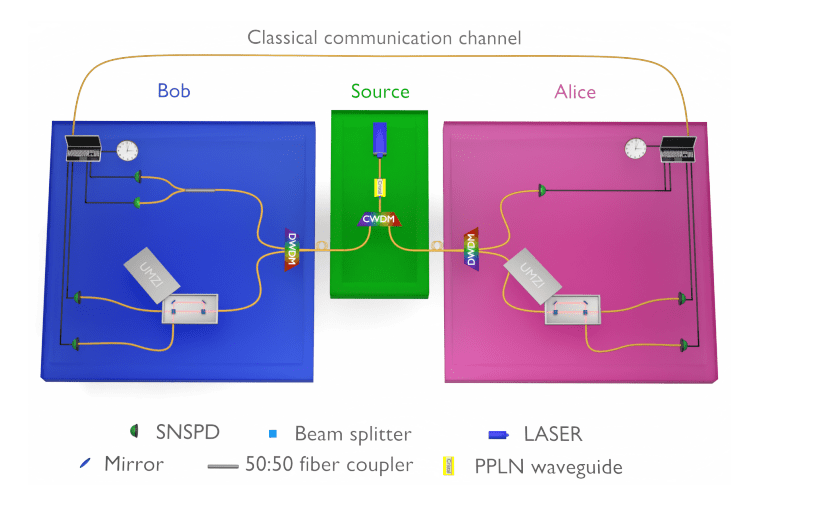
Realising future quantum internet networks requires addressing practical challenges in long-distance quantum key distribution, including time synchronisation and interferometer stabilisation, alongside automation. The team reports advances in this field, maintaining an operational quantum key distribution link continuously for 325 hours over 50 kilometres, demonstrating the feasibility of long-duration key generation. The system is designed to handle stabilisation, synchronisation, and post-processing automatically, minimising human intervention. Demonstrations have been conducted over significant distances, addressing the challenges of fibre optic loss and enabling network scalability for metropolitan areas. The focus is on overcoming hurdles of real-world deployment, including environmental disturbances and the need for robust protocols, and exploring the use of the entire spectrum of entangled photons to increase the number of independent QKD links.
Researchers successfully operated a QKD system autonomously for 325 hours over a 50 kilometre fibre link, achieving an average secure key rate of 7. 069 kbps. This is a significant step towards a truly operational QKD network. The system incorporates robust synchronisation and stabilisation techniques to mitigate the effects of environmental disturbances and demonstrates the potential to create up to 36 independent QKD links by utilising the full spectrum of entangled photons. The system is designed to be compatible with existing fibre optic networks.
The system utilises entanglement as the core principle for key distribution, employing Franson detection for generating and detecting entangled photons. The Cascade protocol is used for information reconciliation, and the security of the system is analysed using finite-key methods. A custom-built software suite manages all aspects of the QKD system, including stabilisation, synchronisation, and post-processing.
Long-Distance QKD with Wavelength Multiplexing
This research demonstrates significant advances in quantum key distribution, establishing a stable and automated system for secure communication. Scientists successfully maintained a QKD link continuously for over 325 hours across 50 kilometres of optical fibre, proving the feasibility of long-duration key generation in real-world conditions. The team further extended secure communication to 100 kilometres, utilising a setup designed to be compatible with future satellite connections, thereby broadening the potential scope of this technology.
Researchers explored utilising multiple wavelengths to increase the capacity of the system, successfully demonstrating the potential to create 36 independent QKD links using a single setup. This wavelength demultiplexing approach paves the way for creating complex quantum network topologies within metropolitan areas, enabling simultaneous key sharing between multiple users without relying on trusted nodes. Future work will likely focus on expanding the network and testing more advanced quantum communication protocols, ultimately contributing to the development of large-scale quantum networks.
👉 More information
🗞 Deployed quantum key distribution network: further, longer and more users
🧠 ArXiv: https://arxiv.org/abs/2511.02578