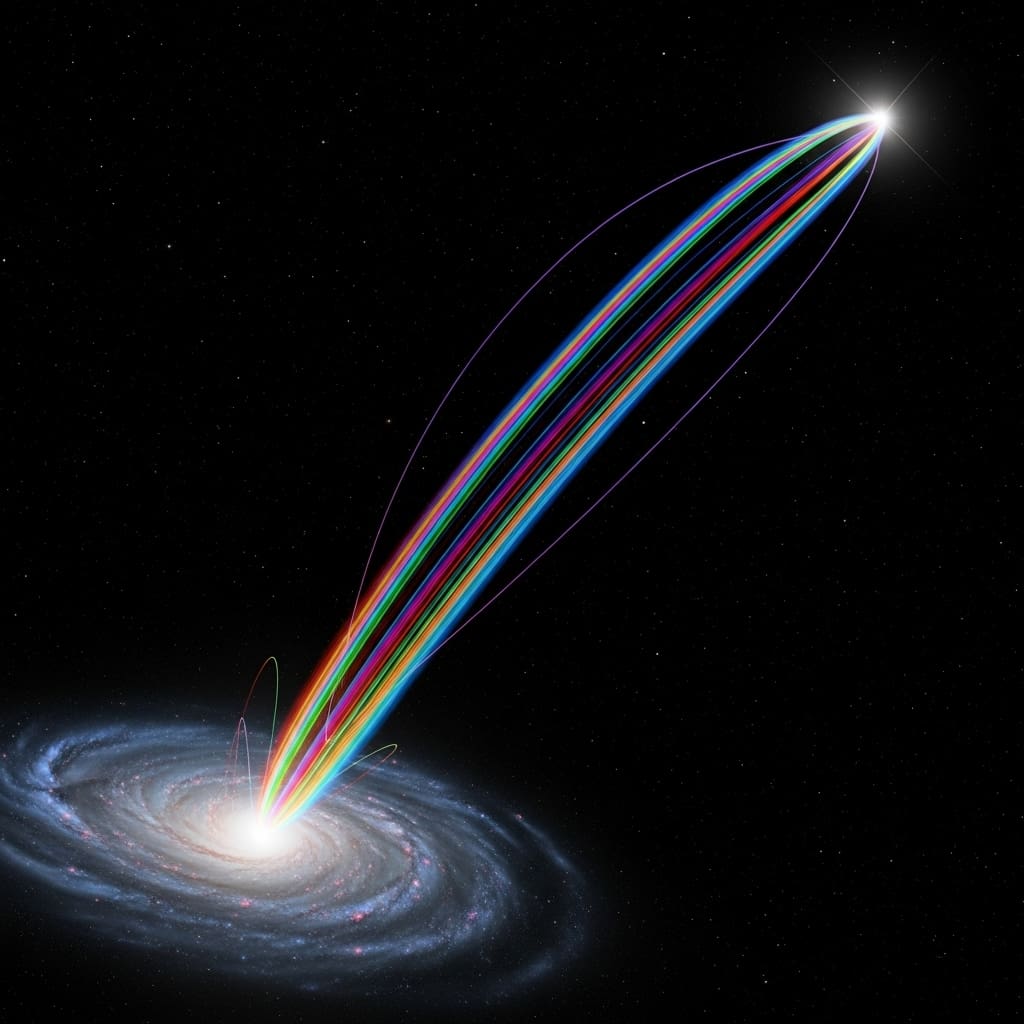
Hypervelocity stars, flung outwards from the Galactic Centre by the immense gravity of the supermassive black hole Sgr A, continue to fascinate astronomers. Manuel Cavieres (Leiden Observatory, Leiden University), Sergey E Koposov (Institute for Astronomy, University of Edinburgh), and Elena Maria Rossi (Leiden Observatory, Leiden University), alongside Zephyr Penoyre, Sill Verberne et al, have discovered a particularly compelling candidate , DESI-312 , using data from the Dark Energy Spectroscopic Instrument and Gaia. This star’s trajectory confidently points back to the Galactic Centre, and its unique supersolar metallicity distinguishes it from other known halo stars. Significantly, DESI-312 is a main sequence or early subgiant star, offering an unprecedented opportunity to analyse the chemical composition of the Galaxy’s central regions without the usual obscuring dust and crowding , a vital step towards understanding the extreme environment around Sagittarius A.
The study meticulously analysed the star’s position, velocity, and chemical composition, revealing a supersolar metallicity of [Fe/H] = 0.27±0.09, a characteristic distinct from other stellar populations with radial orbits.
Its inferred ejection velocity from the Galactic Centre is 698+35 −27, consistent with a ‘Hills mechanism’ ejection, a process where a binary star system is disrupted by the black hole, launching one star into an unbound orbit. Researchers rigorously considered alternative origins, such as ejections from young clusters or globular clusters, but these scenarios could not simultaneously explain both the star’s orbit and its unique metallicity. This crucial difference enables a detailed chemical analysis of its atmosphere, providing an unprecedented, unobstructed view into the composition of the central regions of the Galaxy, free from the obscuring effects of dust and stellar crowding.
The work opens a new window for understanding the formation and evolution of stars in the extreme environment surrounding Sagittarius A. The combined data from DESI and Gaia provides a complete six-dimensional phase-space map, enhancing the precision of the star’s trajectory and confirming its origin. Furthermore,0.122 kpc to Sgr A, a solar three-dimensional velocity of (12.9, 245.6, 7.78) km s−1, and a solar height of 20.8 pc above the Galactic plane. A preliminary selection criterion of |Vr f | 300km s−1 was applied to remove most disc objects, retaining faster, potentially bound, GC ejecta, resulting in a sample of 54,475 stars. Crucially, the team pioneered the use of backward orbit integration with the AGAMA package to investigate the origins of these candidates, adopting the Price-Whelan 2017 potential, a detailed Milky Way mass model comprising a nucleus, bulge, Miyamoto-Nagai discs, and an NFW dark matter halo. Experiments employed 1000 Monte Carlo samples per star, generated by Gaussian sampling of uncertainties in radial velocity, proper motion, and distance, and integrated backward in time over 0.5 Gyr using adaptive time steps.
The team recorded Galactic plane crossings during integration, calculating a ‘GC crossing ratio’, the fraction of samples crossing the plane within 1 kpc of the GC, to assess the likelihood of a GC origin. Any star exhibiting a ratio_gc ≥ 0.5 was flagged as a candidate GC ejecta, a threshold designed to capture both bound and unbound HVSs, unlike many previous studies. Measurements confirm the star’s location in the inner halo, exhibiting a supersolar metallicity of [Fe/H], distinct from other known stellar populations with radial velocities. Data shows the star’s Gaia measurements include a parallax of 0.231 ±0.082 mas, proper motions of Gaia μα cos δ = −12.6 ±0.0864 mas yr−1 and Gaia μδ = −13.8 ±0.069 mas yr−1, and an apparent magnitude of G = 17.1246 mag. Spectroscopy from DESI yielded a radial velocity of −172 ±0.62km/s, an effective temperature of 5579.3 ±29.1 K, a surface gravity of log g = 4.21 ±0.0651 dex, and a metallicity of [Fe/H] = 0.263 ±0.027 dex.
The team recorded a v sin i of 0.01km/s and a heliocentric distance of 4.78 ±0.83 kpc. Tests prove that applying a methodology focused on supersolar metallicity ([Fe/H] 0) effectively mitigated contamination from Gaia Enceladus-SaGa stream (GSE) stars, which typically exhibit metallicities peaking at [Fe/H] ∼−1.6 and quenching at [Fe/H] ∼−0.5. Furthermore, comparison with the well-studied HVS S5-HVS1, which has a metallicity of [Fe/H] 0.29 ±0. This star’s trajectory has been confidently traced back to the GC, exhibiting a velocity consistent with a Hills ejection mechanism, which involves disruption of a binary star system by the supermassive black hole Sgr A. The research team employed a robust methodology, transforming stellar positions and velocities into a Galactocentric reference frame and utilising backward orbit integration with the AGAMA package to confirm the GC origin. Quality selections were applied to the DESI and Gaia data to ensure reliable astrometry and spectroscopic measurements, resulting in a refined sample of potential HVS candidates. The authors acknowledge a limitation in their analysis, noting that the assumed Galactic potential model introduces some uncertainty in the orbit integrations. Future research will focus on refining the Galactic potential model and expanding the search for HVSs to larger datasets, potentially revealing more stars ejected from the GC and improving our understanding of the dynamics of the Milky Way’s central regions. This discovery contributes to a growing body of evidence supporting the role of the supermassive black hole in shaping the Galactic halo and provides a valuable probe of the extreme physical conditions near Sgr A.
👉 More information
🗞 Discovery of Galactic center ejected star in DESI DR1
🧠 ArXiv: https://arxiv.org/abs/2601.19866