Networks represent a crucial infrastructure for linking advanced technologies and unlocking applications in areas such as computing, cryptography, and precision measurement. Researchers continually seek ways to extend their reach and enhance security. Mi Zou, Yu-Ming He, Yizhi Huang, and colleagues demonstrate a significant step forward in this field by realising a new network architecture that utilises an ‘untrusted intermediate relay’. This innovative system employs a high-quality single-photon source to facilitate communication and entanglement distribution, achieving a repetition rate exceeding 300 MHz and successfully establishing secure key exchange over fibre optic cables spanning up to 300 kilometres. The team’s work highlights the potential of this approach to enhance information transmission, broaden network coverage, and offer greater flexibility in future network deployments.
Quantum Repeaters Extend Secure Communication Distance
Quantum Key Distribution (QKD) promises fundamentally secure communication by leveraging the principles of quantum mechanics to establish encryption keys. A major obstacle to widespread QKD adoption is distance, as quantum signals weaken significantly while travelling through optical fibers. Recent research focuses on overcoming these limitations and extending the range of secure communication, exploring technologies like quantum repeaters, which amplify and relay quantum signals, and improvements to single-photon generation and detection. Scientists are also integrating these components onto chips to create more stable and compact QKD systems.
Another promising approach involves using satellites to distribute quantum keys over vast distances, bypassing the limitations of fiber optic cables. Twin-Field Quantum Key Distribution (TF-QKD) is gaining prominence due to its ability to achieve higher key rates and longer distances compared to earlier methods. To ensure reliability, researchers employ techniques like the decoy-state protocol, which mitigates signal loss and detector imperfections. Recent advancements have demonstrated QKD over hundreds of kilometers, and even intercontinental distances using satellite links, indicating progress towards practical and deployable systems designed for integration with existing communication networks.
Key components driving these advancements include quantum dots, serving as efficient single-photon sources, and integrated silicon photonics, enabling the miniaturization of quantum optical circuits. Highly sensitive detectors, such as Superconducting Nanowire Single-Photon Detectors, are crucial for accurately detecting single photons. This system utilizes a high-quality single-photon source operating at a high repetition rate, demonstrating key establishment over fiber optic cables extending up to 300 kilometers. The team developed a method for transmitting secure information using a variant of twin-field quantum key distribution, incorporating a phase-matching scheme and the decoy-state method, confirming the establishment of a quantum channel capable of distributing distillable entanglement. Scientists harnessed a pulse laser generating narrow light pulses, which were then multiplied in frequency to achieve the desired emission rate.
A single quantum dot, coupled to a specialized cavity, is resonantly excited by these pulses, resulting in the emission of single photons. To selectively emit photons at desired times, an electro-optic modulator eliminates specific excitation pulses, ensuring precise control over photon emission. Researchers converted the single-photon wavelength to the telecommunication wavelength using a specialized waveguide pumped by a continuous-wave laser, ensuring compatibility with existing optical fiber systems. To verify the indistinguishability of the photons, scientists measured the interference visibility between single photons and coherent light pulses at the measurement nodes. This involved detailed analysis of coincidence counts, allowing them to calculate the visibility as a function of detection time window, intensity ratio, and transmission distance. The experimental results closely matched theoretical predictions, demonstrating the potential of this approach for building future quantum networks capable of long-distance quantum communication.
Five-Node Network Enables Scalable Quantum Communication
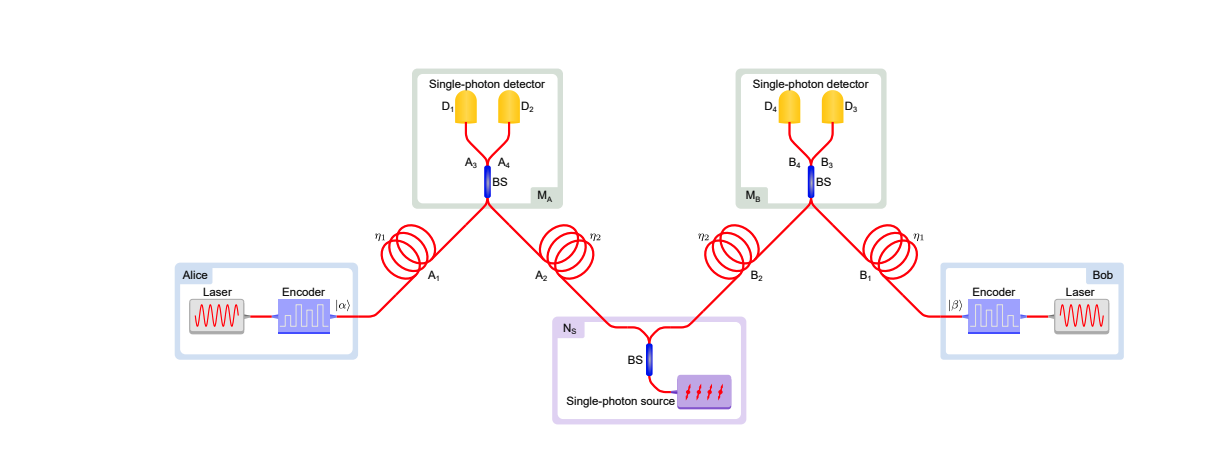
Researchers have developed a novel five-node quantum network structure that significantly expands the potential of long-distance quantum communication. This breakthrough delivers a scalable architecture incorporating three untrusted intermediate nodes, a single-photon source, and two measurement nodes, functioning as quantum relays. The team achieved a high repetition rate, demonstrating a substantial improvement in data transmission speed for quantum networks. This modular design overcomes limitations of previous systems, which often relied on a single relay node and struggled with scalability. The network operates by entangling single photons emitted from a central source with light pulses sent by two users, Alice and Bob.
Experiments reveal that this interference-based process enables secure information transfer, even when the intermediate nodes are untrusted, removing stringent security and placement constraints. The system successfully implements a variant of twin-field quantum key distribution, utilizing a decoy-state method to ensure secure communication. Data confirms that the network can establish quantum correlations over distances up to 300 kilometers, extending the reach of quantum communication significantly. This five-node structure introduces a three-layer star configuration, enhancing the signal-to-noise ratio and improving the robustness of individual links. The design addresses key challenges in quantum network scalability by enabling complex topologies and facilitating implementation in diverse communication scenarios. By integrating quantum relay nodes, the team demonstrates a practical pathway toward more flexible and adaptable quantum networks, paving the way for future applications in secure communication, distributed quantum computing, and advanced metrology.
Quantum Relay Enables 300km Secure Communication.
This research demonstrates a functional quantum relay platform built around a single-photon source, successfully establishing secure key distribution over fiber optic cables spanning up to 300 kilometers. The system employs a modular architecture with intermediate nodes, enhancing both the capacity and flexibility of quantum networks. By utilising a high-quality single-photon source, the relay overcomes distance limitations inherent in direct quantum communication, paving the way for expanded network coverage and more practical deployment scenarios. The findings suggest that quantum dot single-photon sources are well-suited for use as effective relays in quantum networks, and that this technology could also facilitate entanglement distribution between different quantum systems. Future work could explore the compatibility of this relay structure with various light sources, potentially broadening its applicability and versatility within emerging quantum technologies.
🗞 Realization of an untrusted intermediate relay architecture using a quantum dot single-photon source
🧠 ArXiv: https://arxiv.org/abs/2508.21479