Quantum secure direct communication offers an inherently secure method for transmitting information, relying on the fundamental laws of physics to guarantee privacy, but practical limitations in transmission rates have hindered its widespread adoption. Min Wang from the Beijing Academy of Quantum Information Sciences, Gui-Fa Zhu from Guangxi Normal University, and Guo-Fei Long from Beijing TGW Quantum Technology Co., LTD, alongside colleagues, now demonstrate a significant advance by integrating semantic communication principles with quantum secure direct communication. The team successfully applies this approach to transmit 3D point cloud data, achieving a remarkable 46. 30-fold increase in efficiency compared to direct transmission methods and exceeding the established limits of both Wyner and Shannon capacity. This breakthrough not only promises to unlock the potential for large-scale deployment of quantum secure communication systems, but also represents a fundamental step forward in the field of information science by simultaneously boosting data rates and enhancing security.
Rooted in the inviolable fundamental laws of quantum mechanics, QSDC enables ultra-sensitive detection of even the faintest eavesdropping attempts, guaranteeing true communication security solely when no interference exists. If eavesdropping or intrusion is detected mid-transmission, the system instantly terminates the process, preserving confidentiality. This approach fundamentally differs from traditional cryptographic methods, which rely on computational complexity rather than physical laws to protect information.
The research focuses on enhancing the practical implementation of QSDC systems, specifically addressing challenges related to signal degradation and distance limitations. Investigations explore novel encoding schemes and optimised detection strategies to improve both the communication rate and the security level of QSDC protocols. These advancements aim to move QSDC from a theoretical possibility towards a viable technology for secure data transmission in real-world scenarios.
Semantic Communication Boosts Quantum Security
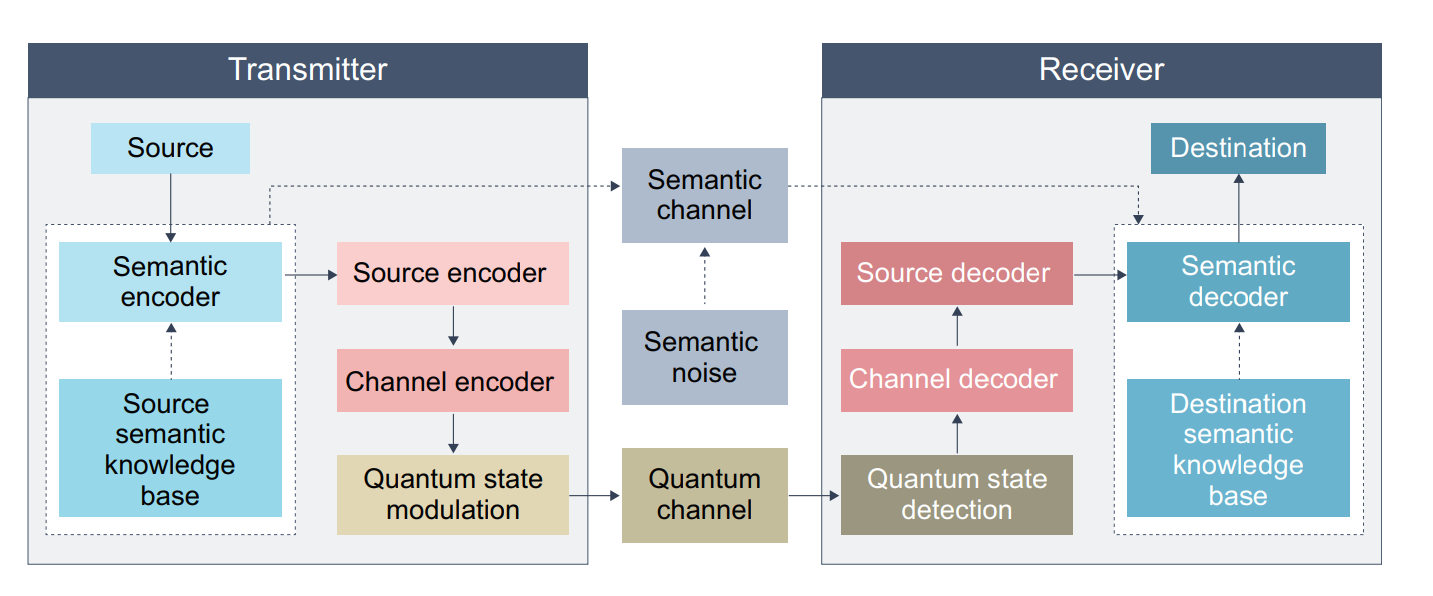
This research delivers a breakthrough in secure communication, achieving kilobit-per-second transmission over 100km of commercial optical fiber while guaranteeing data security. Scientists developed a semantic communication scheme, applied to 3D point clouds, that achieves a 46. 30-fold efficiency gain over direct transmission, surpassing both Wyner and Shannon capacity limits. This advancement addresses a critical bottleneck in quantum secure direct communication (QSDC), paving the way for large-scale deployment. Deep learning techniques, including PointNet, graph convolutional networks, and diffusion models, are used to encode point cloud data into a semantic representation and decode it at the receiver.
This allows for compression and noise reduction, improving communication performance. Experiments demonstrate that the system maintains a quantum bit error rate (QBER) of 3. 31%, well below the threshold for one-way QSDC protocols. During three hours of data collection over a 50km fiber link, the average communication rate reached 37. 36 kbps, ensuring safe and smooth transmission of semantic codes.
Researchers measured encoding times of approximately 4ms and decoding times of approximately 1. 5ms, demonstrating negligible processing delays compared to channel latency. Further analysis revealed that utilizing a saturated channel reduced transmission time significantly, demonstrating the efficiency of semantic communication in balancing transmission speed and reconstruction quality, crucial for real-time applications. The system achieved equivalent data rates ranging from 1591. 52 kbps to 263. 05 kbps for varying semantic code lengths.
Kilobit Secure Communication Over 100km Fibre
This research demonstrates a significant advancement in quantum secure direct communication, achieving a substantial improvement in transmission efficiency through the integration of semantic communication principles. By extracting essential information and eliminating redundancy from 3D point cloud data, the team has experimentally validated a scheme that delivers a 46. 30-fold increase in efficiency compared to direct transmission methods. This surpasses the limits of conventional Shannon and Wyner capacity while maintaining secure communication. The system achieves kilobit-per-second transmission over 100km of commercial optical fiber, a crucial step towards practical, large-scale deployment of QSDC systems.
Researchers measured encoding times of approximately 4ms and decoding times of approximately 1. 5ms, demonstrating negligible processing delays compared to channel latency. Further analysis revealed that utilizing a saturated channel reduced transmission time significantly, demonstrating the efficiency of semantic communication in balancing transmission speed and reconstruction quality, crucial for real-time applications. The system achieved equivalent data rates ranging from 1591. 52 kbps to 263. 05 kbps for varying semantic code lengths. This work represents a significant step forward in secure communication technologies, offering both enhanced efficiency and robust security.
Semantic Communication Boosts Quantum Security Efficiency
This research demonstrates a significant advancement in quantum secure direct communication, achieving a substantial improvement in transmission efficiency through the integration of semantic communication principles. By extracting essential information and eliminating redundancy from 3D point cloud data, the team has experimentally validated a scheme that delivers a 46. 30-fold increase in efficiency compared to direct transmission methods. This surpasses the limits of conventional Shannon and Wyner capacity while maintaining secure communication. The findings represent a pivotal step towards practical, large-scale deployment of quantum secure direct communication systems, addressing a key limitation of previous approaches: insufficient transmission rates. While acknowledging that semantic communication models require further refinement to improve generalisation and minimise noise, and that quantum channels remain susceptible to environmental interference, the researchers highlight the potential for this technology to underpin future applications in areas such as smart cities, intelligent transportation, and secure communications networks. Future work will likely focus on developing efficient quantum repeaters and error-correction schemes to extend transmission distances and enhance system robustness, paving the way for widespread adoption of this innovative communication paradigm.
🗞 Quantum Semantic Communication Beyond the Shannon-Wyner Channel Capacity
🧠 ArXiv: https://arxiv.org/abs/2511.07760