The increasing power of quantum computers presents a significant threat to current digital security systems, demanding new approaches to protect sensitive processes like electronic voting. Ashwin Poudel, Utsav Poudel, and Dikshyanta Aryal, alongside Anuj Nepal, Pranish Pathak, and Subramaniyaswamy V, address this challenge with a novel e-voting framework that combines quantum-resistant cryptography with blockchain technology. Their system employs advanced lattice-based digital signatures and biometric authentication to ensure voter identity and prevent fraud, while a permissioned blockchain guarantees tamper-proof storage of votes and complete auditability. Demonstrating both high accuracy in spoof detection and minimal computational overhead, this research offers a practical and resilient solution to the critical need for secure and trustworthy digital elections, paving the way for more accessible and reliable democratic processes.
Post-Quantum Secure E-Voting Architecture Design
This research introduces a new electronic voting architecture designed to withstand the emerging threat of quantum computing. The system leverages advancements in post-quantum cryptography to ensure the confidentiality and integrity of votes, even when facing attacks from powerful quantum computers. Specifically, the architecture incorporates cryptographic methods designed to resist known quantum algorithms, providing a forward-looking security solution for democratic processes. The proposed framework aims to deliver a robust and reliable e-voting system capable of maintaining voter privacy and election accuracy in the quantum era.
Facial Blockchain Registration with Lattice Cryptography
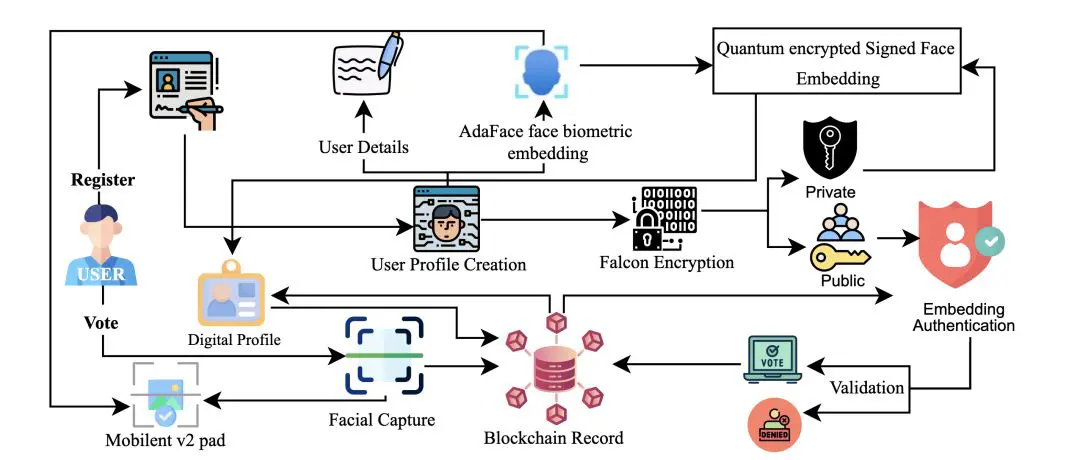
This study pioneers a post-election voting architecture integrating several advanced technologies to ensure secure and verifiable elections, beginning with voter registration. The process captures facial embeddings, which are digitally signed using Falcon, a lattice-based cryptographic signature scheme, and stored on a permissioned blockchain, guaranteeing data integrity and preventing unauthorized modification. Falcon was selected due to its resistance to both classical and quantum attacks, its compact signature size, and its efficiency in resource-constrained environments. The system employs MobileFaceNet, a lightweight convolutional neural network, to extract these facial embeddings, optimizing real-time face verification on mobile devices.
During the voting process, real-time biometric verification is performed, utilizing anti-spoofing techniques to prevent fraudulent access. The system enhances its capabilities by integrating Red-Green-Blue (RGB) input with alternative sensing modalities like Near-Infrared (NIR), depth, and thermal imaging, significantly improving detection of advanced three-dimensional (3D) mask attacks. To further refine accuracy, the study incorporates AdaFace, a framework that dynamically adjusts margins based on image quality, using a ResNet-50 network to create 512-dimensional facial embeddings. Input images undergo detection, alignment, and resizing to 112×112 pixels before embedding creation.
The system monitors performance using Prometheus and Grafana for real-time auditing, demonstrating low latency and robust spoof detection. Extensive testing on the CelebA Spoof dataset yielded average classification error rates (ACER) below 3. 5%, while the Wild Face Anti-Spoofing (WFAS) dataset showed ACER under 8. 2%. Blockchain anchoring incurs minimal overhead, with approximately 3. 3% gas usage for registration and only 0. 15% for voting, ensuring system efficiency and scalability.
Biometric Blockchain Voting System Secures Elections
The research team has developed a novel electronic voting framework integrating Falcon lattice-based digital signatures, biometric authentication utilizing MobileNetV3 and AdaFace, and a permissioned blockchain for secure vote storage, creating a unified and resilient architecture. Voter registration involves capturing facial embeddings, which are digitally signed with Falcon and stored on the blockchain, ensuring data integrity and preventing unauthorized modification. During the voting process, real-time biometric verification is performed, employing anti-spoofing techniques and cosine-similarity matching to confirm voter identity. Experiments demonstrate the system achieves low latency and robust spoof detection capabilities, monitored through Prometheus and Grafana for real-time auditing and transparency.
Specifically, the average classification error rate (ACER) remains below 3. 5% when tested on the CelebA-Spoof dataset and under 8. 2% on the more challenging Wild Face Anti-Spoofing (WFAS) dataset, demonstrating high accuracy in identifying fraudulent attempts. Blockchain anchoring incurs minimal overhead, with only approximately 3. 3% gas cost for voter registration and 0.
15% for each vote cast, ensuring system efficiency and scalability. The experimental results confirm the system’s ability to operate efficiently under concurrent loads. This work delivers a significant advancement in secure voting technology, offering a tamper-proof and quantum-resistant solution for digital systems.
Biometric Blockchain Voting System Achieves Efficiency
This research presents a novel electronic voting system integrating biometric authentication with post-quantum cryptography and blockchain technology, addressing critical challenges in secure and verifiable digital elections. The team successfully developed a pipeline combining facial recognition, anti-spoofing measures, and Falcon lattice-based encryption, achieving real-time biometric verification with latency under 12 milliseconds even under substantial system load. Blockchain integration ensures tamper-proof vote storage with minimal overhead, demonstrated by gas consumption rates of approximately 3. 3% for registration and 0.
15% for voting, supporting both auditability and transparency. The system demonstrates a strong balance between accuracy, security, and computational efficiency, with biometric classification error rates below 3. 5% on standard datasets. While the current work establishes a robust foundation, the authors acknowledge the potential for future improvements, specifically exploring lightweight temporal models to enhance liveness detection through analysis of video data. This ongoing research aims to further optimise performance and scalability, paving the way for secure and efficient digital democratic infrastructures.
🗞 A Quantum-Secure and Blockchain-Integrated E-Voting Framework with Identity Validation
🧠 ArXiv: https://arxiv.org/abs/2511.16034