The increasing demand for connected vehicle technology necessitates robust and reliable communication systems, and researchers are now focusing on optimising 5G Vehicle-to-Everything (V2X) communication for critical applications such as road safety and autonomous driving. Dmitry Bankov, from the Institute for Information, along with Artem Krasilov, Artem Otmakhov, and colleagues, investigate a key aspect of this technology, specifically focusing on ‘Mode 2’ communication, where vehicles independently manage transmission resources. Their work addresses the challenges of delivering timely data in scenarios involving sporadic, unpredictable traffic, for example, a vehicle broadcasting a warning upon detecting a hazard. By analysing the performance of this communication mode, the team proposes several improvements that demonstrably increase system capacity by up to 40%, paving the way for more effective and reliable vehicle-to-everything communication systems.
V2X Performance Boost for Sporadic Alerts
This research investigates methods to enhance 5G Vehicle-to-Everything (V2X) Mode 2 performance, particularly when handling sporadic traffic such as emergency alerts or sudden hazard warnings. Scientists propose and analyse several approaches, combining algorithmic improvements with advanced communication techniques. A key focus is optimising how vehicles select communication channels for initial transmissions, a readily implementable improvement that simulations show can increase system capacity by up to 40% in future V2X networks. Furthermore, the team explored more sophisticated decoding algorithms for the Physical Sidelink Control Channel (PSCCH), utilising an ideal decoding method based on successive interference cancellation to improve data delivery reliability by up to 20%.
The findings demonstrate that resource selection algorithms offer the most readily implementable performance boost, while advanced PSCCH decoding provides incremental improvements. Full-duplex communication holds promise, but requires substantial hardware and algorithmic complexity to achieve significant gains. Overall, this work demonstrates that a combination of algorithmic optimisation and advanced communication techniques can significantly improve the performance of 5G V2X Mode 2 for sporadic traffic, paving the way for more reliable and efficient vehicle communication.
Vehicular Mode 2 Access for Low Latency
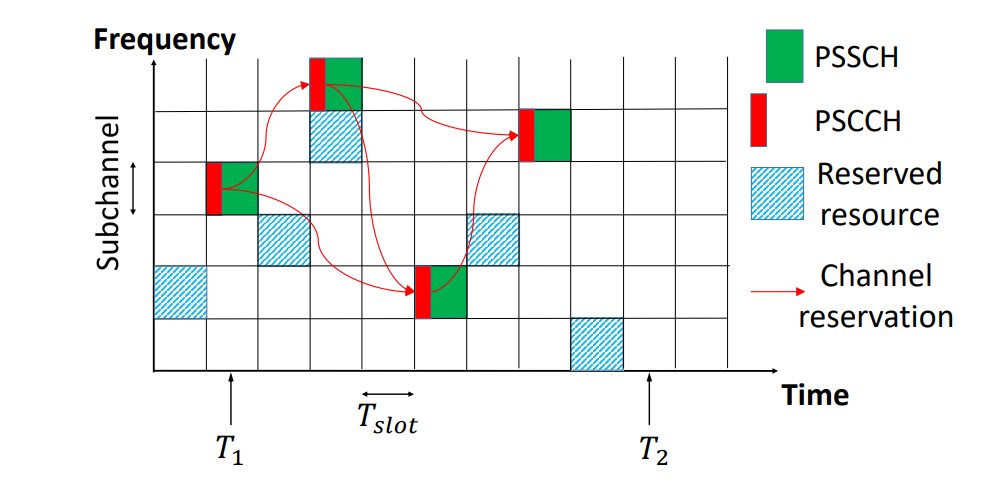
Scientists have achieved significant advancements in 5G Vehicle-to-Everything (V2X) networks, crucial for autonomous vehicles and road safety applications. Recognising the need for timely and reliable communication, they investigated two channel access methods, Mode 1 and Mode 2, concentrating on Mode 2, where vehicles autonomously select resources for transmission, minimising latency. Researchers developed a system-level simulation environment to analyse Mode 2 performance with sporadic traffic, focusing on Decentralized Environmental Notification Messages (DENMs), critical alerts requiring low latency and high reliability. The simulation modelled vehicles generating DENMs at random times, mirroring real-world emergency scenarios, and assessed the impact of various approaches to improve system capacity. The team implemented a resource reservation mechanism within Mode 2, allowing vehicles to inform neighbouring vehicles about future transmission locations, reducing interference during retransmissions. Through simulations, they demonstrated that the proposed approaches can increase network capacity by up to 40%, significantly improving the performance of future V2X systems and ensuring reliable communication in critical driving situations.
Enhanced 5G V2X Capacity for Road Safety
Scientists have achieved significant advancements in 5G Vehicle-to-Everything (V2X) communication, specifically focusing on improving data delivery for road safety and autonomous vehicle applications. The research addresses the need for timely and reliable communication between vehicles and infrastructure, utilising two channel access methods, Mode 1 and Mode 2. This work concentrates on Mode 2, where vehicles autonomously select resources for transmission, crucial for sporadic traffic like Decentralized Environmental Notification Messages (DENMs) generated when a vehicle detects a dangerous situation. Experiments demonstrate that the proposed enhancements to Mode 2 can increase system capacity by up to 40%, while maintaining a low level of complexity. The team focused on sporadic traffic, where a vehicle generates a packet at a random time when a dangerous situation is detected, imposing strict requirements on delay and reliability. Measurements confirm that the optimised Mode 2 system can effectively handle stringent Quality of Service (QoS) requirements, delivering critical safety information with minimal delay and packet loss.
Enhanced 5G V2X for Sporadic Traffic
This research presents significant advances in the performance of 5G Vehicle-to-Everything (V2X) communication, specifically focusing on Mode 2 operation for sporadic traffic scenarios. The team analysed the existing Mode 2 system and identified opportunities to improve its capacity and reliability, crucial for time-sensitive applications like road safety and autonomous driving. Through simulation, they demonstrate that their proposed enhancements can increase system capacity by up to 40%, maintaining a low level of complexity. The work extends beyond previous studies by investigating the Mode 2 resource reservation mechanism under stringent latency and reliability requirements. The team’s analysis of orthogonal resource allocation for both Cooperative Awareness Messages and Dissemination messages provides valuable insights into optimising performance in challenging communication environments. This research contributes a practical pathway towards more efficient and dependable communication for connected and autonomous vehicles.
🗞 Enhancing 5G V2X Mode 2 for Sporadic Traffic
🧠 ArXiv: https://arxiv.org/abs/2510.17395