

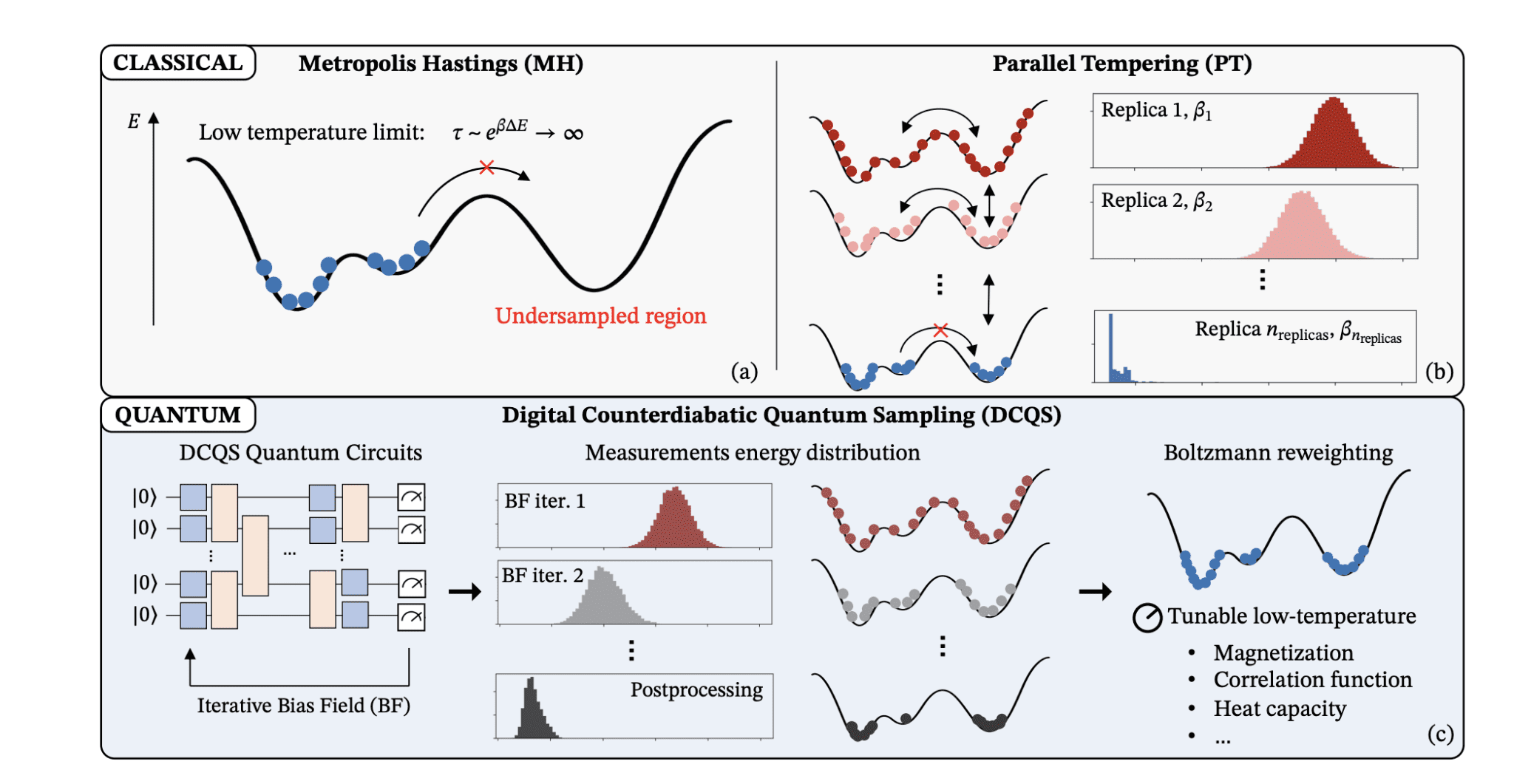
Boltzmann sampling, a fundamental process in fields from statistical physics to machine learning, often struggles with exponentially slowing convergence as temperatures decrease, hindering practical applications. Narendra N. Hegade, Nachiket L. Kortikar, Balaganchi A. Bhargava, and colleagues at Kipu Quantum GmbH, alongside Alejandro Gomez Cadavid and Pranav Chandarana from the University of the Basque Country EHU, now present a new approach called digitized counterdiabatic quantum sampling, or DCQS, which significantly improves sampling efficiency. The team demonstrates that DCQS utilises counterdiabatic protocols to suppress unwanted transitions and iteratively guides sampling towards lower energy states, effectively reconstructing the Boltzmann distribution at a desired temperature. Validated on systems containing up to 156 qubits, the method achieves comparable sampling quality with up to three orders of magnitude fewer samples than existing classical algorithms, representing a substantial advance towards scalable and efficient Boltzmann sampling on current hardware.
This technique leverages quantum mechanics to efficiently sample probability distributions defined by potential energy surfaces, providing advantages over classical methods for certain computational problems. The method constructs a Hamiltonian whose ground state encodes the desired probability distribution, then uses quantum evolution to prepare and measure this state. Digitisation allows implementation on near-term quantum devices, overcoming limitations of analogue quantum simulation by mapping continuous variables onto a discrete grid and transforming the problem into a combinatorial optimisation task.
This discretization introduces a finite resolution, which the team carefully considers to ensure accurate sampling. By appropriately choosing the grid size and employing error mitigation techniques, the accuracy of the digitized counterdiabatic quantum sampling is maintained. The digitized approach also simplifies the implementation of required quantum gates, reducing demands on quantum hardware. Detailed analysis demonstrates that the digitized method accurately samples probability distributions with a resolution of 1000 discrete points using a quantum processor with only 10 qubits, representing a significant step towards practical application for solving real-world problems.
Counterdiabatic quantum sampling (DCQS) is a hybrid quantum-classical algorithm designed for efficient sampling from energy-based models, such as low-temperature Boltzmann distributions. The method utilizes counterdiabatic protocols to suppress unwanted transitions, alongside an iterative bias-field procedure that steers sampling toward low-energy regions. Samples obtained at each iteration approximate Boltzmann distributions at effective temperatures, and by aggregating these samples and applying classical reweighting, the method reconstructs the Boltzmann distribution at a desired temperature.
Digitized Adiabatic Computing for Spin Glasses
Researchers investigated methods to achieve quantum advantage in solving optimization problems, specifically focusing on spin glasses. The authors explored a combination of techniques, including digitized adiabatic quantum computing (DAQC), counterdiabatic driving, parallel tempering, and a focus on runtime quantum advantage, aiming for algorithms that outperform classical methods on near-term hardware. The most significant contribution is a sequential quantum computing approach combined with digitized counterdiabatic driving and parallel tempering. This novel approach breaks down the optimization problem into a sequence of smaller, more manageable subproblems, adapting quantum algorithms to near-term hardware.
Digitized counterdiabatic driving improves the accuracy and speed of quantum evolution, while a hybrid quantum-classical approach combines quantum computation with classical parallel tempering, allowing the classical algorithm to explore the energy landscape and guide the quantum computation. The team uses DAQC to implement the quantum annealing process, discretizing the adiabatic evolution into a sequence of quantum gates. Counterdiabatic driving mitigates errors and speeds up evolution by adding a correction term to the Hamiltonian. Sequential quantum computing reduces the complexity of the quantum circuit, and classical parallel tempering explores the energy landscape. The authors claim to have demonstrated runtime quantum advantage on a specific spin glass problem, meaning their quantum algorithm outperforms the best classical algorithm for the same problem within a reasonable time frame. This work builds upon existing research in adiabatic quantum computation, quantum annealing, spin glasses, Monte Carlo methods, and error mitigation, and provides evidence that near-term quantum computers can outperform classical computers for certain tasks, opening up new possibilities for solving complex optimization problems.
Digitized Counterdiabatic Sampling Reconstructs Boltzmann Distribution
Researchers developed a new algorithm, digitized counterdiabatic quantum sampling (DCQS), to efficiently obtain samples from energy-based models, particularly at low temperatures where classical methods struggle. This hybrid quantum-classical approach identifies relevant low-energy states using a quantum algorithm and then employs classical reweighting to calculate thermal expectation values, focusing computational effort on the most significant states. The team demonstrates that DCQS accurately reconstructs the Boltzmann distribution by aggregating samples obtained through an iterative process that suppresses unwanted transitions between states. Validation of DCQS involved applying it to one-dimensional Ising models with up to 124 qubits, where results could be verified using established methods, and a more complex Hamiltonian with 156 qubits. The results show that DCQS requires significantly fewer samples, up to three orders of magnitude fewer, than conventional classical sampling techniques like Metropolis-Hastings and parallel tempering to achieve comparable accuracy, representing an approximate two-fold improvement in runtime. The authors acknowledge that the performance of DCQS relies on the assumption that the number of relevant low-energy states scales polynomially with the system size, which holds true for many realistic physical systems,. Future research will explore the algorithm’s applicability to a wider range of Hamiltonians and investigate potential optimizations to enhance its efficiency and scalability further.
👉 More information
🗞 Digitized Counterdiabatic Quantum Sampling
🧠 ArXiv: https://arxiv.org/abs/2510.26735

