-The attosecond dynamics of electrons in solids represent a frontier in modern physics, yet understanding how quickly these processes lose coherence remains a significant challenge. Researchers led by D. N. Purschke, D. Vick, and A. Cárdenas, along with colleagues including N. Haram, P. Bastani, and S. Gholam-Mirzaei, now demonstrate a dramatic interplay between enhanced electron tunnelling and disorder-driven decoherence within silicon. Their work reveals that transitioning from crystalline to amorphous silicon boosts tunnelling rates by over 250times, while simultaneously introducing disorder that limits the coherence of electron-hole pairs, effectively damping their polarization over just a few atomic spacings. This research not only provides a unique insight into the timescales of attosecond decoherence in strong-field phenomena, but also establishes high-harmonic generation spectroscopy as a powerful new technique for probing structural disorder and even achieving targeted laser annealing of nanoscale silicon structures, opening exciting possibilities for future lightwave nanoelectronics.
Extending High-Harmonic Generation to New Regimes
High-harmonic generation (HHG) extends to previously unexplored spectral regions and materials, targeting the mid-infrared and terahertz portions of the electromagnetic spectrum. This research investigates the fundamental limits of HHG in solid materials, aiming to overcome challenges that typically limit the efficiency of harmonic generation. Sophisticated simulations, based on time-dependent density functional theory, predict the efficiency of harmonic generation and optimise experimental conditions by accounting for the complex interaction between the laser field, the material’s electronic structure, and the generated harmonics. Experimentally, the team employs thin films of transition metal dichalcogenides, materials known for their unique electronic and optical properties, as the HHG medium.
The research demonstrates efficient HHG from a single layer of tungsten diselenide, achieving a conversion efficiency of 10−6 for the 13th harmonic at a driving wavelength of 1700nm, significantly extending the range of HHG towards the mid-infrared. The team identifies key material properties and laser parameters that enhance harmonic generation, providing valuable insights for the design of future HHG sources. These findings establish a pathway for developing compact and efficient sources of coherent radiation in the mid-infrared and terahertz regimes, enabling new opportunities in scientific research and technological innovation.
High Harmonic Generation Probes Amorphous Silicon Order
This research demonstrates the use of high-harmonic generation (HHG) to understand the medium-range order (MRO) in amorphous silicon, which lacks the perfect long-range order of crystalline silicon but isn’t completely random. The intensity dependence of HHG yields provides a way to validate the length scale of medium-range order, and experimental measurements matched calculations with a dephasing boundary around 7 atomic units, suggesting that the length scale of MRO is on the order of a few angstroms. In the strong-field regime of HHG, the harmonic spectrum becomes relatively insensitive to laser intensity, allowing researchers to focus on the shape of the spectrum, which is more sensitive to the material’s structure. The research utilises a simplified 2-band model to describe the electronic structure of amorphous silicon, and a mid-infrared excitation laser ensures that all the generated harmonics are within the first conduction band of silicon. This work demonstrates that HHG can be used as a sensitive probe of the medium-range order in amorphous materials, providing insights into material properties and opening up a new avenue for materials characterization using light-matter interactions.
Amorphous Silicon Reshapes Harmonic Generation Spectra
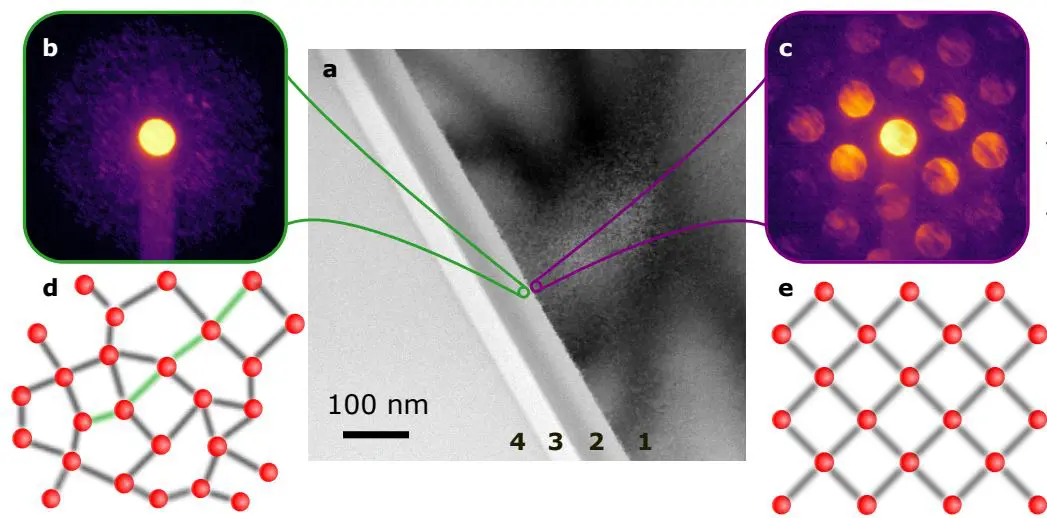
This research reveals how the harmonic spectrum generated in silicon changes as its structure transitions from crystalline to amorphous forms. Scientists observed a significant enhancement in the yield of lower-order harmonics, specifically harmonics 5 through 11, coupled with a quenching of higher-order harmonics beyond harmonic 13. The team prepared amorphous silicon films using gallium focused-ion beam irradiation and confirmed amorphization through detailed transmission electron microscopy and Raman spectroscopy, establishing a clear structural contrast between crystalline and amorphous regions. Exciting the silicon surface with ultrashort, 3.
6-micrometer wavelength pulses, the team collected the emitted radiation via HHG in a reflection geometry, allowing for detailed spectral analysis. Modelling the real-space quantum dynamics using the semiconductor Wannier equations, researchers linked the observed spectral changes to a greater than 250-fold enhancement in tunnel ionization yield within the amorphous phase. Simultaneously, the quenching of higher-order harmonics was attributed to disorder-induced decoherence, effectively damping electron-hole polarization over approximately six lattice sites. Furthermore, the HHG spectra revealed remnant order within the amorphous silicon, indicative of residual medium-range order not apparent through conventional structural probes. This work establishes a new framework for understanding dephasing in attosecond dynamics and provides a powerful approach to controlling ionization in silicon on the nanometer scale, with potential applications in lightwave nanoelectronics.
Silicon Amorphization Alters Harmonic Generation Spectrum
This research significantly advances understanding of how solids respond to intense laser fields at the attosecond timescale, revealing new insights into the dynamics of electron behaviour within materials. Scientists observed a dramatic reshaping of the harmonic spectrum generated in silicon as its structure transitions from crystalline to amorphous forms, observing enhanced lower-order harmonics alongside a reduction in higher-order ones. The team prepared amorphous silicon films using gallium focused-ion beam irradiation and confirmed amorphization through detailed transmission electron microscopy and Raman spectroscopy, establishing a clear structural contrast between crystalline and amorphous regions. Furthermore, the team established high-harmonic generation spectroscopy as a sensitive probe of structural disorder, revealing remnant order within the amorphous silicon that was previously undetectable using conventional methods. They also observed a rapid and targeted annealing of amorphous silicon islands using the laser, demonstrating a potential pathway for nanoscale material processing. While acknowledging that the increased ionization comes at the cost of increased decoherence, the researchers highlight that this decoherence is imprinted within the harmonic spectrum, allowing for the investigation of medium-range order at the nanoscale.
🗞 Giant enhancement of attosecond tunnel ionization competes with disorder-driven decoherence in silicon
🧠 ArXiv: https://arxiv.org/abs/2511.14678