Optimising traffic flow in modern cities presents a formidable challenge, as conventional methods struggle with the sheer complexity of the problem. Renáta Rusnáková, Martin Chovanec, and Juraj Gazda, all from the Technical University of Košice, now demonstrate a novel approach using quantum annealing to tackle this issue. Their research reformulates traffic optimisation as a problem suited for quantum computers, effectively capturing the need to both reduce congestion and improve overall travel times. By integrating realistic mobility data, considering multiple route options, and employing a clever clustering technique to simplify large networks, the team achieves near-optimal solutions, reducing congestion by up to 25% and matching the performance of traditional solvers while paving the way for quantum solutions to real-world urban challenges.
Quantum Annealing for Traffic and Optimization
This extensive collection of research papers explores the application of quantum annealing (QA), and hybrid QA approaches, to solve complex combinatorial optimization problems, with a particular focus on traffic optimization. The studies demonstrate that combining quantum and classical computing offers a powerful approach to tackling these challenges. Researchers consistently find that hybrid algorithms, integrating QA with established classical optimization techniques, are more effective than using QA alone. This often involves using QA to generate promising initial solutions or to explore specific areas of the problem space, followed by classical refinement to achieve optimal results.
The way a problem is translated into a format suitable for QA, known as a QUBO formulation, significantly impacts performance, requiring careful encoding and the use of penalty functions to handle constraints. While D-Wave systems show promise, their performance is currently limited by factors such as qubit connectivity and qubit quality. The limited connections between qubits require a process called minor embedding, which can increase problem complexity. However, newer D-Wave systems, like the Advantage2, with increased qubit counts and connectivity, offer potential for improved performance. Scaling these solutions to larger, more realistic problems remains a significant challenge.
Data-Driven Traffic Optimization via Quadratic Unconstrained Binary Optimization
Scientists have developed a novel data-driven approach to traffic flow optimization, reformulating the complex problem as a Quadratic Unconstrained Binary Optimization (QUBO). This method captures both congestion reduction and travel-time efficiency by integrating realistic mobility data with analytically derived penalty constraints to model vehicle interactions. The study pioneers a workflow that generates concrete route alternatives for each vehicle, enabling a more nuanced understanding of traffic dynamics. Researchers sourced map data from OpenStreetMap and utilized the Valhalla routing engine to generate two alternative routes for each vehicle, sampling each route into 10-second intervals to capture precise location, speed, and direction.
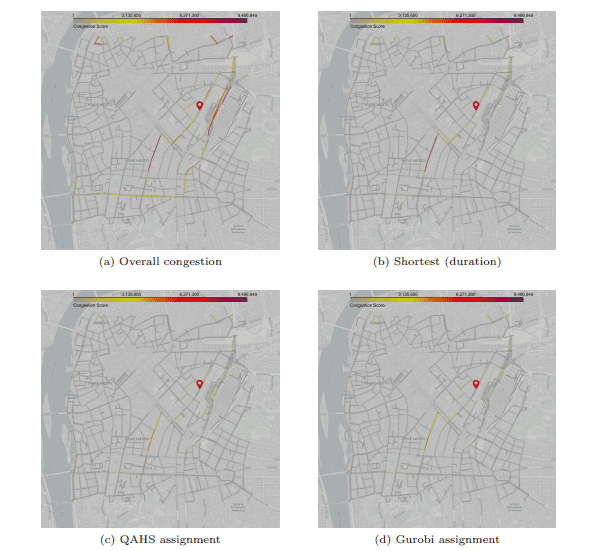
To address the computational challenges of large-scale networks, the team applied Leiden clustering, effectively reducing problem size while preserving critical congestion patterns. This innovative technique allows the system to scale to simulations involving up to 25,000 vehicles. Congestion is computed from spatiotemporal overlaps of route points, considering leader-follower order. The resulting QUBO is solved using a variety of methods, including D-Wave quantum annealing, classical metaheuristics like Simulated Annealing and Tabu Search, and mathematical programming solvers. Performance is rigorously evaluated by comparing solution quality and runtime against random assignments and shortest-route assignments, demonstrating that the hybrid quantum annealing approach achieves near-optimal solutions within 1% of the classical solver Gurobi.
Traffic Optimization via Data-Driven Quadratic Programming
This work presents a data-driven approach to city traffic optimization, reformulating the problem as a Quadratic Unconstrained Binary Optimization to simultaneously reduce congestion and improve travel times. Researchers developed a model integrating realistic mobility data, multiple routing options, and analytically derived penalty constraints to address the complexities of large-scale networks. To manage computational demands, the team applied Leiden clustering, preserving critical congestion patterns while reducing the overall problem size. Benchmarking the system on networks with up to 25,000 vehicles, experiments demonstrate the hybrid approach achieves near-optimal solutions, remaining within 1% of the performance achieved by the classical solver Gurobi.
Importantly, the method reduces overall congestion by up to 25% compared to shortest-path routing. The team meticulously quantified congestion by measuring the frequency of leader-follower vehicle pairs on road segments, calculating a score based on distance and relative speed, normalized by an average speed and a sensitivity factor. This score reflects the duration of close interactions. Researchers derived pairwise congestion weights between vehicles and their route alternatives, creating a tensor representing cumulative congestion interaction costs. The resulting congestion weights, combined with travel time penalties, enable the optimization algorithm to identify routes that minimize both congestion and overall travel time.
Quantum Optimization Reduces City Traffic Congestion
This research demonstrates a competitive hybrid quantum approach to large-scale traffic flow optimization, achieving solutions within 1% of a state-of-the-art classical solver while maintaining stable runtimes. By reformulating traffic management as a Quadratic Unconstrained Binary Optimization problem, the team developed a model that balances individual travel efficiency with overall congestion reduction, resulting in up to 25% less congestion compared to shortest-path routing. This formulation offers a promising addition to future Intelligent Transportation Systems, potentially complementing existing navigation services with congestion-aware route assignments and improving road network utilization. The study successfully scales quantum methods to realistic city networks containing up to 25,000 vehicles, a significant advancement beyond previous work focused on smaller test cases.
Experiments reveal that performance is sensitive to network topology, highlighting the importance of evaluating algorithms across diverse urban maps. While acknowledging current limitations in quantum hardware, specifically the instance size and solution quality constraints of the D-Wave system, the findings suggest a practical stage of quantum readiness for tackling real-world optimization challenges. Future work will likely focus on leveraging advances in quantum hardware, solver connectivity, and embedding techniques to expand the scale and quality of solvable problems.
👉 More information
🗞 Quantum Annealing for Realistic Traffic Flow Optimization: Clustering and Data-Driven QUBO
🧠 ArXiv: https://arxiv.org/abs/2510.06053