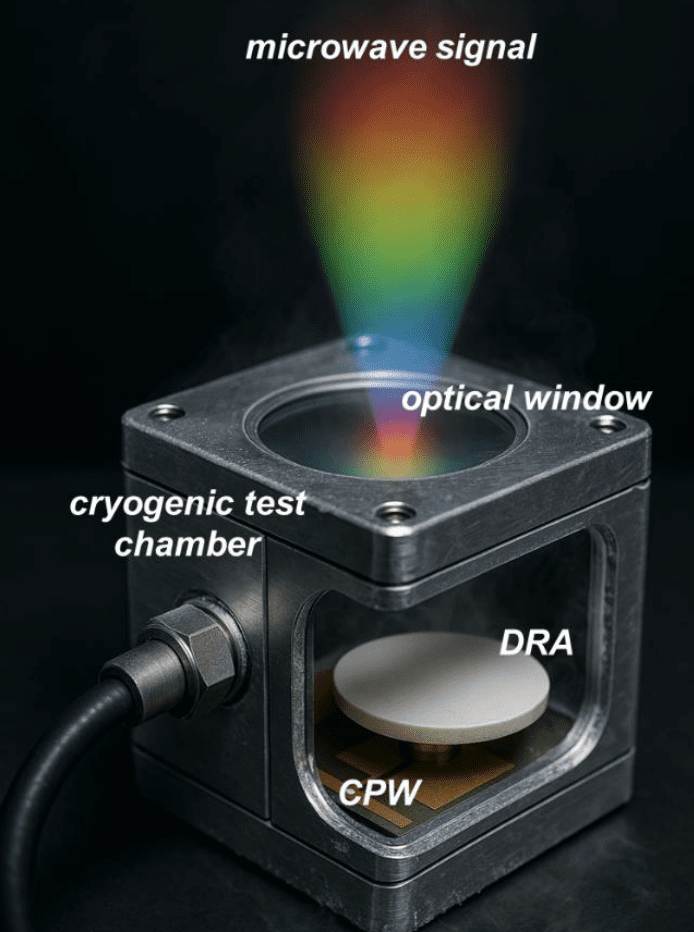
The quest for improved cryogenic systems faces a fundamental challenge: the performance limitations of materials at extremely low temperatures, particularly in wireless communication. Ingrid Torres and Alex Krasnok, from Florida International University, alongside their colleagues, investigate this issue by directly comparing two promising ceramic materials, MgTiO3-CaTiO3 and (Zr,Sn)TiO4, as potential components for wireless antennas operating far below freezing. Their research reveals a significant difference in stability, with (Zr,Sn)TiO4 exhibiting exceptional performance at temperatures as low as 10 K, while the other material suffers from substantial instability and signal loss. This discovery enables the creation of a functional wireless link at cryogenic temperatures using minimal power, paving the way for non-invasive diagnostics and wireless connections within ultra-cold environments, and offering a solution to the practical difficulties posed by traditional wired systems.
Wireless Cryogenic Control of Quantum Qubits
This research details the development and testing of dielectric resonator antennas (DRAs) crafted from (Zr,Sn)TiO4 ceramics for transmitting microwave signals in extremely cold environments, specifically for quantum computing. The study addresses the challenges of controlling qubits at cryogenic temperatures, where traditional cabling becomes cumbersome and introduces signal loss. Wireless microwave links offer a promising solution, eliminating physical connections and reducing thermal load. Researchers focused on (Zr,Sn)TiO4 ceramics due to their low energy loss, high ability to store electrical energy, and suitability for cryogenic temperatures.
The team designed and fabricated DRAs using the selected ceramic material, carefully optimizing the antenna’s shape for effective performance at microwave frequencies. They thoroughly characterized the material’s electrical properties at cryogenic temperatures and then tested the antennas in a cold environment to measure their signal return loss, radiation patterns, and efficiency. These experimental results were then compared with computer simulations to validate the antenna design and performance. The results demonstrate that (Zr,Sn)TiO4 is a viable material for DRAs operating in cryogenic environments, exhibiting low loss and stable electrical properties.
The fabricated DRAs demonstrated good signal return and radiation characteristics at the target frequencies, proving the feasibility of using wireless microwave links for controlling and reading information from qubits in cryogenic quantum computers. This technology offers the potential for miniaturization and integration into cryogenic systems. This research contributes to the development of scalable and efficient cryogenic quantum computing systems. The demonstrated wireless link provides a promising solution for qubit control and readout, reducing complexity and improving performance. The study highlights the importance of material selection for cryogenic applications and provides valuable insights into the properties of (Zr,Sn)TiO4 ceramics. This work opens up possibilities for further optimization of DRA designs, integration with qubit circuits, and development of more sophisticated wireless communication systems for quantum computing.
Cryogenic Dielectric Resonator Antenna Performance Comparison
Researchers conducted a comparative study to evaluate the performance of two ceramic materials, MgTiO3-CaTiO3 (MCT) and (Zr,Sn)TiO4 (ZST), as dielectric resonator antennas at cryogenic temperatures. They operated both materials as antennas from room temperature down to 10 Kelvin, ensuring identical conditions for a direct comparison. This approach allowed for precise measurement of key antenna characteristics under extreme cooling, revealing fundamental differences in their behavior. Scientists fabricated disk-shaped resonators from each material and then characterized their performance as radiative antennas at 10 Kelvin.
The team employed a low input power of only 1 milliwatt to operate the ZST disk, successfully establishing a wireless link capable of detecting room-temperature dielectric targets. This detection utilized both subtle shifts in the signal frequency and changes in signal strength, demonstrating the potential for non-invasive cryogenic diagnostics and wireless communication. To quantify performance, researchers measured resonant frequency shifts and loaded quality factors (Q-factor) for both materials across the temperature range. The team observed a substantial frequency drift of 230 MHz in the MCT resonator as the temperature decreased to 10 Kelvin, accompanied by a significant loss of signal quality. In stark contrast, the ZST resonator exhibited exceptional stability, with a resonant frequency shift of only 30 MHz and an enhancement of the loaded Q-factor by 20-25%. This significant difference in performance underscores the superior properties of ZST for cryogenic applications, paving the way for high-coherence interfaces and wireless cryogenic systems.
ZST Resonators Demonstrate Exceptional Cryogenic Stability
Scientists have demonstrated a significant advancement in cryogenic microwave systems by identifying (Zr,Sn)TiO4, or ZST, as a superior material for high-performance radiative antennas operating at extremely low temperatures. Their research directly addresses limitations imposed by energy losses in conventional materials used in cryogenic processors and interconnects, paving the way for more efficient and scalable designs. Experiments reveal that a ZST resonator maintains exceptional stability down to 10 Kelvin, exhibiting a resonant frequency shift of only 30 MHz, a remarkable improvement compared to the 230 MHz shift observed in MgTiO3-CaTiO3 (MCT), a commonly used alternative. The team discovered that the ZST resonator’s loaded quality factor actually increases by 20-25% at these low temperatures, while MCT suffers from significant losses and instability.
This enhanced performance enabled the researchers to successfully operate the ZST disk as a radiative antenna at 10 Kelvin with just 1 milliwatt of input power, establishing a functional wireless link through a cryostat window. This wireless connection reliably detected room-temperature dielectric targets using both subtle shifts in signal frequency and changes in signal strength, demonstrating a viable method for non-invasive cryogenic diagnostics and wireless communication. Simulations and measurements confirm that ZST resonators achieve near-critical coupling, maximizing power transfer and exhibiting a significantly deeper reflection null compared to MCT. This indicates intrinsically lower losses and better impedance matching in ZST, resulting in a strong magnetic field enhancement factor crucial for applications like circuit quantum electrodynamics where strong field-matter interaction is essential. The findings establish ZST as a leading material for high-coherence interfaces and provide a practical template for designing wireless cryogenic systems, overcoming the limitations of traditional cabling and enabling the next generation of scalable cryogenic electronics.
ZST Ceramics Enable Cryogenic Wireless Communication
This research presents a comparative analysis of two ceramic materials, MgTiO3-CaTiO3 (MCT) and (Zr,Sn)TiO4 (ZST), to determine their suitability for use in cryogenic microwave systems. The findings establish ZST as the superior material, demonstrating exceptional thermal stability, with a resonant frequency shift of only 30 MHz when cooled from room temperature to 10 Kelvin, and a significant 22. 6% enhancement in loaded quality factor. In contrast, the MCT material exhibited substantial thermal instability and a collapse in performance at low temperatures, rendering it unsuitable for precision applications.
The improved performance of ZST was then leveraged to create a wireless communication link at 10 Kelvin, using just 1 milliwatt of power. This system successfully detected targets through a window, utilizing both frequency shifts and changes in signal strength, and maintained a detectable signal up to 46 centimeters away. This demonstrates the potential for thermally efficient, cable-free interconnects within complex cryogenic environments, addressing a key limitation in these systems. The authors acknowledge that the MCT material, while stable at room temperature, proved unsuitable in its current form for deep-cryogenic operation. Future work could focus on optimizing the composition or fixture of MCT to improve its low-temperature performance, or further exploring the potential of ZST in advanced cryogenic applications.
👉 More information
🗞 A Cryogenic Dielectric Antenna for Wireless Sensing and Interfacing Outside the 10 K Environment
🧠 ArXiv: https://arxiv.org/abs/2509.06199