

The quest for efficient terahertz (THz) sources takes a significant leap forward with new research demonstrating the generation and control of ‘ferrons’, excitations within ferroelectric materials that act as the electric counterparts of magnons. Baolong Zhang, Ruihuan Duan, and Sobhan Subhra Mishra, along with colleagues, reveal how these ferrons can be harnessed in layered niobium oxide materials to create ultralow-power THz sources with dramatically improved efficiency. The team not only confirms the existence of multiple ferron modes at room temperature, but also achieves radiation efficiencies several orders of magnitude greater than existing semiconductor emitters, and importantly, demonstrates direct control of these oscillations using an electric field. This breakthrough establishes ‘Ferronics’ as a promising platform for next-generation wireless communication, ultrafast electronics, and advanced photonics, offering a pathway to manipulate light and fields with unprecedented precision.
Ferronic Excitations and Terahertz Emission in 2D Materials
This research demonstrates the generation and control of ferronic excitations, collective vibrations of the ferroelectric order, in 2D materials, specifically niobium oxide dihalides. Scientists have not only observed these ferrons but also shown how to efficiently generate them using ultrafast laser pulses and control their behavior with electric fields, achieving strong terahertz (THz) emission. The THz emission arises from both the shift current effect and the excitation of coherent phonons, offering flexibility in controlling the excitations and optimizing THz emission. The experiments utilize ultrafast laser pulses to excite the ferrons, creating a transient electric field within the material. This research provides a new pathway for creating efficient and tunable THz sources, with potential applications in security screening, medical imaging, materials science, and high-bandwidth communications, while contributing to a better understanding of ferroelectric materials and their collective excitations.
Giant Ferron Generation in Layered NbOX2 Materials
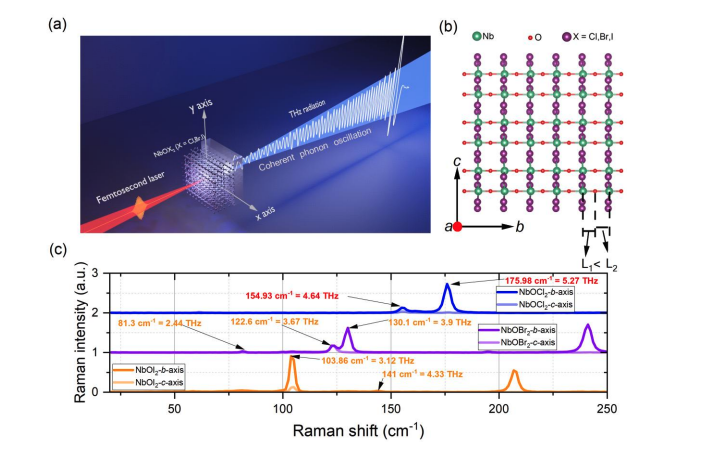
Scientists harnessed the interplay between soft phonons and ferroelectric order in layered NbOX2 materials to generate, detect, and control giant ferrons, establishing a new pathway for ultralow-power terahertz (THz) sources. By exciting thin films of NbOX2 with femtosecond laser pulses, the team observed intense, narrowband THz emission with quality factors reaching up to 228, demonstrating significantly improved radiation efficiency, up to five orders of magnitude greater than existing semiconductor emitters. Detailed analysis of the THz waveforms revealed multiple ferron modes contributing to the emission, evidenced by distinct peaks at 3. 12 THz, 3.
64 THz, and 4. 81 THz. These peak positions closely matched results from Raman spectroscopy, confirming the origin of the THz emission from coherent phonon oscillations. By truncating the initial THz pulse, scientists accurately measured the trailing ferron frequencies, enabling precise identification of subsequent oscillations. The team also observed that the THz generation exhibits C2 symmetry and a reversal of waveform polarity upon sample rotation, confirming the materials’ unique crystalline structure. Varying the pump laser wavelength achieves efficiencies two orders of magnitude higher than intense lithium niobate THz sources.
Room Temperature Ferrons Enable Terahertz Technology
Scientists have directly observed and harnessed giant ferrons, excitations of electric polarization in ferroelectric materials, at room temperature, opening new avenues for ultralow-power terahertz (THz) technology. These findings establish a new platform, termed “Ferronics,” for controlling order using light and electric fields, with potential impact on ultrafast electronics, photonics, and next-generation wireless communication. Experiments utilizing layered niobium oxide dihalides successfully generated, detected, and controlled these ferrons, demonstrating a significant leap forward in THz source development. The materials emit intense, narrowband THz radiation with remarkably high quality factors, reaching up to 228, and radiation efficiencies exceeding state-of-the-art semiconductor emitters by up to five orders of magnitude.
Resonant excitation of a high-quality ferron mode achieved efficiencies two orders of magnitude greater than those of intense lithium niobate THz sources, highlighting the superior performance of this new approach. Detailed analysis revealed multiple ferron modes contributing to the observed emission, confirming the existence of these previously elusive excitations. The observed THz emission frequencies correspond directly to phonon oscillations identified through Raman spectroscopy, confirming the origin of the radiation from coherent vibrations within the material. Furthermore, the team demonstrated direct, non-volatile electric-field control of ferron oscillations, enabling precise manipulation of these excitations. The increasing emission frequency observed as the halide atom mass decreases supports the understanding of ferron behavior as a classical harmonic oscillator, providing further insight into the underlying physics.
Terahertz Ferrons Controlled in Niobium Oxyhalide
This research provides direct experimental evidence for the existence of ferrons, long-theorized excitations of electric polarization in ferroelectric materials, at terahertz frequencies. The team successfully generated, detected, and controlled these ferrons within layered niobium oxyhalide crystals, demonstrating coherent terahertz radiation and, crucially, electric-field control of ferron oscillations. The observed radiation is characterized by multiple, long-lived ferron modes exhibiting remarkably high quality factors and emission efficiencies, up to five orders of magnitude greater than conventional semiconductor emitters. The findings establish a new platform, termed ‘Ferronics’, for manipulating quantum excitations and controlling order within materials. Notably, resonant excitation of a ferron mode achieved efficiencies two orders of magnitude higher than those of lithium niobate terahertz sources. Future work may focus on leveraging these van der Waals ferroelectrics to develop electrically tunable, on-chip terahertz sources and ultimately, ferronic polariton terahertz lasers for next-generation integrated technologies.
🗞 Electric-field Control of Giant Ferronics
🧠 ArXiv: https://arxiv.org/abs/2509.06057


