Achieving reliable quantum computation demands effective methods for correcting errors, a process critically dependent on accurate decoding techniques, and Yi Tian, Yi-Cong Zheng from Furlet Technology, and Xiaoting Wang from the University of Electronic Science and Technology of China, alongside colleagues, present a significant advance in this field. Their research addresses the challenge of decoding surface codes, a promising approach to fault-tolerant quantum computation, by tackling the impact of realistic noise patterns found in actual quantum hardware. The team introduces a new decoder, Iterative Reweighting Minimum-Weight Perfect Matching, which systematically incorporates correlated errors to dramatically improve performance, reducing the number of qubits needed to achieve practical error correction. This method not only enhances accuracy but also promises a substantial reduction in the overhead currently required for building large-scale, fault-tolerant quantum computers, bringing the prospect of real-time decoding closer to reality.
Surface Code Decoding Algorithms and Error Models
This document provides a comprehensive overview of research concerning quantum error correction (QEC), specifically focusing on decoding algorithms for surface codes. The field explores methods to protect quantum information from errors, a crucial step towards building practical quantum computers. Key concepts include surface codes, considered a promising approach due to their suitability for two-dimensional architectures, and decoding, the process of identifying and correcting errors based on measurements of the quantum system. Understanding error models, which characterize the types of errors that occur in real quantum hardware, is also fundamental.
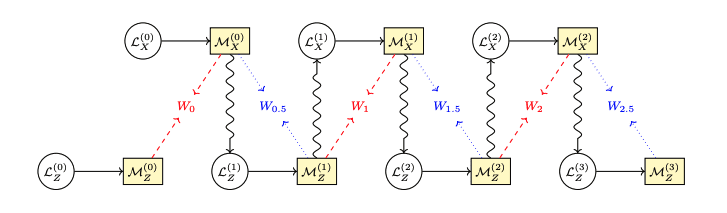
These errors can include bit-flips and phase-flips, and their characteristics influence the design of effective decoding algorithms. A critical metric is the error threshold, representing the maximum error rate a code can tolerate while still providing reliable protection. Several decoding algorithms have emerged, each with its strengths and weaknesses, including Minimum Weight Perfect Matching (MWPM), Union-Find, and Belief Propagation. Machine learning techniques, including neural networks and reinforcement learning, are emerging as promising tools for decoding, though they require substantial training data. Other methods include tensor network simulations, Markov Chain Monte Carlo, and hardware acceleration using FPGAs. The team recognized that standard decoders often treat errors independently, neglecting crucial correlations that arise in actual quantum hardware. They engineered a system that systematically incorporates these correlations to improve decoding performance by leveraging fault-detection patterns to guide reweighting and calculate conditional probabilities. This innovative approach involves an iterative process where the decoder alternates weight updates between three-dimensional lattices, enhancing its ability to handle complex error propagation. This breakthrough addresses a critical challenge in building practical quantum computers: reliably correcting errors that arise during computation. The team’s approach focuses on accurately modeling the types of noise found in real quantum hardware, specifically correlated bit-flip and phase-flip errors that often occur during circuit operation. The IRMWPM decoder systematically incorporates these correlations by analyzing fault-detection patterns and updating weights on decoding lattices, enhancing its ability to handle realistic error propagation. This decoder addresses the challenges posed by correlated errors, which commonly arise in real quantum devices, by systematically incorporating information about these correlations into the decoding process. The method works by iteratively refining the weights assigned to potential error paths on a decoding lattice and demonstrably converges in a finite number of steps while maintaining the reliability of the original decoding method. The results demonstrate substantial improvements in decoding performance, particularly at lower physical error rates, with reductions in logical error rates and an increase in the accuracy threshold. Importantly, the decoder requires only a small number of additional iterations compared to standard methods, making it suitable for near-term implementation in real-time quantum error correction systems. Future work will focus on extending this framework to other quantum codes and exploring approximate fault models to broaden its applicability, with potential for implementation on specialized hardware like FPGAs or ASICs.
👉 More information
🗞 Enhancing Fault-Tolerant Surface Code Decoding with Iterative Lattice Reweighting
🧠 ArXiv: https://arxiv.org/abs/2509.06756