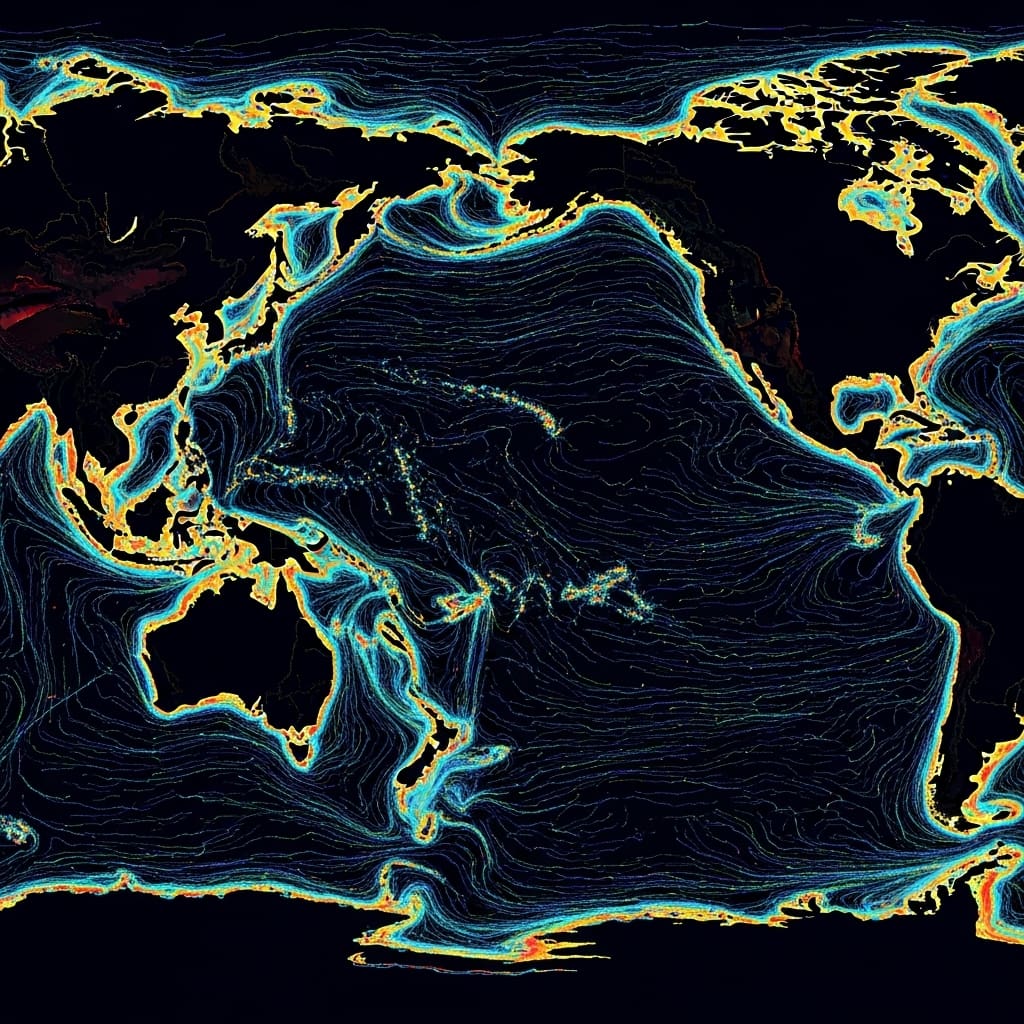
Scientists are tackling a fundamental challenge in utilising data from the new Surface Water and Ocean Topography (SWOT) satellite: accurately determining ocean surface velocities from sea-surface height measurements. Takaya Uchida, Badarvada Yadidya, and Vadim Bertrand, from Florida State University and Université Grenoble Alpes respectively, alongside Jia-Xian Chang, Brian Arbic, Jay Shriver et al., present a novel method to robustly extract the geostrophic component of ocean currents, overcoming ambiguities in spatial scaling often encountered with altimetric data. Their research builds on recent advances in internal tide corrections and employs dynamic mode decomposition to produce a global, freely available dataset of sea-surface velocities derived from SWOT’s fast-sampling phase , a significant step towards improving oceanographic modelling and understanding. This work offers crucial insights into ocean dynamics, evidenced by its ability to resolve previously unseen current features.
This innovative method allows for a robust extraction of geostrophic signals, circumventing the ambiguity of selecting appropriate spatial scales for filtering, and the team is distributing the resulting global dataset as a public resource. This careful pre-processing, combined with the application of a multi-resolution COherent Spatio-Temporal scale Separation (mrCOSTS) technique, a variant of DMD, enabled the team to identify and isolate geostrophic signals across the global ocean, excluding regions near the Equator and areas with insufficient data coverage. The mrCOSTS method recursively applies DMD, proving particularly versatile for data containing a wide range of frequencies.
The study reveals distinctive features in the frequency-wavenumber spectra of SSHa, clearly differentiating between geostrophic and ageostrophic components. These PDFs provide compelling evidence supporting the accuracy and validity of their approach. By rigorously extracting the geostrophic component, the team has created a dataset that can significantly improve our understanding of ocean circulation and its role in global climate patterns. This work opens new avenues for studying ocean dynamics with unprecedented accuracy, offering a valuable resource for researchers investigating a wide range of oceanographic phenomena.
The publicly available global dataset will facilitate more reliable estimations of ocean velocities, reducing errors associated with traditional spatial filtering methods. Beyond fundamental research, this breakthrough has practical implications for applications such as improved ocean forecasting, more accurate tracking of marine pollutants, and enhanced navigation safety, all reliant on precise knowledge of ocean currents. The team’s innovative use of DMD and mrCOSTS represents a significant step forward in harnessing the full potential of SWOT data for advancing oceanographic science.
DMD for Sub-Inertial Geostrophic Velocity Retrieval
The research team tackled the challenge of applying geostrophic balance, a fundamental principle linking ocean currents and sea-surface height, to altimetric data, particularly given SWOT’s one-day repeat orbit. This innovative technique enables robust velocity estimation without predefining spatial scales, thereby improving the accuracy and consistency of ocean current measurements. Researchers excluded data within ±5° of the Equator, where inertial frequencies approach zero, and discarded grid points with less than 50% temporal data coverage, ensuring data quality and analytical rigor. The team distributed the resulting global dataset as a public resource, fostering wider scientific collaboration and validation.
Experiments employed DMD, a linear-algebraic method akin to frequency-wavenumber spectral decomposition but circumventing the need for periodic boundary conditions. Conceptually, DMD functions as an empirical orthogonal function (EOF) analysis, linking spatial modes to specific temporal frequencies and phases. This approach, originating in fluid mechanics, was adapted for oceanographic applications, building upon prior work in capturing tidal patterns and identifying spatiotemporal structures in sea-surface temperature. The technique reveals spatial patterns of sea-surface elevation in balance with ocean currents, evolving on scales exceeding hundreds of kilometers and timescales longer than tens of days. These analyses provide valuable insights into the characteristics of geostrophic flow and serve as a benchmark for validating the accuracy of the derived velocity fields. By rigorously extracting geostrophic signals in both space and time, this work overcomes the limitations of traditional methods and provides a more reliable foundation for understanding ocean circulation and its role in global climate dynamics.
MrCOSTS extracts geostrophic component from SWOT data
The team employed a multi-resolution COherent Spatio-Temporal scale Separation (mrCOSTS) method, building upon recent advancements in internal tide (IT) corrections, to process Level 3 (L3) SWOT data. Analyses excluded regions within ±5° of the Equator and grid points with less than half of the time series available, ensuring data quality and validity. Experiments revealed that applying an isotropic Gaussian spatial filter with a standard deviation of three grid points, approximately 6km, effectively smoothed the data prior to mrCOSTS application. The mrCOSTS method recursively applied dynamic mode decomposition (DMD) across four levels, utilising window lengths of [9, 10, 30, 60] days and singular value decomposition (SVD) ranks of [4, 4, 10, 12] respectively.
Spatial modes associated with frequencies below 0.1 cycles per day were then summed to generate the geostrophic SSHa component, ηg, providing a clear signal for further analysis. This innovative approach successfully separated geostrophic signals from other oceanographic phenomena, including submesoscale dynamics and ITs, which are not strictly geostrophically balanced. Results demonstrate the successful extraction of geostrophic SSHa, documented in a snapshot presented in Fig0.0.1a of the work. Subtracting the IT and geostrophic components from the total SSHa yielded the ageostrophic eddy component, ηa, representing variability beyond ITs and isotropic turbulence.
Furthermore, the study incorporated data from 65 Lagrangian Surface Velocity Program (SVP) drifters deployed in the western Mediterranean Sea between March 27th, 2023, and January 22nd, 2024, providing over 27,000 data points. Collocating drifter observations with SWOT pass No0.0 within a ±6-hour window resulted in approximately 12,700 matched data points for independent validation. Measurements confirm that Ekman contributions were removed from drifter velocities using ECMWF Reanalysis (ERA5) wind stress and a second-order Butterworth filter with a 48-hour cutoff period was applied to remove near-inertial oscillations. This breakthrough delivers a valuable tool for oceanographers, enabling more accurate velocity estimations from altimetric observations and opening new avenues for understanding complex ocean dynamics.
MrCOSTS Isolates Geostrophic Flows from SWOT Data effectively
This approach addresses challenges posed by SWOT’s limited temporal resolution, traditionally requiring assumptions about spatial scales when extracting velocity information. By combining temporal and spatial information, mrCOSTS effectively mitigates spectral leakage caused by temporal aliasing, yielding dynamically plausible spatial modes at sub-inertial frequencies. Researchers processed the entire fast-sampling phase of the SWOT mission and are making the resulting geostrophic fields publicly available as a data product. Comparisons with drifter data in the western Mediterranean Sea indicate that mrCOSTS-derived velocity estimates are comparable to, and potentially better than, the standard L3HRET product.
The authors acknowledge that perfect alignment with drifter data was not achieved, suggesting the influence of factors beyond geostrophy, such as submesoscale dynamics and fronts, on drifter trajectories. They also note the potential for future advancements through machine learning techniques, which may capture velocities associated with larger Rossby numbers or enhance the identification of submesoscale features; however, they emphasise that a robust isolation of geostrophic flow provides a crucial baseline for extracting velocity information from altimetry observations. Future work could focus on integrating this geostrophic baseline with machine learning approaches to further refine velocity estimates and improve understanding of ocean dynamics.
👉 More information
🗞 A strictly geostrophic product of sea-surface velocities from the SWOT fast-sampling phase
🧠 ArXiv: https://arxiv.org/abs/2601.18182