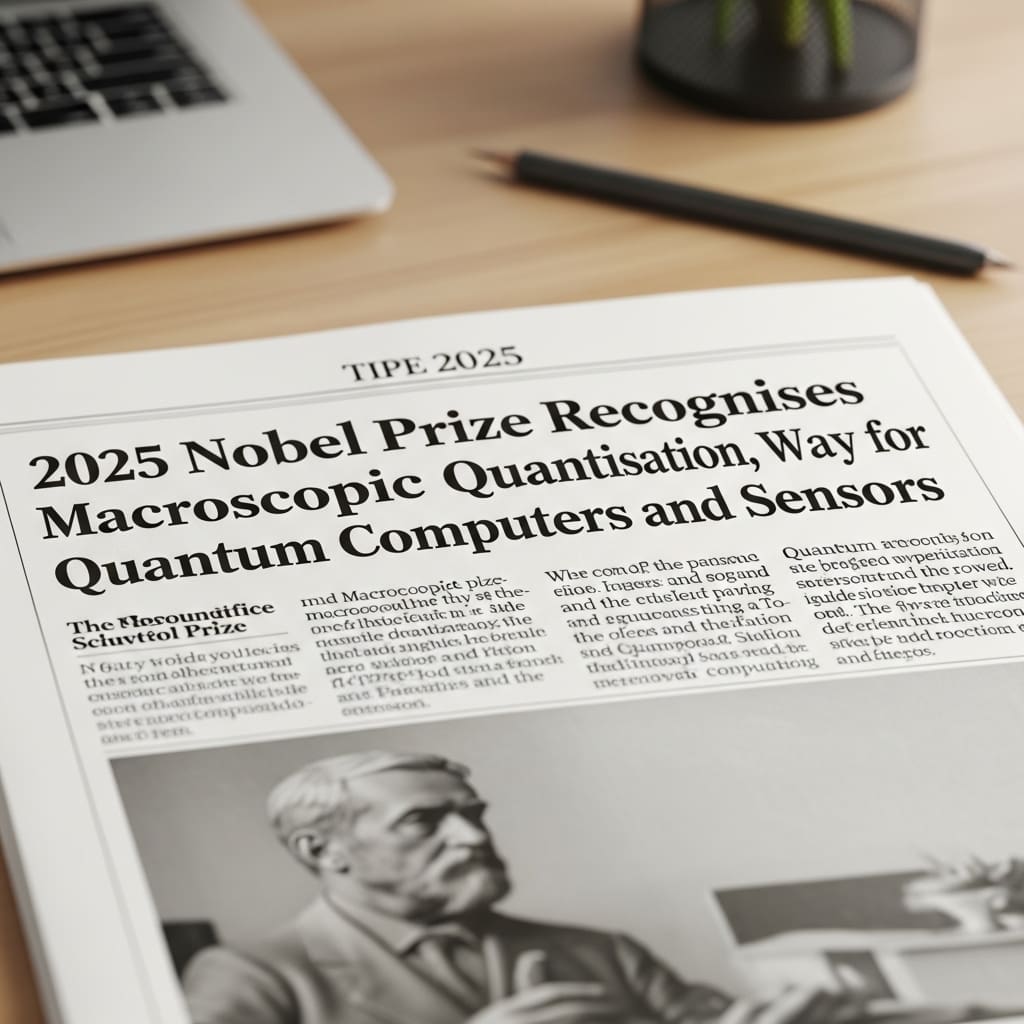
The fundamental laws governing quantum mechanics, traditionally observed at the atomic level, recently expanded to encompass the behaviour of larger, macroscopic systems, a breakthrough recognised with the 2025 Nobel Prize in Physics. John Clarke, John Martinis, and Michel Devoret receive the award for their discovery of macroscopic mechanical tunnelling and energy quantisation in an electric circuit, achievements that promise to revolutionise technologies ranging from computing to sensing. This work builds upon decades of research into superconductivity and macroscopic quantum phenomena, and importantly acknowledges the foundational contributions of scientists at the B. I. Verkin Institute for Low Temperature Physics and Engineering of the National Academy of Sciences of Ukraine, whose pioneering studies paved the way for these recent advances. By demonstrating quantum effects in increasingly large systems, these researchers redefine the boundary between the quantum and classical worlds, opening exciting new avenues for scientific exploration and technological innovation.
Summary of Nobel Prize and the contribution of Ukrainian scientists to the understanding of quantum phenomena.
A significant portion of the research focused on understanding the effects of dissipation and decoherence on macroscopic quantum systems, a critical challenge in building stable qubits. The article draws a direct line between the early experiments at ILT NASU and the work of the Nobel laureates, demonstrating how the Ukrainian research anticipated and informed later developments in qubit control. This work builds upon decades of research into superconductivity and the quantum behavior of materials, revealing that quantum effects are not limited to the microscopic world. Experiments confirmed the theoretical prediction that large collections of electrons can exhibit quantum phenomena, specifically tunneling through barriers even when classical physics dictates they should not. Researchers focused on superconducting devices, utilizing the unique properties of materials where electrons flow without resistance, and observed correlated tunneling of Cooper pairs, pairs of electrons bound together within a superconductor, through a thin dielectric barrier.
Measurements revealed a supercurrent density comparable to single-particle current density, demonstrating that these pairs act as a single quantum entity, fundamentally different from classical expectations. The team’s work experimentally confirmed the predictions of Brian Josephson, specifically the stationary Josephson effect involving supercurrent flow through a tunnel barrier. Measurements showed a large supercurrent density, indicating the coherent tunneling of Cooper pairs, allowing scientists to treat the phase of the superconducting condensate’s wave function as a physically measurable quantity. The team’s findings open new avenues for developing advanced technologies, including computers and sensors that leverage the principles of quantum mechanics.,.
Macroscopic Quantum Tunnelling Confirmed in Circuit
The work extends beyond this initial detection, leading to the development of point-contact spectroscopy and establishing a dedicated research department focused on this technique. While the experiments confirm theoretical predictions, the authors acknowledge the difficulty in directly measuring such weak signals and the need for continued refinement of experimental techniques. Future research may focus on exploring the potential applications of these quantum phenomena in developing advanced technologies, including novel computing and sensing devices, and further investigating the limits of macroscopic quantum behaviour.
👉 More information
🗞 The Nobel Prize in physics and the contribution of Ukrainian scientists to the understanding of quantum phenomena, in particular the behavior of macroscopic systems (The 2025 Nobel Prize in Physics)
🧠 ArXiv: https://arxiv.org/abs/2512.19956