

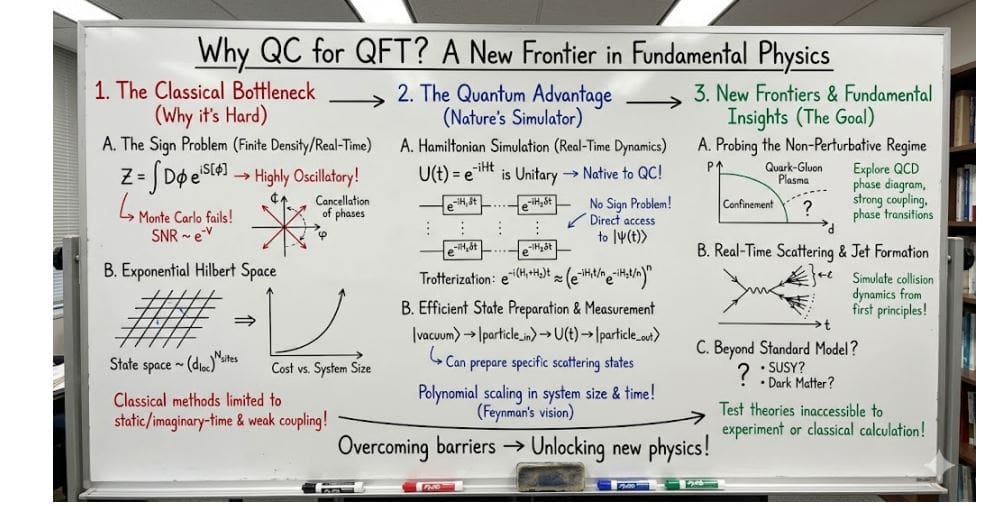
Quantum field theory, a cornerstone of modern physics, presents formidable computational challenges, and researchers are now exploring the potential of quantum computers to overcome them. Aninda Sinha and Ujjwal Basumatary, from the Indian Institute of Science, have developed a comprehensive set of lecture notes detailing how quantum computing methods can be applied to fundamental problems in quantum field theory. This work represents a significant step towards bridging the gap between these two complex fields, offering a pedagogical approach accessible to those without prior expertise in either area. By outlining techniques for simulating physical systems, including the anharmonic oscillator and models like Ising field theory, this research provides a valuable resource for students and scientists alike, and paves the way for benchmarking quantum computations and anticipating future runs on quantum hardware.
The work assumes familiarity with either quantum computing or quantum field theory and presents the material at a pedagogical level. It reviews the anharmonic oscillator, establishing a foundation for practical treatment of several quantum field theories in one plus one dimensions, namely φ⁴ theory, Ising field theory, and the Schwinger model. Alongside this, the work reviews essential concepts in quantum computing and explores tensor network techniques, which are crucial for benchmarking quantum computers. Furthermore, error modeling is performed using Qiskit, with the aim of preparing for simulations on near-term intermediate-scale quantum devices. These notes represent an expanded version of a one-semester course taught by AS during August-November 2025 at the Indian Institute of Science and TA-e.
Quantum Simulation of Lattice Gauge Theories
This collection of research focuses on using quantum computers, and related techniques like tensor networks, to simulate systems described by Quantum Field Theory, particularly those involving gauge theories, such as the theory of strong interactions. This represents a major frontier in both quantum computing and theoretical physics, as simulating these theories classically is extremely difficult, potentially offering a quantum advantage. Researchers investigate various quantum computing platforms, including qubits and higher-dimensional qudits, alongside physical realizations like trapped ions and continuous-variable quantum computing. Simulation methods explored include digitizing quantum field theories on a discrete spacetime lattice, Hamiltonian simulation using algorithms like qubitization, variational quantum algorithms, quantum phase estimation, tangent space methods, and classical tensor networks like Matrix Product States.
Specific theories under investigation include Quantum Chromodynamics, the Schwinger model, U(1) lattice gauge theory, scalar field theory, and the Bose-Hubbard model. Researchers address challenges such as error correction, scalability, resource requirements, enforcing Gauss’s law, state preparation, and measurement. Advanced topics include thermal pure quantum states, calculating scattering amplitudes, studying dynamical quantum phase transitions, and exploring non-Abelian lattice gauge theories and infinite matrix product states. Current trends emphasize hybrid quantum-classical algorithms, developing more efficient quantum algorithms, exploring different quantum computing platforms, applying quantum simulation to real-world problems in materials science and high-energy physics, and combining quantum simulation with machine learning. This collection of papers represents a vibrant and rapidly evolving field aiming to harness the power of quantum computers to solve intractable problems and deepen our understanding of the fundamental laws of nature.
Quantum Field Theory Simulations on Quantum Hardware
This work presents a comprehensive exploration of quantum computing methods applied to quantum field theory, delivering significant results across several theoretical models. Researchers successfully implemented and tested these methods using both classical simulations and, crucially, actual quantum hardware. Investigations began with the anharmonic oscillator, establishing a foundation for more complex quantum field theories including φ⁴ theory, Ising field theory, and the Schwinger model. The team developed a robust framework for simulating these models using techniques like Density Matrix Renormalization Group and Time-Evolving Block Decimation.
In φ⁴ theory, simulations using Matrix Product States revealed detailed insights into scattering processes on a lattice. Researchers also explored the transverse-field Ising model, demonstrating the application of these techniques to study magnetic systems. Furthermore, the Schwinger model, a simplified model of quantum electrodynamics, was analyzed using Matrix Product States, providing a platform to investigate string-breaking phenomena and the role of specific exponential terms. A key achievement was the implementation of these simulations on actual quantum hardware, allowing for direct testing of the theoretical framework.
This involved building quantum circuits and performing measurements using Qiskit primitives, and employing adiabatic ground-state preparation techniques. The team also investigated the impact of noise sources on quantum computers, and explored error mitigation techniques to improve the accuracy of simulations. Analysis of entanglement served as a diagnostic tool to assess the complexity of the simulations, providing valuable insights into the resources required for accurate modeling. These results demonstrate the potential of quantum computing to tackle challenging problems in quantum field theory, paving the way for future investigations into more complex physical systems. Student term papers further showcase the breadth of exploration and the application of these techniques to diverse research areas.
Simulating Quantum Field Theories with Tensor Networks
These lectures present a comprehensive exploration of quantum computing methods applied to quantum field theory, developing practical techniques and benchmarking them against established theoretical frameworks. Researchers successfully implemented tensor network techniques, specifically the Time-Evolving Block Decimation algorithm, to simulate several quantum field theories including φ⁴, the Ising model, and the Schwinger model. These simulations demonstrate the feasibility of using matrix product states to model dynamic processes like particle scattering and, in the case of the Schwinger model, to investigate phenomena such as string breaking. The work also involved an assessment of the computational demands of these simulations, including analysis of gate counts and entanglement as indicators of complexity, and initial explorations of running these algorithms on actual quantum hardware.
While acknowledging the limitations of current quantum devices, the researchers highlight the potential for future advancements to enable more accurate and efficient simulations of complex quantum systems. Student term papers further expanded on these investigations, demonstrating the breadth of research undertaken. Future work will likely focus on refining these techniques and extending them to more complex physical scenarios, pushing the boundaries of our ability to simulate nature at the quantum level.
👉 More information
🗞 Lectures on Quantum Field Theory on a Quantum Computer
🧠 ArXiv: https://arxiv.org/abs/2512.02706

