Recognising the intensity of cavitation, the formation and collapse of vapour bubbles in fluids, is crucial for ensuring the safe and efficient operation of industrial machinery, and significantly impacts maintenance costs. Yu Sha, Ningtao Liu, Haofeng Liu, and colleagues systematically review the evolution of machine learning techniques applied to this critical task, tracing developments from 2002 to 2025. Their work addresses a gap in existing research by providing a comprehensive overview of how methods have progressed, initially relying on manually defined characteristics, and more recently embracing the power of deep learning to automatically analyse complex data. This review not only charts the historical trajectory of cavitation intensity recognition, but also highlights promising future directions including transfer learning and the integration of physical understanding into diagnostic models, offering valuable guidance for researchers and practitioners working with complex industrial systems.
Intelligent Cavitation Intensity Recognition Trend Analysis
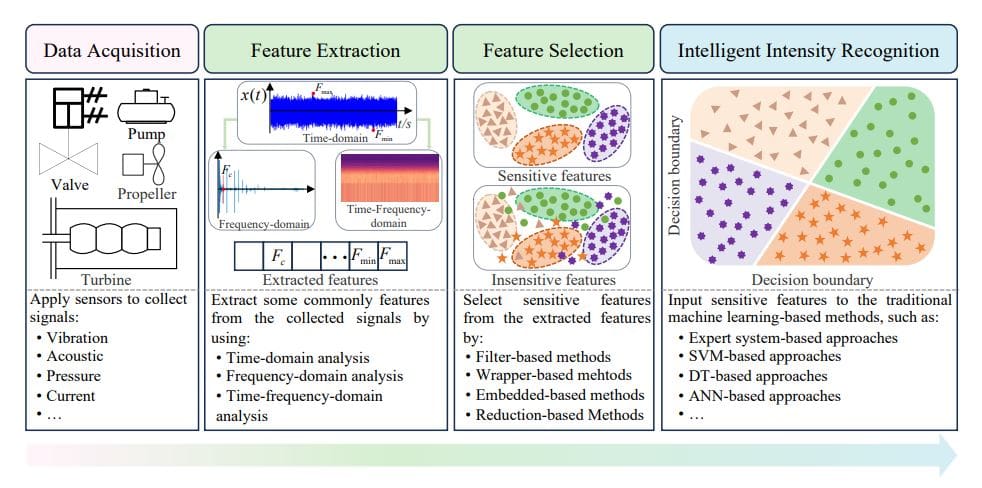
This research pioneers a systematic investigation into intelligent cavitation intensity recognition (ICIR), analyzing hundreds of publications from 2002 to 2025. The study meticulously tracked the evolution of ICIR techniques, revealing a clear progression from traditional machine learning to advanced deep learning methodologies. Researchers conducted a statistical analysis of relevant publications to identify key technical characteristics and developmental trends, establishing a framework for dividing the research into distinct phases. Initially, the work focused on traditional machine learning (TML) methods, where scientists relied on manually engineered features extracted from signals such as acoustic emissions, vibrations, and pressure readings.
While this stage reduced reliance on manual judgement, feature construction remained a labor-intensive process dependent on expert knowledge and limited the generalization capabilities of the models. More recently, the study transitioned to exploring deep learning, driving ICIR into an era of end-to-end modeling. Scientists applied deep belief networks, convolutional neural networks, residual neural networks, dense convolutional networks, MobileNet, ShuffleNet, recurrent neural networks, long short-term memory networks, gated recurrent neural networks, and Transformer architectures to automatically capture cavitation features directly from raw multi-source signals. This approach significantly improved real-time performance and stability under complex operating conditions, enabling comprehensive cross-signal-type analysis and enhancing diagnostic robustness.
Looking ahead, the research emphasizes the importance of standardized, high-quality multi-source data acquisition and the design of physically informed deep learning diagnostic models. By incorporating physical mechanisms, knowledge embedding, and constraint losses into data-driven deep learning, scientists aim to enhance model generalization, interpretability, and engineering credibility. This approach promises to capture the non-linear, multi-scale characteristics of cavitation processes, ensuring diagnostic outputs align closely with practical physical mechanisms and paving the way for sustainable monitoring and predictive maintenance in industrial settings.
Intelligent Cavitation Recognition, A Three-Phase Evolution
This work details a systematic analysis of intelligent cavitation intensity recognition (CIR) research spanning from 2002 to 2025, revealing a clear progression through three distinct phases. Initial investigations, conducted until approximately 2010, relied on traditional machine learning (TML) methods, employing algorithms such as support vector machines, decision trees, and artificial neural networks. These approaches were limited by the need for manually engineered features, hindering generalization across varying operating conditions. From 2010 to 2020, the field transitioned to data-driven deep learning, demonstrating significant improvements in real-time performance and stability.
The application of architectures like convolutional neural networks, recurrent neural networks, and transformers enabled automatic feature extraction from multi-source signals, including acoustic, vibration, and pressure data. Current and future research focuses on integrating physical knowledge into deep learning models, aiming to improve model interpretability and generalization capabilities. This involves embedding physical mechanisms and utilizing physical constraint losses to ensure diagnostic outputs align with practical physical processes. The team’s analysis predicts this approach will be crucial for handling small-sample, high-noise data and achieving reliable cross-condition monitoring. This integration promises to deliver sustainable monitoring and predictive maintenance solutions in complex industrial systems. The team’s work builds upon existing reviews, offering a comprehensive and integrated framework that addresses limitations in previous studies by encompassing diverse methods and devices for a more holistic comparison of feasibility and cost-effectiveness.
Deep Learning Advances Cavitation Intensity Recognition
This review systematically traces the evolution of cavitation intensity recognition, a crucial process for maintaining the safety and efficiency of hydraulic machinery. Researchers have progressed from relying on manual inspection and operator experience to employing automated, intelligent systems for detecting and evaluating cavitation. Initial approaches utilized traditional machine learning techniques, which required careful manual feature engineering based on expert knowledge. More recently, the field has been transformed by the application of deep learning models, capable of automatically extracting relevant features from multiple data sources and significantly improving recognition performance. Current research also explores integrating physical knowledge into these deep learning models, enhancing both interpretability and the ability to generalize across varying operating conditions. Future work is expected to focus on transfer learning, multi-modal data fusion, and the development of lightweight network architectures to facilitate the deployment of intelligent agents for real-time monitoring and diagnosis.
👉 More information
🗞 A Review of Machine Learning for Cavitation Intensity Recognition in Complex Industrial Systems
🧠 ArXiv: https://arxiv.org/abs/2511.15497