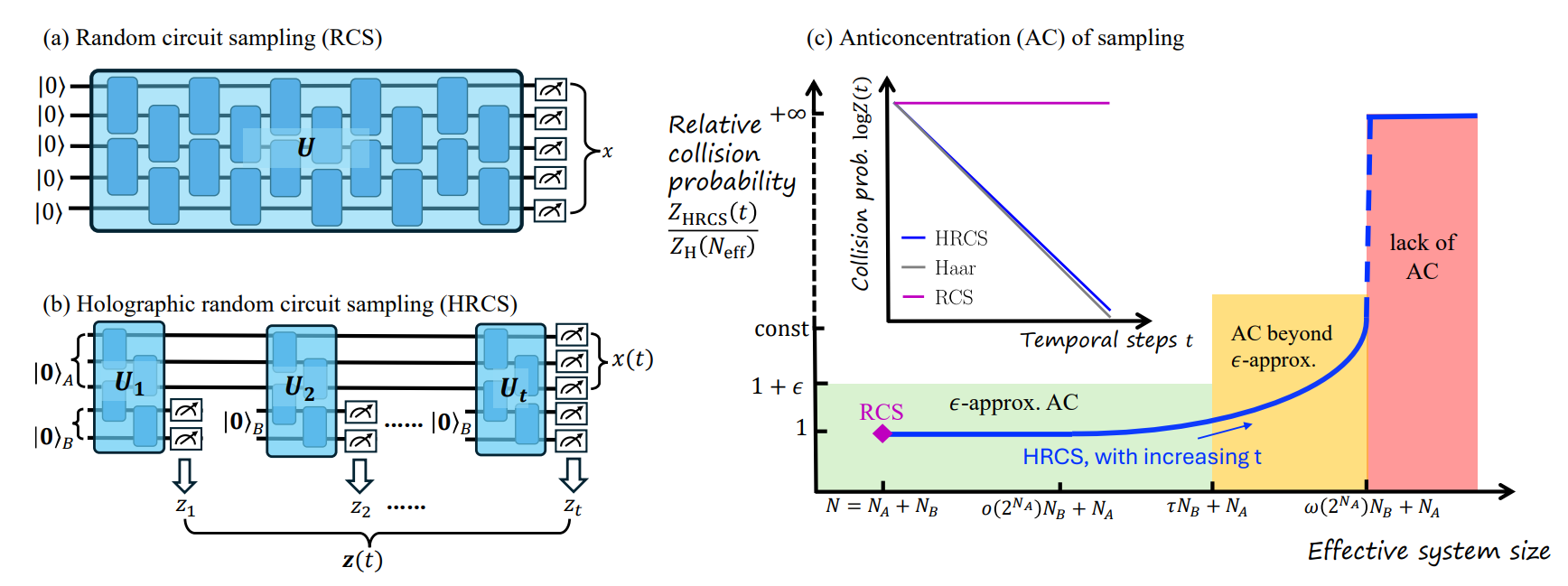
Quantum computers offer the potential to surpass classical computers for specific computational tasks, and researchers are actively pursuing ways to demonstrate this capability on existing hardware. Bingzhi Zhang and Quntao Zhuang, both from the University of Southern California, and their colleagues have achieved a significant step forward in this pursuit by developing a new approach to random circuit sampling. Their work introduces a holographic algorithm that dramatically increases the complexity of sampling, effectively scaling the problem’s dimension with the circuit’s depth. This innovative method allows the team to demonstrate the effective sampling of up to 200 qubits using only 20 physical qubits on current devices, achieving a benchmark fidelity that establishes a promising pathway towards scalable quantum advantage through the clever combination of spatial and temporal resources.
Large-scale quantum algorithms require fault-tolerant devices, but demonstrations of quantum advantage on existing hardware provide important milestones. Researchers have introduced a holographic random circuit sampling algorithm that substantially increases sampling complexity by leveraging repeated interactions and mid-circuit measurements, achieving effective sampling of up to 200 qubits using only 20 physical qubits. This scaling of effective dimension with circuit depth represents a substantial advancement in the pursuit of quantum advantage.
IBM Quantum Device Characterization and Benchmarking
This supplemental material provides detailed supporting data for research on quantum error correction and randomized benchmarking, ensuring reproducibility and allowing other researchers to verify the results. It comprehensively documents the experimental setup and data analysis, covering details about the quantum hardware used, specific error rates, coherence times, and the theoretical basis for expected circuit behavior, including predicted fidelities. The section presents gate error rates, readout error, relaxation time, and dephasing time for each qubit, crucial for understanding noise sources and calibrating quantum circuits. The section begins by explaining the construction of a two-patch circuit and how ideal XEB fidelity is calculated, noting that fidelity scales exponentially with temporal steps but is limited by system dimension. It then provides the equation for noisy XEB fidelity, modeling the effects of noise on the circuit. This comprehensive data allows for thorough evaluation of the quantum hardware’s performance, and the emphasis on error characterization and connection to theoretical predictions strengthens the research.
Holographic Sampling Reaches 200 Qubit Equivalence
Scientists have achieved a significant breakthrough in quantum computation by demonstrating holographic random circuit sampling (HRCS). This new method addresses a key limitation in existing quantum algorithms by fully utilizing the potential of available quantum hardware. The team successfully implemented HRCS on a system of 20 physical qubits, effectively sampling distributions equivalent to those requiring up to 200 qubits. The core innovation lies in interleaving standard quantum circuit layers with mid-circuit measurements performed on a secondary set of qubits, termed the ‘bath’. These measurements, combined with final measurements on the primary system qubits, create a complex, spatiotemporal sampling distribution.
Researchers demonstrate that the complexity of this sampling task grows exponentially with the number of mid-circuit measurements, effectively increasing the system’s computational power without increasing the number of physical qubits. Measurements confirm that the collision probability of the HRCS sampling distribution closely matches the theoretical prediction for a random state, validating the method’s effectiveness. The team developed a mathematical framework to describe HRCS, deriving an equation that predicts collision probability at each step. Experiments using six system qubits and varying numbers of bath qubits confirmed the theoretical predictions, demonstrating the method’s ability to increase the effective system size. The team achieved high cross-entropy benchmark fidelity, demonstrating the method’s ability to generate complex distributions.
Holographic Sampling Scales Quantum Circuit Complexity
This research demonstrates a new approach to random circuit sampling, termed holographic random circuit sampling, which significantly increases the complexity of sampling on near-term quantum computers. By leveraging repeated interactions and mid-circuit measurements, the team achieved effective sampling of up to 200 qubits using only 20 physical qubits on existing hardware. Experimental validation, conducted on IBM quantum devices, confirms the efficacy of this method. Cross-entropy benchmarking revealed high fidelity, closely aligning with theoretical predictions and surpassing the performance of previously reported results from other research groups. The team developed a noise model to account for hardware imperfections, further refining the accuracy of their predictions and demonstrating a clear understanding of the limitations inherent in current quantum technology. The authors acknowledge that finite-size effects and hardware noise currently limit achievable circuit depth and fidelity, and future research will focus on mitigating these effects, potentially through improved error correction techniques or optimized circuit designs.
🗞 Quantum advantage from effective -qubit holographic random circuit sampling
🧠 ArXiv: https://arxiv.org/abs/2511.05433